Taking folic acid: timing, duration, combination products
Futures Nutrition Editorial Team · 12 August 2026

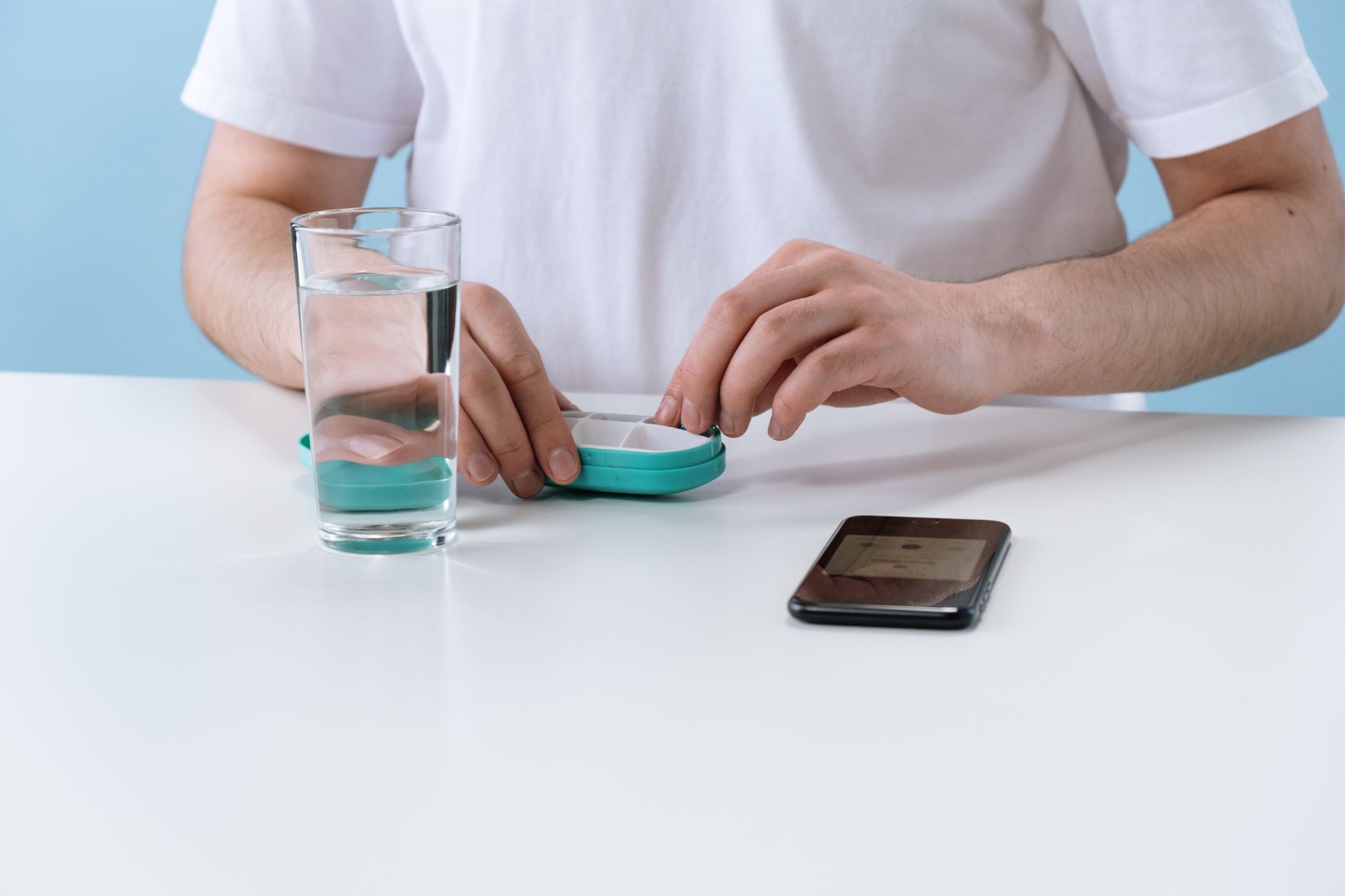
The short answer: there is no fixed time of day for folic acid. Only a single difference is established, and it concerns not the clock but the stomach contents — taken on an empty stomach, folic acid is better utilised than together with a meal. The German Nutrition Society (DGE) puts an exact figure on it: 1 µg folate equivalent corresponds to 0.5 µg folic acid on an empty stomach, but to 0.6 µg together with food. Everything else — morning or evening, before or after exercise, with water or with juice — is a question of habit, not of effect.
That sounds incidental, but it is the practically most important statement in this article. For the difference between fasting and not fasting comes to around 17 % — and a forgotten tablet costs 100 %. Anyone pondering the optimal moment is optimising the smaller of two quantities.
On an empty stomach or with food: the only measurable quantity
Folic acid is absorbed by the body considerably better than the natural folate from foods, and exactly how well depends on whether eating happens at the same time. Two conversions follow from this:
| Intake situation | 1 µg folate equivalent corresponds to | 400 µg folic acid correspond to |
|---|---|---|
| on an empty stomach | 0.5 µg folic acid | 800 µg folate equivalents |
| together with a meal | 0.6 µg folic acid | around 680 µg folate equivalents |
Values according to the DGE (D-A-CH 2018). For food supplements, the DGE and the German Federal Institute for Risk Assessment (BfR) calculate with the formula µg folate equivalent = µg food folate + 1.7 × µg folic acid — the factor 1.7 is the reciprocal of 0.6 and thus expressly assumes intake with a meal. The official calculation therefore starts from the less favourable of the two cases.
In practice it follows: anyone taking their preparation on an empty stomach ends up slightly above what the conversion credits them with. Conversely, no disadvantage arises — the recommendation to supplement 400 µg folic acid daily is a statement about the amount in the preparation, not about the folate equivalent value that results from it. It applies as it stands, regardless of breakfast. Why folate and folic acid are calculated differently at all is set out in Folic acid or folate: where the difference lies.

Two reasons nevertheless speak for taking it with food. First, some people tolerate tablets poorly on an empty stomach. Second, the meal is a more reliable anchor than a resolution: breakfast happens almost every day, "some time before it" does not. The difference of 17 % is the price for that, and it is low.
The time of day: why there isn't one
For folic acid no daily rhythm is documented from which a morning or an evening could be derived. Neither the DGE nor the BfR name a time of day in their answers on folate — they speak throughout of daily amounts.
The reason lies in the time scale on which folate status moves at all. What is meaningful is erythrocyte folate, that is the content in the red blood cells; the World Health Organization (WHO) names for women of childbearing age a target concentration of ≥ 906 nmol/l for the greatest possible risk reduction. Red blood cells live around four months and take up folate only when they are formed. This value therefore responds over weeks, not over hours. Whether a single tablet is swallowed at seven in the morning or at seven in the evening disappears entirely in this averaging.
The only sensible rule is therefore: couple it to a daily action that happens anyway — brushing your teeth, coffee, dinner. What secures the series counts; what optimises the single dose does not.
How long: the duration by situation
Here things become concrete, because unlike with the timing there are clear statements on the duration.
| Situation | Start | End |
|---|---|---|
| Trying to conceive (wanting to become pregnant or could become pregnant) | at the latest 4 weeks before the beginning of pregnancy | end of the first third of pregnancy |
| Pregnancy already begun, without lead time | immediately | end of the 12th week of pregnancy (800 µg instead of 400 µg) |
| General population | only where an inadequate supply has been established | as medically directed |
For the first case the DGE and the BfR concordantly name 400 µg folic acid per day in addition to a folate-rich diet, in order to prevent neural tube defects in the child. The lead time of four weeks appears in both recommendations; the details are in Folic acid in pregnancy: 400 µg, from when.
The second case is the more frequent one, because pregnancies do not stick to timetables. The Netzwerk Gesund ins Leben network recommends that women who have not started at least four weeks before conception take 800 µg folic acid per day until the end of the 12th week of pregnancy. The higher amount shortens the time until the target value in the blood is reached — it does not replace the missing lead time, but it makes it smaller.
The third case is rarely stated as plainly as the BfR states it: for the general population, taking folic acid preparations is advisable only where an insufficient supply has been established. There is no scientific evidence of a benefit above the amounts necessary for a supply that meets requirements. A course with a fixed beginning and end, of the kind familiar from botanicals, does not exist for folic acid — there is an occasion or there is none.
Combination products: what counts towards the total
Folic acid rarely stands alone in the tin. In pregnancy and multivitamin preparations it is accompanied by iodine, vitamin B12, iron and more. For intake this means three things.
First, everything adds up. The tolerable upper intake level (UL) of 1,000 µg per day for adults applies to intake from all preparations and fortified foods together, not per product. Anyone taking a multivitamin and a separate folic acid preparation adds both contributions together. In its opinion 009/2024 of 22 February 2024, the BfR therefore proposes a maximum level of 200 µg folic acid per recommended daily portion of a food supplement — and expressly 400 µg for products serving to reduce the risk of neural tube defects. The uncertainty factor of 2 that leads to the 200 µg exists precisely because of this multiple intake.
Second, fortified foods count too. According to the market survey cited by the BfR, in Germany breakfast cereals contain 170–340 µg folic acid per 100 g, soft drinks and juices 30–245 µg per 100 ml, cocoa powder 194–286 µg per 100 g and table salt fortified with folic acid 10,000 µg per 100 g — two grams of it, half a teaspoon, deliver 200 µg. Anyone taking a preparation and additionally eating such products regularly quickly ends up higher than the pack suggests.

Third, folic acid is not the same as folate on the label. If a combination product contains a 5-MTHF compound instead of folic acid — calcium L-methylfolate, 5-MTHF glucosamine or 5-MTHF sodium salt — different conversion factors apply. The EFSA applies the factor 1.7 for 5-MTHF as long as intake stays below 400 µg per day, and the factor 2 at 400 µg and above. The same number on two packs can therefore mean two different amounts of folate equivalents.
Vitamin B12 in the same preparation
There is one component whose presence changes something substantive. Higher amounts of folic acid can conceal an existing vitamin B12 deficiency in the blood count while the neurological side carries on — this very endpoint underlies the upper limit of 1,000 µg, as the EFSA confirmed in 2023 after review. The Arbeitskreis Folsäure & Gesundheit working group, whose members include the BfR, the DGE and the Robert Koch Institute, points out in its practical guide that this risk can be prevented by the combined administration of vitamin B12 and folic acid.
That is an argument for a combination product and against isolated high amounts of folic acid in people with an unclear B12 status — above all in older people and on a vegan diet. The connections are set out in detail in Folic acid and vitamin B12: the overlooked gap; the usual strength for this is Vitamin B12 1,000 µg.
Intervals to other nutrients and drinks
For iron and zinc there are documented interval recommendations, for calcium and coffee likewise. For folic acid itself the DGE and the BfR name nothing of the sort — neither for coffee or tea nor for milk or other minerals. Where such notes appear on a combination pack, they apply to the other components, not to the folic acid.
One point nevertheless belongs here: the Arbeitskreis Folsäure & Gesundheit lists the taking of certain medicines as a possible cause of an inadequate folate supply — via interactions with folate. Which preparations are affected in an individual case, and whether anything follows from that, belongs in medical practice and not on an advice page.
What to check on the label
Before buying, three lines are worth reading: the amount per daily dose, the folate source used and the number of tablets per day. If it says "pteroylmonoglutamic acid", that is the chemical name of folic acid.

Folic acid 1,000 µg carries 500 % of the nutrient reference value per tablet and thus sits exactly on the upper limit for adults — at this strength the question of further preparations and fortified foods is not an academic one. Anyone looking for an amount closer to the 400 µg of the preconception recommendation will find the alternatives in the folic acid category. How the various reference values — 200, 300, 400, 1,000 µg — relate to one another is set out in Folic acid daily requirement: 200, 300 or 400 µg?.
For folate, eight claims are authorised in the EU under Regulation (EU) No 432/2012; these five describe what the vitamin is involved in:
Folate contributes to normal blood formation.
Folate contributes to normal amino acid synthesis.
Folate contributes to normal psychological function.
Folate contributes to the reduction of tiredness and fatigue.
Folate contributes to maternal tissue growth during pregnancy.
Food supplements are not a substitute for a balanced and varied diet and a healthy lifestyle.
Frequently asked questions
I have forgotten a tablet — should I take two the next day? No. The recommendations are daily amounts over a period, and the upper limit of 1,000 µg applies per day. A missed day barely shifts the average over weeks, whereas a double daily dose brings nothing that the following day would not bring anyway. Simply carry on as normal.
Does hot coffee or tea destroy the folic acid in the tablet? No. What is sensitive to heat, light and oxygen are the natural folates in foods — which is why a considerable part is lost during cooking. Synthetic folic acid is heat-stable; according to the Arbeitskreis Folsäure & Gesundheit it even survives baking, which is why fortified flour and salt work at all.
Can I take folic acid permanently? As long as intake from all preparations and fortified foods together stays below the upper limit of 1,000 µg per day, no time limit follows from the assessments of the EFSA and the BfR. The other question is whether there is an occasion for it: the BfR considers preparations advisable for the general population only where an inadequate supply has been established.
My combination product contains 400 µg folic acid plus iodine and B12 — is that enough for the preconception phase? The condition of the authorised claim is at least 400 µg folic acid per daily dose, so that is met. What remains to be checked is whether the daily dose really corresponds to one tablet or to two, and whether a second preparation that also contains folic acid is running alongside it. Where a pregnancy already exists, the attending medical practice is the right contact.