Taking chromium: timing, meals and spacing
Futures Nutrition Editorial Team · 13 August 2026

The short answer: for chromium there is no official recommendation on the time of day — neither the EFSA nor the German Federal Institute for Risk Assessment (BfR) names one, and the label simply says "one tablet daily". What actually shifts absorption is not the clock but the company it keeps: chromium is poorly absorbed in general, and individual food components move that already small share in both directions. In practice that means: with a meal, but not in the same hour as a high-dose mineral supplement.
Anyone who asks about fat with vitamin D and about the gap before bedtime with melatonin asks the same question about chromium — and gets a different kind of answer. With chromium there is no substantiated reason for a particular moment in the day. There is, however, a series of substances for which an influence on absorption is described, and they are usually sitting on the same table.
Why the time of day plays no role here
For many nutrients a moment can be argued for: fat solubility, half-life, a daily rhythm in the body. For chromium every one of these anchors is missing. In 2014 the dietetic products panel of the European Food Safety Authority (EFSA) could not even derive a requirement: no average requirement, no intake recommendation, no adequate intake — the evidence did not allow it (EFSA Journal 2014;12(10):3845). Where no requirement is quantified, there are certainly no studies on whether 7 a.m. is better than 7 p.m.
Metabolism supplies no argument either. Absorbed chromium is excreted via the kidneys, smaller amounts via sweat and bile; by far the largest part of the chromium in food is never absorbed in the first place and leaves the body in the stool. A window in which absorption works particularly well has not been described.
What remains is a banal but practical point: regularity beats the clock. A tablet tied to a fixed meal — breakfast, lunch — is simply forgotten less often than one taken "at some point".
With a meal or on an empty stomach?
Here it is worth looking at the order of magnitude. The EU Scientific Committee on Food (SCF) puts the absorption of trivalent chromium from food at 0.4 to 2.5 per cent; for chromium from supplements the EFSA names a range of 0.1 to 5.2 per cent. The individual measurements in the SCF table run from 0.13 per cent for chromium chloride to 2.8 per cent for chromium picolinate — which is why the rough range of 0.1 to 3 per cent is often quoted for trivalent chromium overall. What the figure depends on is stated explicitly by the SCF: on the chemical properties of the compound, on the level of intake and on the other components of the meal. Put differently: over 95 per cent passes through unused anyway — and that is precisely why the accompanying substances carry relative weight.
In its opinion on chromium in food and drinking water (EFSA Journal 2014;12(3):3595) the EFSA collected what has been investigated on this:
| Factor | Direction | Evidence |
|---|---|---|
| Ascorbic acid (vitamin C) | increases absorption | human study with chromium chloride in women (Offenbacher 1994); plus animal experiments |
| Starch, simple sugars, organic acids | increase absorption | predominantly animal experiments |
| Oxalate | increases absorption | rat experiments (Chen 1973, Nelson 1973) |
| Individual amino acids, nicotinic acid | increase absorption | animal experiments, hypothesis: formation of readily soluble complexes |
| Phytate (wholegrains, pulses, nuts) | lowers absorption | rat experiments |
| Calcium, zinc, iron, manganese | lower absorption | older animal experimental work (Mertz 1970, Chen 1973, Hill 1975) |
| Antacid containing aluminium and magnesium hydroxide | lowers absorption | rat experiment (Davis 1995) |
Two qualifications belong with this. First, the largest part of these findings comes from animal experiments; the only human study among those named concerns vitamin C. Second, none of these factors shifts absorption into a different order of magnitude — a little becomes somewhat more, or somewhat less little. The EFSA sums up the differences between the individual chromium compounds with the same finding: present, but small.

For practice this leads to the unexcited recommendation you will find on most labels: with a meal. A meal with vegetables or fruit brings vitamin C and organic acids along with it; taking chromium on an empty stomach has no substantiated advantage and is the more unpleasant option for sensitive stomachs.
What to keep your distance from
The more interesting question is not "when" but "not at the same time as what". Three points are concrete enough to act on:
High-dose minerals. Calcium, zinc, iron and manganese are on the braking side of the table. Anyone taking a zinc supplement, a calcium supplement or an iron supplement alongside chromium most easily puts the two on different meals — chromium at breakfast, the mineral at dinner. One to two hours' spacing is the usual rule of thumb for that; here too there is no official specification.
Iron in the blood. Absorbed chromium binds to transferrin, that is, to the same transport protein that also carries iron. A mutual influence is therefore theoretically possible. The EFSA considered it unlikely for supplements with less than 100 µg of chromium; it was investigated in animals with considerably higher amounts. Anyone taking a 200 µg product long term while also supplementing iron has an additional reason to separate the two in time.
Acid binders. For an antacid containing aluminium and magnesium hydroxide, reduced chromium absorption has been described in animal experiments. Anyone taking such products regularly should plan for the gap as well.
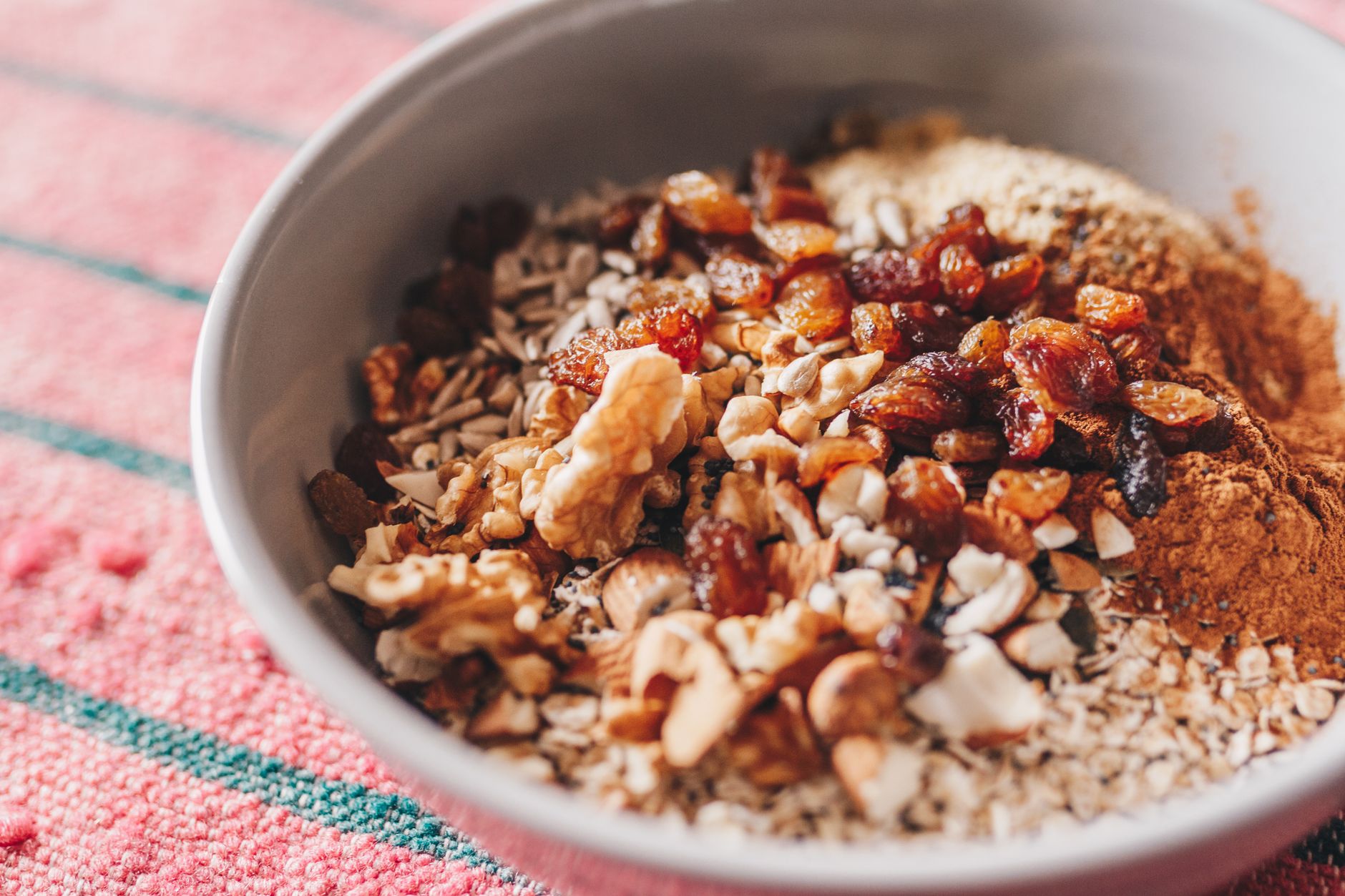
The reverse also applies: wholegrain products, pulses and nuts contain phytate, and phytate lowers chromium absorption in animal experiments. That is no reason to avoid the muesli, though — those same foods are among the relevant chromium sources in the first place.
How long, and why no test answers the question
No course duration is laid down for chromium anywhere; nor is there any reason for breaks in intake. What also does not exist, however, is a usable laboratory value: markers for the body's chromium status have not been identified. Chromium concentrations in serum and urine do rise measurably when 180 to 200 µg per day are supplied over eight to twelve weeks — whether they reflect habitual intake is, in the EFSA's assessment, unknown. An older investigation even found urinary chromium excretion to be independent of the level of intake at intakes between roughly 10 and 60 µg per day (Anderson and Kozlovsky 1985).
For the reader this means: a blood test does not answer the question "do I need this at all" for chromium. It is decided through the diet — and in Germany that diet has been measured at 61 ± 31 µg per day in women and 84 ± 55 µg in men, that is, across the whole range that the D-A-CH expert societies name as an estimated value. The measured figures come from German duplicate diet studies compiled by the BfR.
What our label says
Our Chromium 200 µg contains 200 µg of chromium as chromium picolinate per tablet, which corresponds to 500 % of the nutrient reference value. The recommended use reads: one tablet daily, with sufficient liquid. No time of day is specified — for the reasons given above.

Two reference figures are worth keeping in mind here, because they come out differently: in 2021 the German Federal Institute for Risk Assessment (BfR) proposed a maximum level of 60 µg per recommended daily portion, while the EFSA names 250 µg per day as a guidance value for additional intake from supplements and fortified foods. Neither is a legal limit — binding European maximum levels for vitamins and minerals in food supplements have still not been set. The difference becomes important above all when several products come together: chromium is often tucked away in multivitamin and mineral combinations, which is worth checking in the Minerals category.
Exactly two health claims are authorised for chromium, regardless of when it is taken: Chromium contributes to normal macronutrient metabolism. Chromium contributes to the maintenance of normal blood glucose levels. (Regulation (EU) No 432/2012). What the second sentence covers and what it does not is set out in Chromium and blood sugar: what the claim covers. Food supplements are not a substitute for a balanced and varied diet and a healthy lifestyle.
Frequently asked questions
Should chromium be taken in the morning or in the evening? Both are possible; there is no substantiated difference. Tying it to a fixed meal makes sense, because that makes intake more reliable. If you also take a mineral supplement, its timing decides: chromium then goes with the other meal.
Is there any point in taking chromium together with vitamin C? Ascorbic acid is the only one of the factors named for which increased chromium absorption has also been described in humans — in an investigation with chromium chloride in women. That is not a reason to buy a vitamin C supplement specially; a meal with vegetables or fruit serves the same purpose.
Does chromium have to be taken on an empty stomach to work? No. There is no substantiated advantage to taking chromium on an empty stomach, and absorption is low in any case. The meal is more likely to bring factors along that favour it.
Can chromium be taken continuously, or are breaks necessary? There are no specifications on course duration or breaks. Anyone supplementing long term should above all keep an eye on the total when further products containing chromium are added — the EFSA guidance value of 250 µg refers to the entire additional intake, not to a single product.
Sources: EFSA NDA Panel, Scientific Opinion on Dietary Reference Values for chromium, EFSA Journal 2014;12(10):3845 (no AR, no PRI, no AI; absorption of supplemented chromium 0.1-5.2 %; vitamin C as an enhancer after Offenbacher 1994; phytate and oxalate after Chen et al. 1973; binding to transferrin; urine as the main route of excretion; no markers for body status; Anderson and Kozlovsky 1985 on urinary excretion at 10-60 µg/day); EFSA CONTAM Panel, Scientific Opinion on the risks to public health related to the presence of chromium in food and drinking water, EFSA Journal 2014;12(3):3595, section on absorption (starch, simple sugars, ascorbic acid, oxalate, nicotinic acid and organic acids as enhancers; phytate, calcium, manganese, titanium, zinc, vanadium and iron as inhibitors after Mertz 1970, Chen et al. 1973, Hill 1975; antacid with aluminium and magnesium hydroxide after Davis et al. 1995; small differences between the chromium compounds); SCF (2003), Opinion on the Tolerable Upper Intake Level of Trivalent Chromium (Table 2: chromium chloride 0.13-0.4 %, chromium picolinate 2.8 ± 1.4 %, from foods 0.4-2.5 %; influencing factors compound, level of intake and meal components; no UL derivable); EFSA ANS Panel, EFSA Journal 2010;8(12):1882 (250 µg/day as a guidance value for additional intake; assessment of the iron interaction below 100 µg); Regulation (EU) No 432/2012 (official wording of the authorised claims); Regulation (EU) No 1169/2011, Annex XIII (nutrient reference value for chromium: 40 µg); German Federal Institute for Risk Assessment, proposed maximum levels for chromium in foods including food supplements (2021): 60 µg per recommended daily portion, and there also the German duplicate diet studies (61 ± 31 µg in women, 84 ± 55 µg in men) and the D-A-CH estimated values; composition and recommended use according to the label of the product mentioned.