Calcium in food: the portion beats the 100 g figure
Futures Nutrition Editorial Team · 12 August 2026

The short answer: the main calcium suppliers are milk, dairy products and cheese, followed by calcium-rich vegetables such as kale, broccoli and rocket, calcium-rich mineral water and a few nuts. What decides the matter is not the figure per 100 grams but the amount of a food that actually gets eaten. Hard cheese has roughly ten times the calcium content of kale — but you eat one slice of it, not 200 grams.
This conversion is exactly where the everyday calculation fails. A 100-gram column puts Emmental at 1,372 mg next to broccoli at 87 mg and suggests that vegetables carry no weight. Per portion it is 412 mg against 174 mg — still a difference, but a completely different one. And there are two places in the supermarket where the sum falls apart without warning: the plant drink without fortification, and quark.
What a usual portion delivers
The values in the first twelve rows come from the portion table of the German Nutrition Society (DGE), which is based on the DGExpert nutrient database. The last three rows are added because they stand right beside these foods on the shelf and appear in no classic food composition table.
| Food | Usual portion | Calcium per portion | per 100 g or 100 ml |
|---|---|---|---|
| Emmental (45 % fat in dry matter) | 1 slice (30 g) | 412 mg | 1,372 mg |
| Kale, cooked | 200 g | 358 mg | 179 mg |
| Parmesan (40 % fat in dry matter) | 3 tbsp (30 g) | 353 mg | 1,176 mg |
| Low-fat milk (1.5 %) | 250 g | 295 mg | 118 mg |
| Gouda (45 % fat in dry matter) | 1 slice (30 g) | 287 mg | 958 mg |
| Spinach, cooked | 200 g | 280 mg | 140 mg |
| Buttermilk | 200 g | 218 mg | 109 mg |
| Broccoli, boiled | 200 g | 174 mg | 87 mg |
| Yoghurt (1.5 %) | 150 g | 171 mg | 114 mg |
| Rocket | large bowl (70 g) | 112 mg | 160 mg |
| Brazil nuts | 8 nuts (30 g) | 52 mg | 161 mg |
| Hazelnuts | 30 g | 45 mg | 149 mg |
| Plant drink, fortified | 250 ml | 300 mg | 120 mg |
| Plant drink, not fortified | 250 ml | around 33 mg | approx. 13 mg |
| Calcium-rich mineral water | 1 litre | over 150 mg | over 15 mg |
The column on the far right is the one printed on packs. The column before it is the one that counts. Anyone estimating their daily intake adds up portions, not concentrations, and compares that sum with the DGE recommendation of 1,000 mg for adults.
The DGE itself works through an example that shows the order of magnitude immediately: with a quarter of a litre of milk and 50 to 60 g of Emmental — two slices — the recommended intake for adults is already reached. As a rule of thumb for everyday life it recommends two portions of dairy products a day; one portion is 250 ml of milk, 30 g of cheese or 150 g of yoghurt.

The two exceptions that look like calcium sources
The plant drink without fortification
An oat or soya drink replaces milk in coffee, in muesli and at the breakfast table — where calcium is concerned it replaces milk only if it is fortified. Plant drinks that are not fortified naturally contain hardly any calcium; the North Rhine-Westphalia consumer advice centre gives around 13 mg per 100 ml for a soya drink against about 120 mg in cow's milk. That is the factor of ten, and you cannot see it on the outside of the carton.
How often this occurs was measured by the same consumer advice centre in December 2024: of 160 plant drinks examined, 87 % of the conventionally produced ones were fortified with calcium — but barely 6 % of the organic ones. The reason is not carelessness but organic law: in organically produced foods only nutrients required by law may be added, so neither calcium carbonate nor tricalcium phosphate. Since 2022 the calcium-rich red alga Lithothamnium calcareum has been permitted as an ingredient instead, and it was precisely this that appeared in every fortified organic drink in the sample.
Those who do fortify take cow's milk as their benchmark: with two exceptions, every fortified drink declared 120 mg per 100 ml — the same concentration that the German Federal Institute for Risk Assessment (BfR) considers appropriate for milk substitute drinks. Two points belong with this:
- The compound makes a difference. According to the DGE position paper on milk alternatives, the absorption rate from soya drinks fortified with calcium carbonate is comparable to that from cow's milk; with tricalcium phosphate it is lower. Both are in the ingredients list.
- Shaking is not a quirk. The added minerals dissolve poorly and settle. Anyone who does not shake leaves part of the calcium in the bottle.
Which calcium compounds behave in which way — in tablets too — is set out in more detail in Calcium forms: carbonate, citrate, gluconate.
Quark
Milk and dairy products are calcium supplier number one — with one exception that the DGE names explicitly: quark. During production the whey is separated off, and a considerable part of the calcium goes with it. Quark remains an excellent source of protein, but on calcium it is not in the range of cheese or yoghurt. How far below is stated differently in different places: nutrient tables give values for quark of roughly 90 to 120 mg per 100 g, depending on the database and the type. The practical consequence is the same in either case — 250 g of quark do not replace two slices of hard cheese.
Vegetables: not every green leaf counts the same
With vegetables a second question stands beside the content: how much of it actually arrives. Oxalates and phytates — contained among other things in spinach, chard, sesame, oats and pulses — form poorly soluble complexes with calcium in the small intestine and restrict its absorption. That is why spinach ranks high in tables with 280 mg per portion but in practice does not contribute as much as the figure promises.
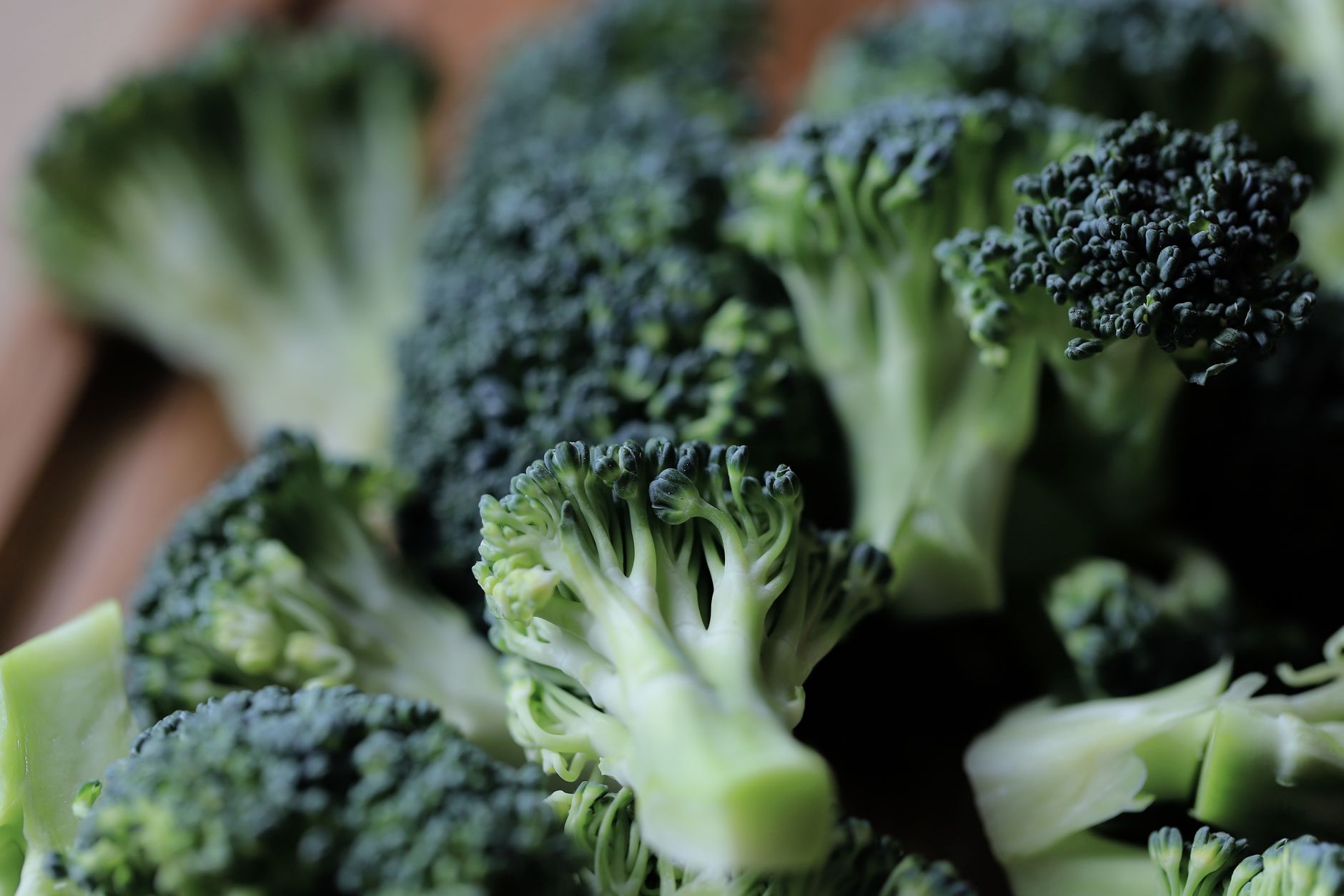
The brassicas have the advantage here. Kale, broccoli and rocket are comparatively low in oxalate, and the DGE lists precisely these three as the vegetables that come first when dairy products are avoided. Two practical points:
- Cooking draws calcium into the water. Anyone who boils vegetables and pours the cooking water away loses part of it. Steaming, or using the water as well, keeps it in the meal.
- Nuts are good but limited sources. Hazelnuts and Brazil nuts are above 100 mg per 100 g. Because of their energy content the DGE advises against making them the main source — 30 g bring around 50 mg, and nobody gets through 300 g on the side.
The source that costs nothing: mineral water
A mineral water may call itself calcium-rich if it contains more than 150 mg of calcium per litre; the content is stated on the label. At two litres a day that is over 300 mg — without a single bite. In the German National Nutrition Survey II, non-alcoholic drinks were the second-largest source of calcium overall after milk and dairy products, and this is the main reason.
The difference between the varieties on the shelf is large: some waters are below 20 mg per litre, others above 500 mg. Between the lowest- and the highest-calcium bottle there are easily 500 mg at two litres a day — half the daily recommendation, decided at the till.
When the sum does not add up
The nutrition survey shows that around half of adults reach the recommended intake through their diet — and the other half do not, with female adolescents and people over 65 as the clearest groups. Anyone who sees a gap after adding things up has two routes: more of the foods at the top of the table, or a supplement in the order of magnitude of the gap.
For the second route one figure from the BfR applies: for food supplements it recommends no more than 500 mg of calcium per daily serving, and from 250 mg upwards a note advising against further calcium-containing preparations. Our Calcium + Vitamin D3 4,000 IU delivers 200 mg of calcium per tablet and thus stays below that threshold — intended as a supplement to what is on the plate, not as a replacement for it. How to compare two packs properly is set out in Buying calcium: elemental mg, not mg of salt; an overview of the other minerals is in the Minerals category.

That vitamin D is in the same preparation has a reason that applies to food as well: without adequate vitamin D supply the intestine absorbs less calcium, whatever the source.
Among the authorised statements for these two nutrients are the following: Calcium is needed for the maintenance of normal bones. Calcium is needed for the maintenance of normal teeth. Vitamin D contributes to normal absorption and utilisation of calcium. (Regulation (EU) No 432/2012). Food supplements are not a substitute for a balanced and varied diet and a healthy lifestyle.
Frequently asked questions
Which food has the most calcium? Per 100 g, hard cheese: Emmental is at around 1,372 mg, Parmesan at 1,176 mg. Calculated per portion, cooked kale with 358 mg per 200 g comes close to a slice of Emmental (412 mg).
Does an oat drink cover calcium the way milk does? Only if it is fortified. Fortified drinks aim at 120 mg per 100 ml and are thus at milk level. Unfortified ones contain hardly any calcium — with organic drinks that is the normal case, because organic law severely restricts fortification. A look at the nutrition table on the pack settles it in five seconds.
Is calcium from food better than from a tablet? Through food, calcium arrives in smaller amounts spread across the day, and that is precisely what is favourable: the DGE points out that more is absorbed in the intestine when intake is spread over several meals instead of taken all at once in a large amount. That is not an argument against preparations but against large single doses — how the daily amount is divided up is set out in Taking calcium: dose per serving and spacing.
Can you take in too much calcium through food? Through usual amounts, practically not — that is how the DGE puts it. The tolerable total intake of 2,500 mg a day applies to all sources together; in Germany it is reached only in the highest intake ranges, and then mostly with preparations involved.
Sources: German Nutrition Society (DGE), "Selected questions and answers on calcium" (June 2013) — portion table based on DGExpert, quark as the exception among dairy products, example calculation of ¼ l of milk + 50–60 g of Emmental, spreading intake over several meals, calcium-rich vegetables and nuts; DGE position paper "Cow's milk (products) and plant-based milk alternatives in a more sustainable diet", Ernährungs Umschau 2024;71(12) — absorption from calcium carbonate vs. tricalcium phosphate, phytates/oxalates as absorption inhibitors, shaking before consumption; Consumer Advice Centre North Rhine-Westphalia, market check "Nutrient fortification of plant drinks" (December 2024) — 160 products, fortification rates of 87 % vs. 6 %, 120 mg/100 ml, 13 mg/100 ml in the unfortified soya drink, Lithothamnium calcareum, DGE portion recommendation; German Federal Institute for Risk Assessment, proposed maximum levels for calcium in food including food supplements, opinion No 009/2021 — 500 mg per recommended daily intake, note from 250 mg upwards, 120 mg per 100 ml for milk substitute drinks; Max Rubner Institute, German National Nutrition Survey II (2008) — main sources of calcium intake, shortfall rates; Regulation (EU) No 432/2012 (official wording of the authorised statements); composition according to the label of the product named.