Vegan calcium: what actually gets absorbed
Futures Nutrition Editorial Team · 12 August 2026
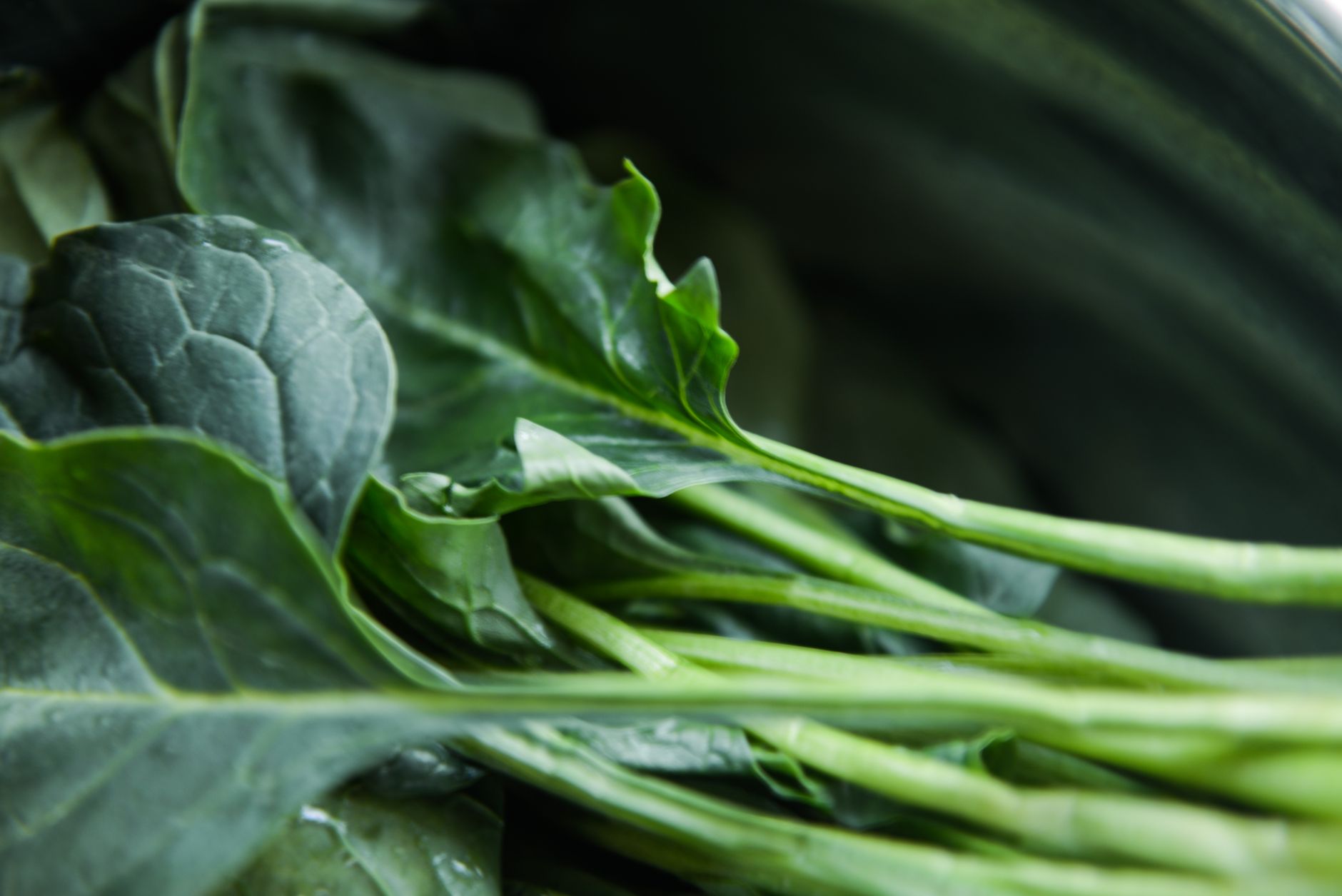
The short answer: without dairy, four sources carry the calcium requirement — low-oxalate brassicas (kale, broccoli, pak choi, rocket), tofu made with calcium sulphate, fortified plant drinks and calcium-rich mineral water. Spinach, chard, rhubarb and hulled sesame look like calcium sources in nutrient tables, but they are not. From spinach, 5.1 per cent of the calcium it contains is absorbed; from milk in the same experimental set-up, 27.6 per cent — with plants, the figure in the table says considerably less about the amount that actually arrives.
That makes the real question not "which vegetable has a lot of calcium" but "which one does it come out of". And at two points on the shelf it is not the food that decides but the variety: with tofu the coagulant, with sesame the hull.
Why the figure says less with plants
Oxalates and phytates — found among other places in spinach, chard, rhubarb, sesame, oats, soya and cashews — form insoluble complexes in the small intestine with calcium, zinc, magnesium and iron and restrict their absorption. That is how the position paper of the German Nutrition Society (DGE) on cow's milk and plant-based milk alternatives (2024) describes it, and it is the reason why two foods with the same calcium value deliver different amounts.
From a mixed diet the body absorbs around 30 per cent of the calcium; from dairy products and fortified foods the rate is of the same order, and from certain green vegetables — pak choi, broccoli, kale — almost twice as high according to the US reference values (Institute of Medicine, 2011). This was measured with labelled calcium:
| Food | measured absorption rate | milk comparison in the same study | Source |
|---|---|---|---|
| Kale | 40.9 % | 32.1 % | Heaney & Weaver 1990, test dose 300 mg |
| Spinach | 5.1 % | 27.6 % | Heaney, Weaver & Recker 1988 |
| Soya drink with calcium carbonate | 21.1 % | 21.7 % (cow's milk) | Zhao, Martin & Weaver 2005, test dose 250 mg |
| Soya drink with tricalcium phosphate | 18.1 % | 21.7 % (cow's milk) | Zhao, Martin & Weaver 2005 |
One caveat belongs with it: the absorption rate falls the larger the single portion is. Values from different studies with different test doses therefore cannot be set against each other directly — the 40.9 per cent for kale and the 21.1 per cent for the soya drink come from different experiments. What the table shows is the ranking, not a formula.
The four sources that carry
Low-oxalate brassicas
Kale, broccoli and rocket are named expressly by the German Nutrition Society (DGE) as the vegetables that come first when dairy drops out. According to its portion table, 200 g of cooked kale supply 358 mg of calcium, 200 g of broccoli 174 mg and a large bowl of rocket (70 g) 112 mg. The advantage is twofold: plenty of calcium and little oxalate, so a high absorption rate on top.
Two practical points: calcium passes into the water during cooking — steaming, or using the cooking water, keeps it in the meal. And nuts are good but limited sources: 30 g of hazelnuts bring around 45 mg, 30 g of brazil nuts 52 mg. Which portion of which food contributes how much is set out in detail in Calcium-rich foods.
Tofu — here the coagulant decides
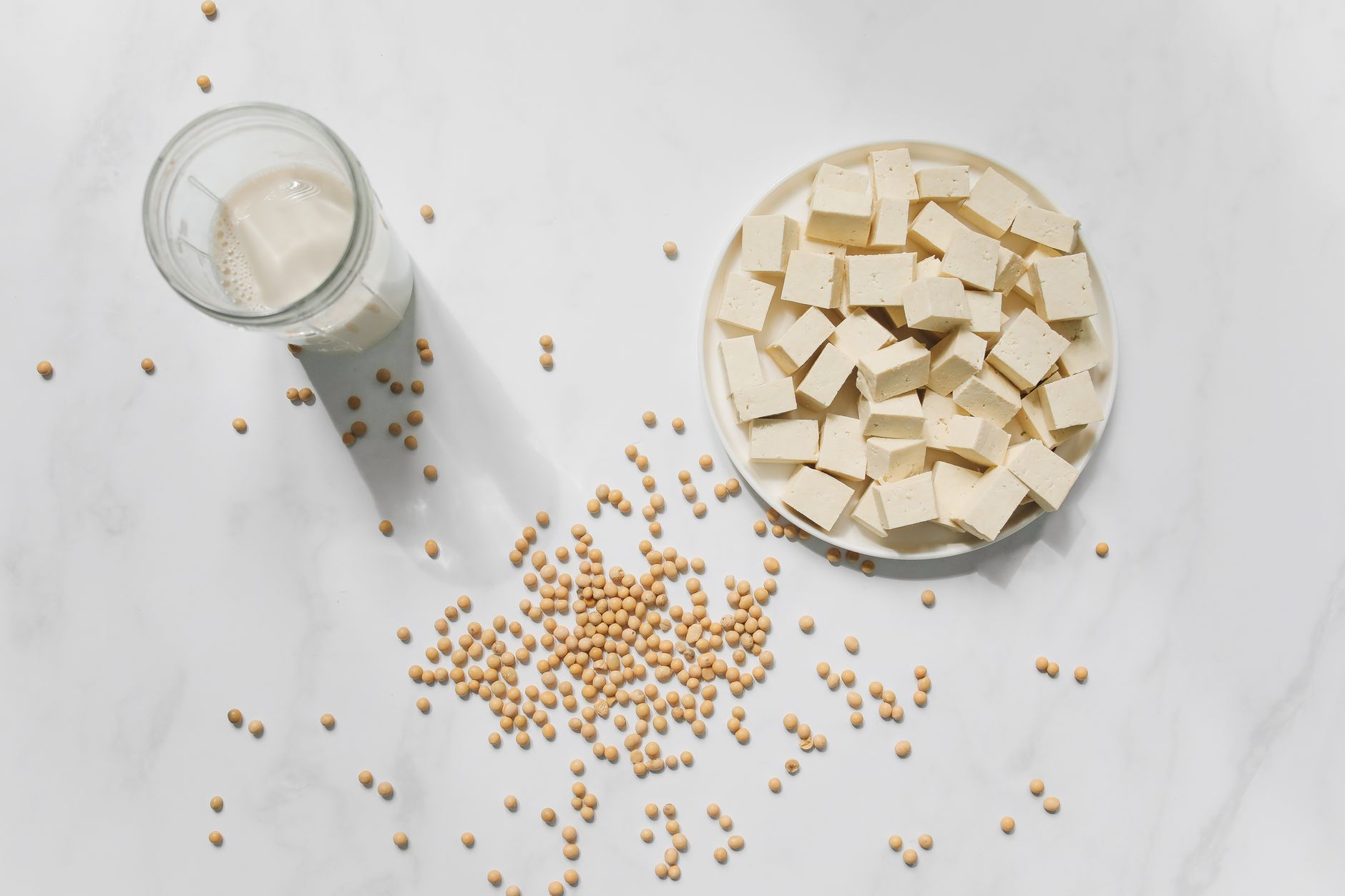
Tofu is made by precipitating soya drink with a coagulant. If calcium sulphate (E 516) is used, part of it stays in the product — if nigari (magnesium chloride, E 511) is used, it does not. In the data of the US nutrient database USDA FoodData Central, the range within the same product group runs from 31 to 683 mg per 100 g:
| Tofu variant | calcium per 100 g |
|---|---|
| firm, prepared with calcium sulphate | 683 mg |
| regular, prepared with calcium sulphate | 350 mg |
| firm, prepared with nigari | 345 mg |
| extra firm, prepared with nigari | 282 mg |
| silken tofu (not pressed) | 31–43 mg |
The figures also show that "nigari" does not automatically mean low in calcium: soya beans bring calcium of their own, and the more firmly the tofu is pressed, the more of it sits in 100 g. The big outlier at the bottom is silken tofu, which is not pressed at all.
You can check this on the ingredient list, not on the nutrition table: in the EU, mineral contents only have to be declared if a manufacturer advertises them — the coagulant, by contrast, appears in the list of ingredients as "calcium sulphate" or "magnesium chloride".
Fortified plant drinks
Unfortified plant drinks contain hardly any calcium naturally. Those who do fortify take their bearings from cow's milk: the addition usually targets 120 mg per 100 ml. Which compound is used appears in the ingredient list and makes a measurable difference — with calcium carbonate, absorption from soya drinks is comparable to that from cow's milk; with tricalcium phosphate it turns out lower.
Two things belong with this. First: shake it. The added minerals settle, and anyone who does not shake leaves part of them in the bottle. Second, the organic special case — in organically produced foods the addition of calcium carbonate or tricalcium phosphate is not permitted; since 2022 the calcium-rich red alga Lithothamnium calcareum may be used as an ingredient instead. Organic plant drinks without that ingredient are therefore as a rule not fortified. How the individual calcium compounds behave — in the drink as in the tablet — is set out in Calcium forms compared.
Calcium-rich mineral water
A mineral water may call itself calcium-containing if its calcium content exceeds 150 mg per litre — that is what Annex 6 of the German Mineral and Table Water Ordinance (Mineral- und Tafelwasser-Verordnung) states. The content itself is on the label. Two litres of it bring more than 300 mg without a single bite — and without any question of oxalate or phytate, because here the calcium is in dissolved form. Between the lowest-calcium and the highest-calcium bottle on the shelf there is easily 500 mg at two litres a day. That is the cheapest adjustment in this whole calculation.
The traps: spinach, rhubarb — and hulled sesame
Spinach, at 280 mg per 200 g portion, is near the top of every table. At a measured absorption rate of 5.1 per cent, around 14 mg of that arrives on paper — less than from a handful of rocket. The same principle applies to chard and rhubarb. That is no reason to avoid spinach; it is a reason not to write it into the calcium calculation.
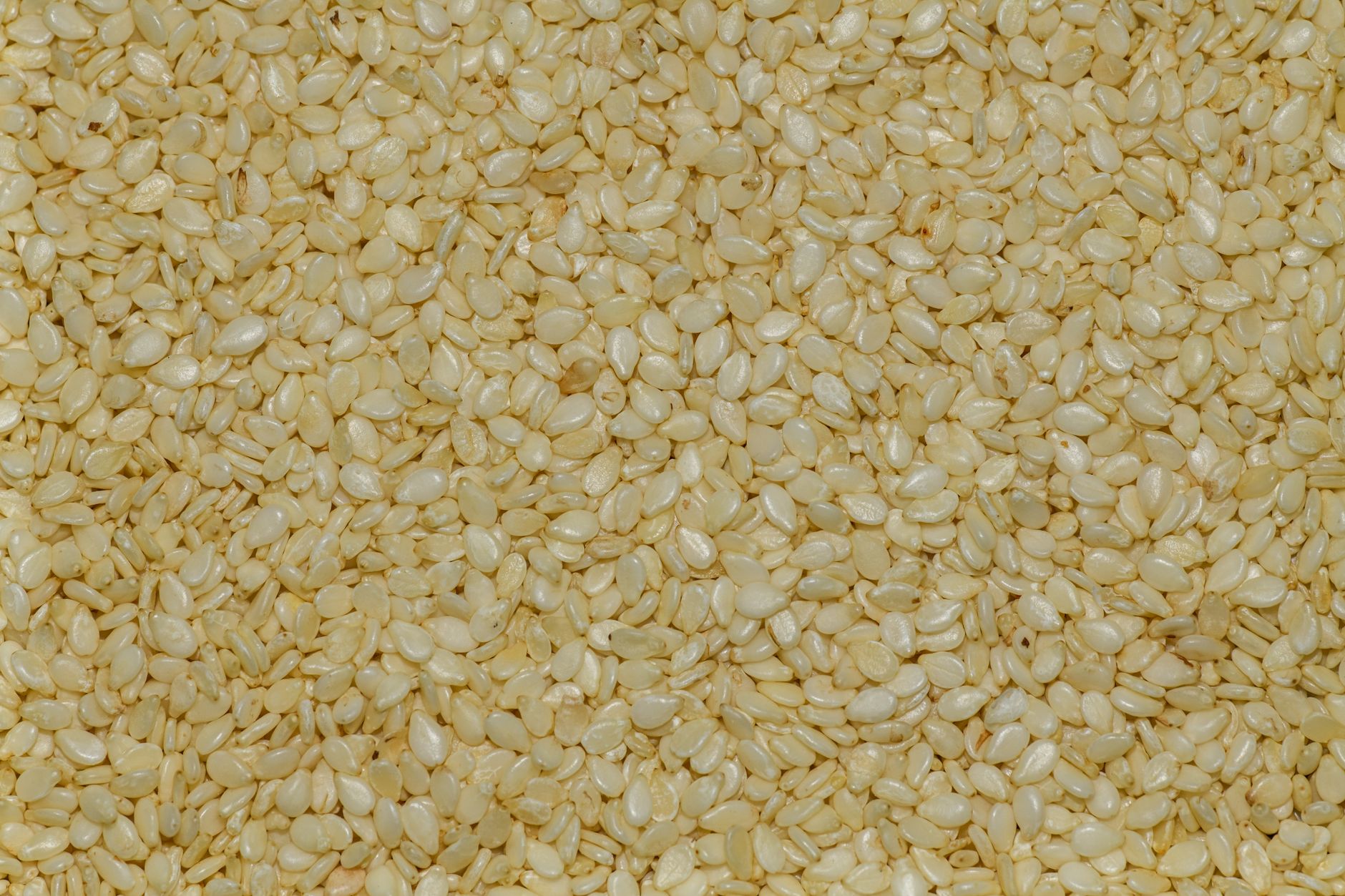
The second case is sesame, and it is the less conspicuous one. The calcium of the sesame seed sits almost entirely in the hull. In the USDA data, whole sesame seeds stand at 975 mg per 100 g, hulled sesame kernels at 60 mg — a factor of more than fifteen that you cannot see on the spoon. With tahini too, everything hangs on which raw material it was ground from: for sesame paste from unhulled seed the database gives 960 mg per 100 g, for tahini of unspecified origin 141 mg. And even with unhulled sesame the oxalate and phytate content remains, binding part of it — the 975 mg are an upper limit, not a balance sheet.
One detail from the same corner: Germany's Max Rubner Institute calculated, for unfortified soya, oat and almond drinks, the ratios of phytate to the individual minerals. According to that, calcium absorption should only be appreciably impaired in soya drinks, while zinc and iron are affected considerably. Heat treatment and fermentation can partly break such complexes down again.
What should add up over the day
The DGE recommends 1,000 mg of calcium a day for adults; the nutrient reference value on packaging is 800 mg. Where the two figures come from and which applies to whom is set out in Daily calcium requirement.
A realistic vegan day looks like this:
- 200 g cooked kale: 358 mg
- 100 g tofu made with calcium sulphate: 350 mg (with firm products considerably more)
- 250 ml fortified plant drink: 300 mg
- 1 litre calcium-rich mineral water: more than 150 mg
Together that is around 1,150 mg — achievable, but not incidentally. That is exactly the finding of the DGE in its position paper on vegan nutrition (2024): calcium counts there among the potentially critical nutrients, and intake tends to be lower on a vegan diet than on a vegetarian or omnivorous one. In the EPIC-Oxford cohort, a 30 per cent higher fracture risk on a vegan diet was no longer observable when only participants with a calcium intake of at least 525 mg a day were considered — regardless of dietary pattern. A more recent analysis of the same cohort found the association, particularly for hip fractures, even after accounting for calcium and protein intake; further factors are therefore likely to be involved. The DGE rates the trustworthiness of this evidence as low to very low.
When the calculation does not add up
Anyone who sees a gap after adding up closes it best where it arose — and tops up the rest. For supplements, the German Federal Institute for Risk Assessment (BfR) recommends no more than 500 mg of calcium per daily portion and, from 250 mg, a note advising against further calcium-containing preparations. How to tell from the label how much of it is elemental calcium and how much is merely salt is explained in Buying calcium: mg elemental instead of mg salt.
Our Calcium + Vitamin D3 4,000 IU supplies 200 mg of calcium as calcium gluconate per tablet and therefore stays below that threshold — intended as a supplement to what is on the plate.

One point belongs with strictly vegan shopping: cholecalciferol (vitamin D3) is predominantly obtained from lanolin — wool grease — the vegan variant from lichen. With the combination product above, the origin of the cholecalciferol is not declared; the D3 in our Vitamin D3 10,000 IU vegan comes expressly from lichen. On the label that is the difference between "cholecalciferol" without an addition and "cholecalciferol from lichen".
Why vitamin D appears in this calculation at all: without sufficient supply the gut absorbs less calcium, no matter the source — with plant sources, then, on top of the oxalate brake. The following statements are authorised for this: Calcium is needed for the maintenance of normal bones. Calcium is needed for the maintenance of normal teeth. Vitamin D contributes to normal absorption and utilisation of calcium. (Regulation (EU) No 432/2012). Food supplements are not a substitute for a varied and balanced diet and a healthy lifestyle.
The second nutrient that a purely plant-based diet does not cover without supplementation is vitamin B12 — everything on that is in Vitamin B12 on a vegan diet. The remaining minerals are shown by the Minerals category.
Frequently asked questions
Is an oat drink enough as a milk substitute where calcium is concerned? Only if it is fortified. Fortified drinks target 120 mg per 100 ml and are thus at milk level; unfortified ones contain hardly any calcium. A glance at the nutrition table on the pack settles it in five seconds — if no calcium is listed there, none has been added.
Is spinach really not a calcium source? Not as a calcium source. 200 g do supply 280 mg, but the measured absorption rate is 5.1 per cent against 27.6 per cent from milk in the same experiment. As a vegetable spinach remains good — it just does not count in the calcium calculation.
How do I recognise calcium-rich tofu? By the ingredient list: if calcium sulphate (E 516) appears there, a high content is to be expected — the USDA data give 683 mg per 100 g for firm tofu of that kind. Silken tofu is at the other end with around 30 to 40 mg per 100 g. The mineral content itself does not have to be on the pack.
Do I need a calcium supplement on a vegan diet? Not necessarily. Anyone combining brassicas, tofu made with calcium sulphate, fortified drinks and calcium-rich mineral water gets past 1,000 mg. Anyone who does not have these four building blocks on the plate regularly has a gap on paper — and that is closed by a supplement in the order of the gap, not in the order of the daily requirement.
Sources: Deutsche Gesellschaft für Ernährung, "Neubewertung der DGE-Position zu veganer Ernährung", Ernährungs Umschau 2024;71(7) — calcium as a potentially critical nutrient, lower intake on a vegan diet, EPIC-Oxford analyses (525 mg/day, hip fractures), rating of the evidence; DGE position paper "Kuhmilch(-produkte) und pflanzliche Milchalternativen in einer nachhaltigeren Ernährung", Ernährungs Umschau 2024;71(12) — oxalates and phytates as absorption inhibitors, 120 mg/100 ml as the fortification target, calcium carbonate vs. tricalcium phosphate, shaking, organic law and Lithothamnium calcareum, MRI calculation of the phytate-to-mineral ratios; DGE, "Ausgewählte Fragen und Antworten zu Calcium" (June 2013) — portion values for kale, broccoli, rocket and nuts, low-oxalate vegetables, reference value 1,000 mg; Heaney RP, Weaver CM, "Calcium absorption from kale", Am J Clin Nutr 1990;51(4):656–657 (PMID 2321572); Heaney RP, Weaver CM, Recker RR, "Calcium absorbability from spinach", Am J Clin Nutr 1988;47(4):707–709 (PMID 3354496); Zhao Y, Martin BR, Weaver CM, "Calcium bioavailability of calcium carbonate fortified soymilk is equivalent to cow's milk in young women", J Nutr 2005;135(10):2379–2382 (PMID 16177199); Institute of Medicine, Dietary Reference Intakes for Calcium and Vitamin D (2011) — around 30 % absorption from a mixed diet, roughly twice the rate from pak choi, broccoli and kale, oxalate and phytate carriers as poor sources; USDA FoodData Central, SR Legacy — tofu (172475, 172476, 174290, 174291, 172461) and sesame (170150, 169412, 170191, 168604); Regulation (EU) No 1169/2011, Annex XIII (nutrient reference value 800 mg) and Annex V on nutrition declaration; Regulation (EU) No 432/2012 (official wording of the authorised claims); Mineral- und Tafelwasser-Verordnung, § 9 and Annex 6 (the description "calcium-containing" at more than 150 mg/l); Bundesinstitut für Risikobewertung, maximum level proposals for calcium in foods including food supplements, opinion No 009/2021; composition according to the labels of the products named.