Daily calcium needs: 800 mg label, 1,000 mg advised
Futures Nutrition Editorial Team · 12 August 2026

The short answer: for adults the German Nutrition Society recommends 1,000 mg of calcium a day. The 800 mg printed on every pack as a reference value are something else — a labelling figure, not a requirement. And unlike most other nutrients, with calcium by far the largest part of that amount comes from what is on the table anyway.
That is exactly what turns the question of the daily requirement into an arithmetic exercise rather than a purchasing decision. Two slices of hard cheese and a glass of milk already cover the recommendation. Anyone who reaches for a tablet without counting their diet easily ends up with an amount nobody needed — and the German Federal Institute for Risk Assessment has, for good reason, proposed a considerably tighter ceiling for food supplements than for other minerals.
Four figures that do not mean the same thing
| Value | Amount per day | What it says | Origin |
|---|---|---|---|
| Nutrient reference value (NRV) | 800 mg | the basis for the percentage figure on the label | Regulation (EU) No 1169/2011, Annex XIII |
| Recommended intake | 1,000 mg | the reference value for adults from 19 years | D-A-CH / German Nutrition Society, 2013 |
| Population Reference Intake (PRI) | 950 mg | the same value at European level, from 25 years | EFSA (2015) |
| Tolerable Upper Intake Level (UL) | 2,500 mg | tolerable total intake from all sources, adults | SCF (2003), confirmed by EFSA in 2012 |
| Proposed maximum level for food supplements | 500 mg | recommendation to the legislator, per daily serving | German Federal Institute for Risk Assessment (BfR), 2021 |
Between the first and the second row there is no contradiction but a difference in purpose. The 800 mg are a labelling value for the whole of Europe, so that "200 mg of calcium" can be expressed as "25 % NRV" and declarations stay comparable. The 1,000 mg are the value that nutrition advice in Germany is based on. Two reference systems therefore sit side by side on the same tin — and the percentage follows the lower one.
The last row is the remarkable one. The UL is 2,500 mg, the BfR proposal for supplements 500 mg — a fifth of it. The gap is not a safety buffer against missing data but the diet, already counted in: the BfR assumes that ordinary meals already deliver the bulk, and sizes the supplement according to what realistically remains. Where more than 250 mg per daily amount consumed is added, the institute additionally recommends a note advising against further calcium-containing preparations.
Why 800 mg is on the pack
The nutrient reference value is a calculation figure from the food information regulation, not a recommendation. But it has a second, very practical function: a nutrient may only be highlighted on a food at all if a certain amount of it is present — at least 15 % of the NRV for solid foods, 7.5 % for beverages. For calcium that means 120 mg per 100 g and 60 mg per 100 ml respectively.
Those 120 mg reappear in a surprising place. Where manufacturers fortify plant-based milk alternatives with calcium, the BfR considers precisely this concentration per 100 ml appropriate — because cow's milk naturally sits there at around 118 to 120 mg per 100 g. A fortified oat drink therefore aims not at a requirement but at the product it replaces.
The reference value by stage of life
The D-A-CH societies last revised the reference values for calcium in 2013. Little changed in the process — only the values for infants from four months (330 instead of 400 mg) and for children from 4 to under 7 years (750 instead of 700 mg).
| Age group | Recommended intake (DGE) | EFSA (its own age groups) |
|---|---|---|
| 1 to under 4 years | 600 mg | 450 mg (1–3 yrs) |
| 4 to under 7 years | 750 mg | 800 mg (4–10 yrs) |
| 7 to under 10 years | 900 mg | 800 mg (4–10 yrs) |
| 10 to under 13 years | 1,100 mg | 1,150 mg (11–17 yrs) |
| 13 to under 19 years | 1,200 mg | 1,150 mg (11–17 yrs) |
| 18 to 24 years | 1,000 mg | 1,000 mg (18–24 yrs) |
| from 25 years | 1,000 mg | 950 mg (from 25 yrs) |
| Pregnant and breastfeeding women from 19 years | 1,000 mg | as for the age group |
| Pregnant and breastfeeding women under 19 years | 1,200 mg | as for the age group |
Two points stand out. First, adolescents between 13 and 18 need the most at 1,200 mg — more than any adult group, because this is when bone mass is built up. Second, the value for pregnant and breastfeeding women from 19 years does not rise. That surprises many, but it follows the reasoning of both bodies: in pregnancy the intestine absorbs more calcium from the same amount of food, and what is given up during breastfeeding is made good again by bone metabolism after weaning.
What the diet actually contributes
Calcium is the nutrient where a single food group carries almost everything. In the German National Nutrition Survey II the largest share for men and women alike came from milk, dairy products and cheese; soft drinks followed in second place, after which no other group played any notable role.
| Portion | Food | Calcium per portion | per 100 g |
|---|---|---|---|
| 1 slice (30 g) | Emmental (45 % fat in dry matter) | 412 mg | 1,372 mg |
| 200 g | Kale, cooked | 358 mg | 179 mg |
| 3 tablespoons (30 g) | Parmesan (40 % fat in dry matter) | 353 mg | 1,176 mg |
| 250 g | Semi-skimmed milk (1.5 % fat) | 295 mg | 118 mg |
| 1 slice (30 g) | Gouda (45 % fat in dry matter) | 287 mg | 958 mg |
| 200 g | Spinach, cooked | 280 mg | 140 mg |
| 200 g | Buttermilk | 218 mg | 109 mg |
| 200 g | Broccoli, boiled | 174 mg | 87 mg |
| 150 g | Yoghurt (1.5 % fat) | 171 mg | 114 mg |
| 70 g | Rocket | 112 mg | 160 mg |
| 30 g | Brazil nuts (8 nuts) | 52 mg | 161 mg |
| 30 g | Hazelnuts | 45 mg | 149 mg |
Values according to DGExpert, cited in the DGE's questions and answers on calcium.
From this the DGE derives an example that makes the order of magnitude immediately clear: with ¼ litre of milk and 50 to 60 g of Emmental — two slices — the recommended intake for adults is already reached. Everything else in the day comes on top.
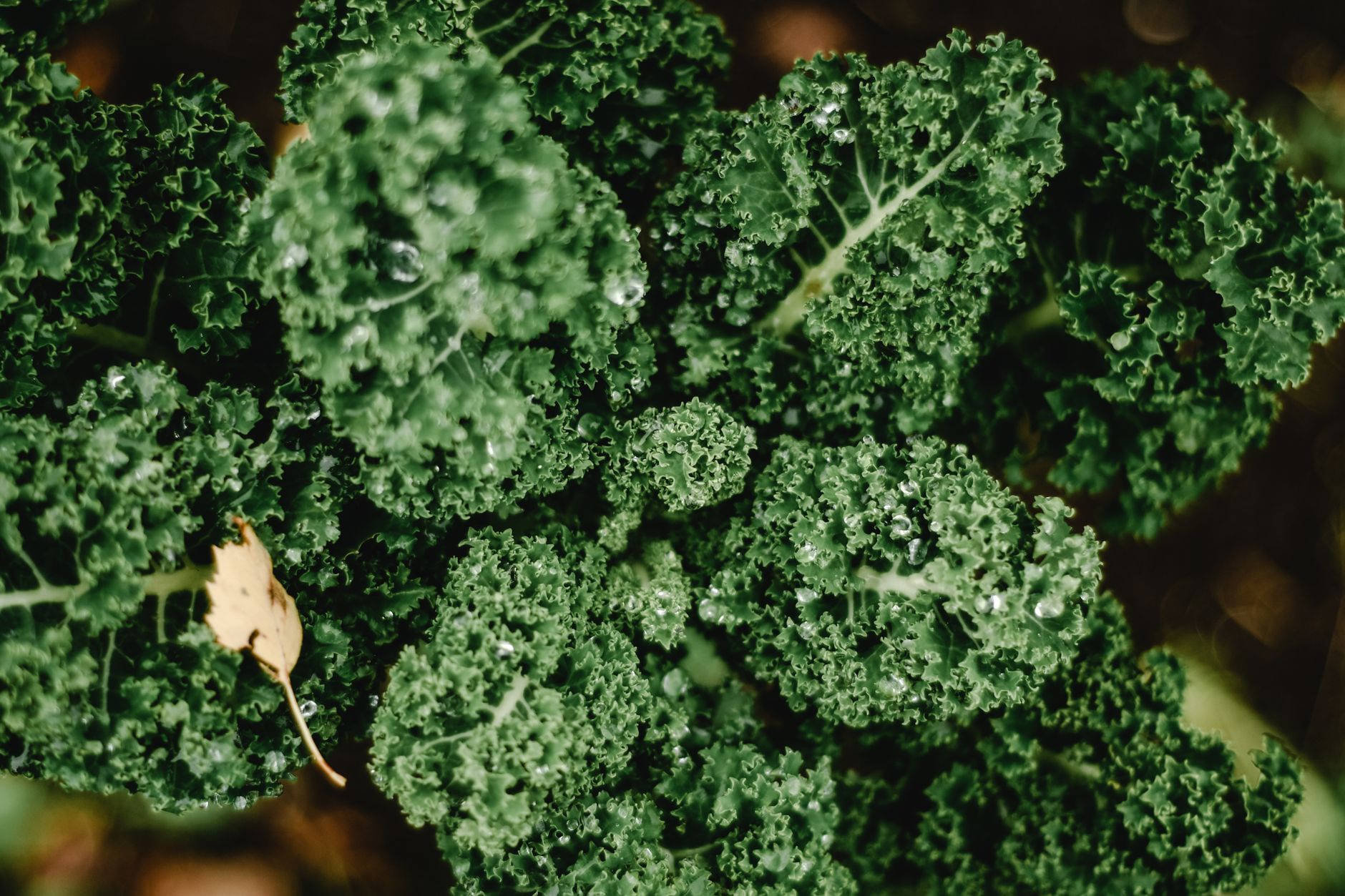
Without dairy products the sum becomes more demanding, but not impossible. Kale, spinach, rocket and broccoli lie between 87 and 179 mg per 100 g; the portion column shows that this does turn into three-figure contributions, because one eats more vegetables than cheese. Nuts are good sources, but limited by their energy content. Which food delivers how much per portion — including the oxalate brake on spinach and the question of which plant drink is fortified at all — is set out in Calcium in food: the portion beats the 100 g figure; for the question of requirement only this counts: the route through food is open, it merely demands some selection.
The source nobody counts

Mineral water may be described as calcium-rich if it contains more than 150 mg of calcium per litre — the content is stated on the label. Anyone drinking two litres of such a water has 300 mg and more in their daily account without having eaten anything. That also explains why beverages of all things were the second-largest calcium source in the nutrition survey. Before any purchasing decision it is therefore worth a glance at your own water bottle: between a low-calcium and a calcium-rich mineral water there can easily be 250 mg a day.
Who reaches the recommendation — and who does not
This is where it gets interesting, because the answer is not "almost nobody". In the German National Nutrition Survey II the median calcium intake was 1,052 mg a day for men and 964 mg for women — roughly at the level of the recommendation. At the same time 46 % of men and 55 % of women did not reach the recommended intake. Both are true: half are above it, the other half below.
The shortfall is very unevenly distributed, though:
| Group | Share below the recommendation |
|---|---|
| Men overall | 46 % |
| Women overall | 55 % |
| Female adolescents (14–18 years) | 74 % |
| Men 65–80 years | 61 % |
| Women 65–80 years | 65 % |
These are the three groups for whom the question of supplementation genuinely arises — and in female adolescents the highest reference value (1,200 mg) meets the lowest rate of attainment. In the broad middle of adults between 19 and 50, by contrast, the median for both sexes lies in the range of the recommendation.
A side note on the figures, because they get muddled in advice columns: from the same study the DGE quotes means of 807 mg (men) and 738 mg (women). That is neither a contradiction nor a typing error but the result of different survey instruments — the nutrition survey measured intake by several methods that systematically yield different levels. Anyone quoted a single figure should know that the range is real.
The calculation before buying
From all of this follows an approach that is clearer here than for almost any other mineral: first estimate the gap, then choose the amount.
- Count the dairy products. Every slice of hard cheese is around 300 to 400 mg, a glass of milk or a pot of yoghurt around 150 to 300 mg each.
- Check the water. Calcium content per litre times litres drunk.
- Add up the vegetables roughly. A portion of calcium-rich vegetables brings 150 to 350 mg.
- The difference to 1,000 mg is the amount at issue — usually 200 to 500 mg, rarely more.
Once that figure is settled, the question moves to the label: not every declaration there is elemental calcium, and depending on the compound the same amount sits behind a very differently sized tablet. How to work that out is set out in Buying calcium: elemental mg, not mg of salt.
Preparations are sensibly dosed in precisely this order of magnitude. Our Calcium + Vitamin D3 4,000 IU delivers 200 mg of calcium per tablet — 25 % of the nutrient reference value — and thus deliberately stays below the threshold of 250 mg from which the BfR recommends the note about further calcium-containing preparations. How calcium ranks alongside other minerals is shown by the overview in the Minerals category.

The vitamin D3 in the same preparation is not decoration: without an adequate vitamin D supply the intestine absorbs less calcium, regardless of how much is offered. The 4,000 IU correspond to 100 µg and thus to the Tolerable Upper Intake Level that EFSA has set for vitamin D in adults — anyone also taking a separate D3 preparation should add the labels together. What to bear in mind is set out in Can you take too much vitamin D?. And anyone taking calcium and magnesium alongside each other will find the evidence on that in Magnesium and calcium.
Among the authorised statements for these two nutrients are the following: Calcium is needed for the maintenance of normal bones. Calcium is needed for the maintenance of normal teeth. Vitamin D contributes to normal absorption and utilisation of calcium. (Regulation (EU) No 432/2012). Food supplements are not a substitute for a balanced and varied diet and a healthy lifestyle.
Frequently asked questions
How much calcium do I need a day? Adults from 19 years: 1,000 mg according to the DGE, 950 mg according to EFSA from 25 years. Adolescents from 13 to 18 need the most at 1,200 mg. The 800 mg on the label are the reference value for the percentage figure, not the requirement.
Does the calcium in mineral water count? Yes, without restriction. The body does not distinguish by origin. A water with more than 150 mg per litre may call itself calcium-rich; at two litres a day that is over 300 mg — a third of the recommendation.
Is a whole daily amount in one tablet better than two smaller portions? No. The DGE points out explicitly that more calcium is absorbed in the intestine when intake is spread over several meals instead of taken once in a large amount. That applies to foods as much as to preparations.
Can you take in too much calcium through your diet? Through usual amounts of food, practically not — that is how the DGE puts it. The UL of 2,500 mg applies to the sum from all sources, and it was not reached even at the highest intakes measured in Germany. It looks different when several preparations are taken alongside each other; that is precisely why the BfR note from 250 mg per daily serving exists.
I already take a preparation — how much does that usually contribute? In the nutrition survey 614 men and 1,105 women supplemented calcium, at a median of 146 mg (men) and 200 mg (women) a day. That matches the order of magnitude of a realistic gap — not the whole daily amount.
Sources: Regulation (EU) No 1169/2011, Annex XIII (nutrient reference value for calcium: 800 mg); Regulation (EU) No 432/2012 (list of authorised health claims, official wording); German Nutrition Society, reference values for nutrient intake — calcium (2013 revision) and "Selected questions and answers on calcium" (June 2013, portion table based on DGExpert); EFSA NDA Panel, Scientific Opinion on Dietary Reference Values for calcium, EFSA Journal 2015;13(5):4101 (PRI 950 mg from 25 years, 1,000 mg for 18–24 years); Scientific Committee on Food (2003), confirmed by EFSA in 2012 (UL 2,500 mg/day for adults); German Federal Institute for Risk Assessment, proposed maximum levels for calcium in foods including food supplements, opinion No 009/2021 (500 mg per recommended daily intake, note recommended from 250 mg, 120 mg per 100 ml for milk substitute drinks); Max Rubner Institute, German National Nutrition Survey II, results report part 2 (2008) (medians 1,052 and 964 mg/day, shortfall rates, main sources, supplementation); composition and recommended intake according to the label of the product named.