Melatonin for children and teenagers: the rules
Futures Nutrition Editorial Team · 11 August 2026
11 August 2026
In short: for children and teenagers, melatonin exists in the EU as a prescription medicine — and that medicine is tied to clearly defined fields of application. Freely available food supplements containing melatonin, by contrast, are products for adults: they are not aimed at minors, and the German Federal Institute for Risk Assessment expressly counts children and adolescents among the groups that should not take them on their own initiative. So there is no such thing as "the children's dose" of a tablet off the shelf — there are two separate routes, and one of them runs through the paediatrician.
Melatonin contributes to the reduction of time taken to fall asleep. The beneficial effect is obtained by consuming 1 mg of melatonin close to bedtime.
Two routes that should not be confused
The same substance sits inside two entirely different kinds of product, and the differences are not cosmetic.
| Food supplement | Medicine | |
|---|---|---|
| Availability | freely available | prescription only |
| Basis | portion statement, authorised claim under Regulation (EU) No 432/2012 | marketing authorisation with an assessed indication |
| Reference to age | no separate claim relating to children authorised | age limits are stated in the authorisation |
| Release | usually immediate | prolonged release in the children's preparations |
| Supervision | none provided for | medical prescription and monitoring |
Anyone looking for something for a child is usually looking at the first and thinking of the second. That is exactly where the question goes wrong in everyday life.
What the authorised claim says about age — and what it does not
The European list of authorised health claims holds two entries for melatonin: one on the time taken to fall asleep (1 mg per portion) and one on jet lag (at least 0.5 mg). Both were assessed and authorised for the general population.
What does not exist is a claim for children. Regulation (EC) No 1924/2006 has its own category for "claims referring to children's development and health" (Article 14). For melatonin, there is nothing there. No reference to children can therefore be derived from the authorised claim — it was not assessed for that purpose, and it contains no amount for children either. Further detail on the amounts and strengths is set out in Melatonin dosage: 0.5, 1, 2, 5 or 10 mg?.
On top of that comes a note printed on every food supplement pack and easily read past: "Keep out of the reach of young children." That is not a manufacturer's platitude but a legally required statement.
What the Federal Institute for Risk Assessment points out
The BfR commented on melatonin-containing food supplements in 2024 (opinion No 042/2024). Children and adolescents come first in its list of groups that should be excluded from independent, unsupervised use — together with pregnant and breastfeeding women, women wishing to conceive, people with impaired liver or kidney function, with autoimmune conditions or epilepsy.
The point that concerns childhood specifically: whether longer-term intake by mouth affects growth in height is, in the institute's assessment, currently unresolved. That is not a warning about a demonstrated effect — it is the more honest statement that the available data do not answer the question. With a substance that intervenes in a hormonal system, and in a phase of life in which that very system is being rebuilt, this is the actual reason for the reticence.
Among undesirable effects, the BfR names drowsiness the following day, headaches, reduced attention and prolonged reaction times, among others. Such effects have been reported at low amounts of 1 mg and below as well. How long that can drag on is covered in Melatonin duration — for schoolchildren the next morning, that is the practically relevant question.
Melatonin on prescription: what actually exists for children
A melatonin medicine specifically for minors has been authorised in the EU since 2018 — as a so-called PUMA authorisation, that is, an authorisation granted specifically for use in children. It consists of prolonged-release mini-tablets 3 mm in diameter, which release the substance over hours instead of all at once.
The field of application is narrowly framed:
- sleep disorders (insomnia) in children and adolescents aged 2 to 18 with an autism spectrum disorder and/or neurogenetic disorders with a disturbed melatonin day-night rhythm,
- since 2025 additionally in children and adolescents aged 6 to 17 with attention deficit hyperactivity disorder (ADHD),
- in each case only once sleep hygiene measures have proved insufficient.
Three things stand out. First: this is not about the occasional restless night but about defined constellations. Second: the order is written into the authorisation — first the daily routine, then the preparation. Third: the dosage form is a different one. A prolonged-release tablet mimics a slow rise; an ordinary tablet delivers everything at once.
For comparison: the melatonin medicine authorised for adults (2 mg prolonged-release tablets) is intended for patients aged 55 and over. Between 18 and 55 there is thus neither a children's nor an adults' medicine — another sign that the age limits come from individual marketing authorisation applications and do not add up to a continuous scale.

Why teenagers get tired later in the evening
In many teenagers, falling asleep late is not misbehaviour but biology. During puberty the internal rhythm shifts backwards: the body's own melatonin release begins later in the evening than in childhood and correspondingly ends later in the morning. The result is a phase in which the body is simply not yet set to night at 10 p.m. — while the alarm clock goes off at half past six all the same.
This shift can be reinforced, and precisely by what happens in bed in the evening: bright light at close range. Screens matter less because of their content than because of their light and their distance from the eye.
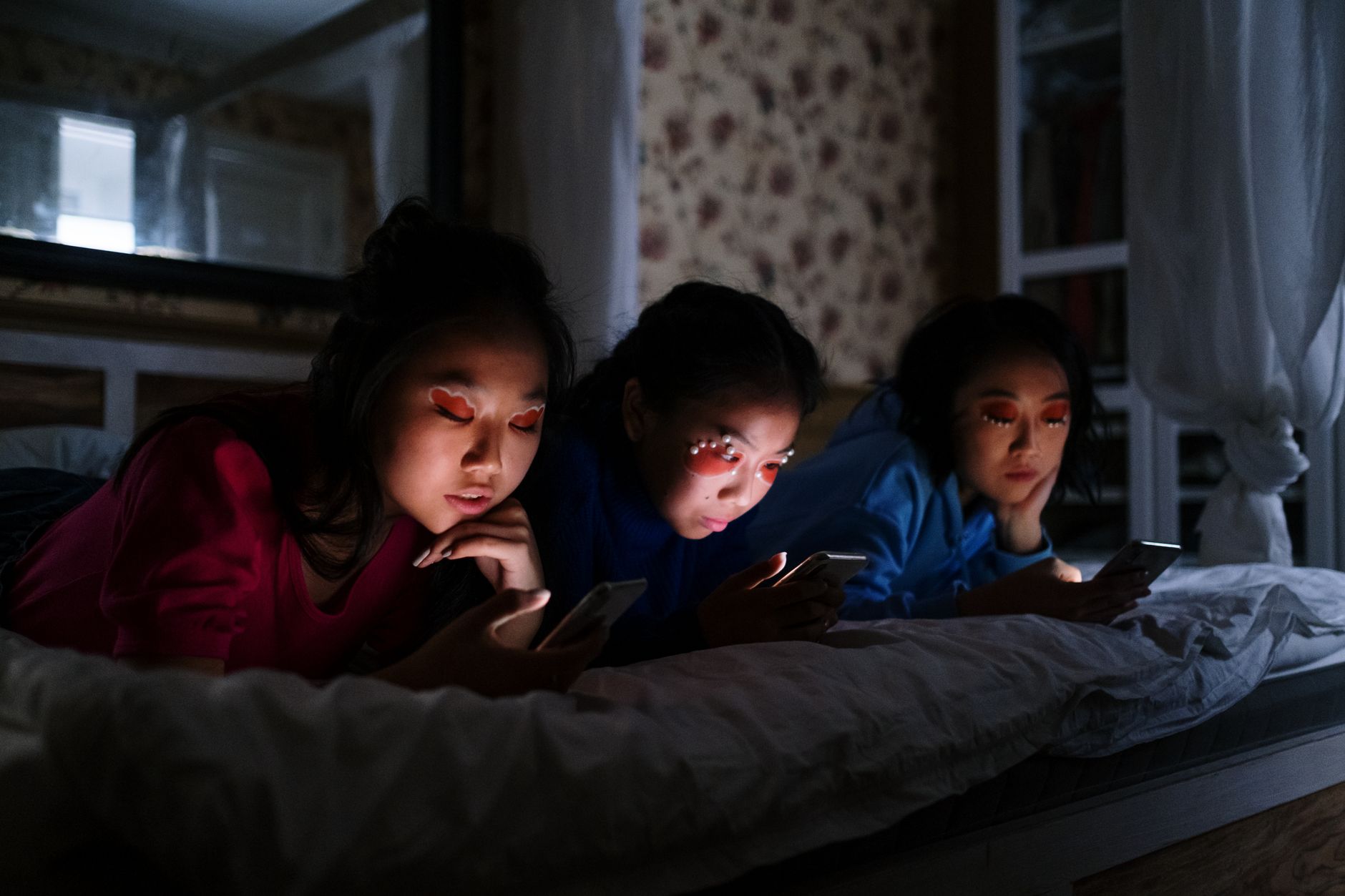
What is practically usable here has little to do with tablets: daylight early in the morning, dimmed light in the evening, consistent times at weekends too. That sounds unspectacular, but it is exactly the lever the children's preparation's authorisation reaches for when it puts "sleep hygiene measures" first.
Gummies, dosing errors and what is actually in the pack
One reason the topic is internationally unsettled lies in the dosage form. In the USA, melatonin products are frequently sold as fruit gummies — in a form children know from sweets.
Two figures on that, both from published investigations:
- An analysis of 25 melatonin gummy products sold in the USA found a discrepancy between declared and measured amount in 22 out of 25; actual contents ranged between 74 % and 347 % of the stated figure, and one product contained no melatonin at all (JAMA, 2023).
- Between 2012 and 2021, US poison control centres recorded a total of 260,435 melatonin ingestions in children and adolescents; the annual number rose by 530 %. The increase was driven mainly by unintentional ingestions in children up to five years old (CDC, MMWR 2022).
Neither says anything about the safety of a correctly dosed tablet — but a good deal about two things worth watching when buying: a form that does not look like a sweet, and a verifiable amount per portion in the nutrition table. And it explains why storing out of the reach of children is not a formality.
The strengths in our range — all of them for adults
Our melatonin products are food supplements and are aimed at adults. None of them is a children's product, and none of the strengths can be converted into a children's amount by splitting — that is the job of a medical prescription, not a kitchen scale. The ladder of strengths looks like this:


Nor is the smallest strength in our range a "children's version": the divisible melatonin 2 mg gives 1 mg when halved — the amount the falling-asleep claim is tied to. Further up — 5 mg and 10 mg — no strength carries an additional authorised claim. All strengths side by side are in the melatonin category.
Food supplements are not a substitute for a balanced and varied diet and a healthy lifestyle.
The short version
- For minors, the EU has a prescription-only melatonin preparation with a narrowly framed field of application — not a freely available one.
- The authorised claim was assessed for the general population; a claim for children does not exist.
- The BfR excludes children and adolescents from independent use; among the open questions is the one about growth in height.
- The late rhythm during puberty is biological — the first lever is light and time structure, not a tablet.
- Keep out of the reach of children is more than a standard phrase where melatonin is concerned.
Frequently asked questions
From what age may melatonin be taken as a food supplement?
There is no statutory age limit for food supplements in Germany — what there is, is the claim authorised for the general population and the BfR's recommendation to exclude children and adolescents from it. In practice that means: the products are aimed at adults, and where minors are concerned the question belongs in the paediatrician's consulting room.
Can an adult tablet simply be halved or quartered?
Splitting is only provided for at all with tablets that have a score line, and even then it only changes the amount, not the release. The medicine authorised for children differs not merely by fewer milligrams but by a delayed release over hours — and that cannot be produced by splitting.
My child has accidentally taken a tablet — what now?
Do not wait, ask: the poison information centre is reachable around the clock and is there for exactly this. It helps to have the pack to hand, because the amount per tablet and the number of missing tablets are the first questions.
Why is the topic discussed differently in the USA than here?
Because different products sit on the shelves there. In the USA melatonin is marketed as a supplement in gummy form, often in amounts that are unusual for a food in the EU. The figures from there on mistaken ingestions among small children have less to do with the substance than with that dosage form.
Matching products from our range
Sources: Regulation (EU) No 432/2012 (authorised health claims, melatonin: time taken to fall asleep 1 mg, jet lag 0.5 mg); Regulation (EC) No 1924/2006, Article 14(1)(b) (claims referring to children's development and health); German Federal Institute for Risk Assessment, opinion No 042/2024 "Food supplements containing melatonin: BfR points out possible health risks"; European Commission/EMA, authorisation of Slenyto (PUMA, 2018; extension of indication to ADHD 2025), summary of product characteristics for Slenyto 1 mg/5 mg prolonged-release tablets; summary of product characteristics for Circadin 2 mg prolonged-release tablets; Cohen PA et al., "Quantity of Melatonin and CBD in Melatonin Gummies Sold in the US", JAMA 2023; Lelak K et al., "Pediatric Melatonin Ingestions — United States, 2012–2021", MMWR 71(22), 2022; German Food Supplements Regulation (NemV), mandatory statement on storage.