Vitamin K2: MK-7 or MK-4 — what the difference is
Futures Nutrition Editorial Team · 11 August 2026

Vitamin K2 is not a single substance but a family: the menaquinones, numbered by the length of their side chain. Two of them matter in practice, MK-4 and MK-7 — and they behave so differently in the body that you cannot set one off against the other. MK-7 has a half-life of roughly 68 hours; MK-4 disappears from the blood within hours and, at the amount a food supplement delivers, cannot be detected in serum at all. For anyone buying in the EU the question is largely settled anyway: the vitamin K source permitted for food supplements is menaquinone, and in law that term is defined as mainly MK-7.
So anyone wondering whether MK-4 might be the better form is usually not comparing two options, but one option with an import. The two figures on a label that actually tell you something are different ones: the microgram amount and the words all-trans.
What the number after the MK means
All K vitamins share the same chemical core, a 2-methyl-1,4-naphthoquinone ring. Only the side chain attached to it differs:
- Vitamin K1 (phylloquinone) carries a phytyl side chain and occurs in green plants.
- Vitamin K2 (menaquinones) carries a chain of isoprene units. Their number is in the name: MK-4 has four, MK-7 has seven.
Those three extra isoprene units are the whole difference — and they make the molecule markedly more fat-soluble. Everything else follows from that: in 2002 Schurgers and Vermeer gave six volunteers 2 µmol each of K1, MK-4 and MK-9 at the same time and tracked the vitamins through the lipoprotein fractions of the blood (Biochimica et Biophysica Acta 1570). K1 stayed largely bound to the fraction the liver clears; the menaquinones also turned up in LDL, MK-4 even in HDL. The long-chain MK-9 also remained in circulation far longer than K1 or MK-4.
Half-life: the difference that counts
With vitamin K, half-life is not a footnote but the property that separates the forms. For MK-7 it was determined in a study by Schurgers and colleagues (Blood 109, 2007): 15 healthy volunteers received K1 and MK-7 together, both peaked in serum after four hours — but MK-7 then fell only slowly, with a half-life of around 68 hours. With continued intake, serum levels rose to seven to eight times baseline.
| Vitamin K1 | MK-4 | MK-7 | |
|---|---|---|---|
| Side chain | phytyl | 4 isoprene units | 7 isoprene units |
| Serum peak | after approx. 4 h | — | after 4–6 h |
| Serum half-life | short (hours) | short (hours) | approx. 68 h |
| measurable in serum at usual supplement amounts | yes | no | yes, up to 48 h |
| permitted in the EU as a source for food supplements | yes (phylloquinone) | not listed as such | yes (as menaquinone) |
The row on which most comparisons founder is the fourth. Sato, Schurgers and Uenishi gave healthy women a single dose of 420 µg MK-4 or 420 µg MK-7 with breakfast (Nutrition Journal 11, 2012). MK-7 was well absorbed, peaked after six hours and was still detectable 48 hours later. MK-4 was not detectable in the serum of any participant at any time point. Seven days at 60 µg daily changed nothing either, while MK-7 raised levels significantly in every participant. The authors conclude that dietary MK-4 does not contribute to vitamin K status as measured by serum vitamin K levels.
What does not follow from this
That does not make MK-4 useless, and the body does need it: all K vitamins can be converted to MK-4 in tissue, which is why MK-4 is credited with roles of its own beyond carboxylation. It is just that the route there apparently does not run through an MK-4 tablet — in an animal study by the same group, a diet-level amount of MK-4 did not raise MK-4 content outside the liver, whereas a dose of MK-7 did.
MK-4 shows measurable effects only at quite different amounts. In a dose-finding study by Takeuchi and colleagues, 500 µg MK-4 per day over two months had no effect on the carboxylation of osteocalcin, a laboratory marker of vitamin K status; 1,500 µg was needed. For MK-7, 45–90 µg per day is reported for the same marker. And where MK-4 is genuinely used as a medicine — in Japan since 1995 under the name Glakay — the daily dose is 45 mg: 225 times the 200 µg in a typical combination supplement, and available on prescription only.
Origin: fermentation versus animal tissue
The two forms also come from entirely different sources.
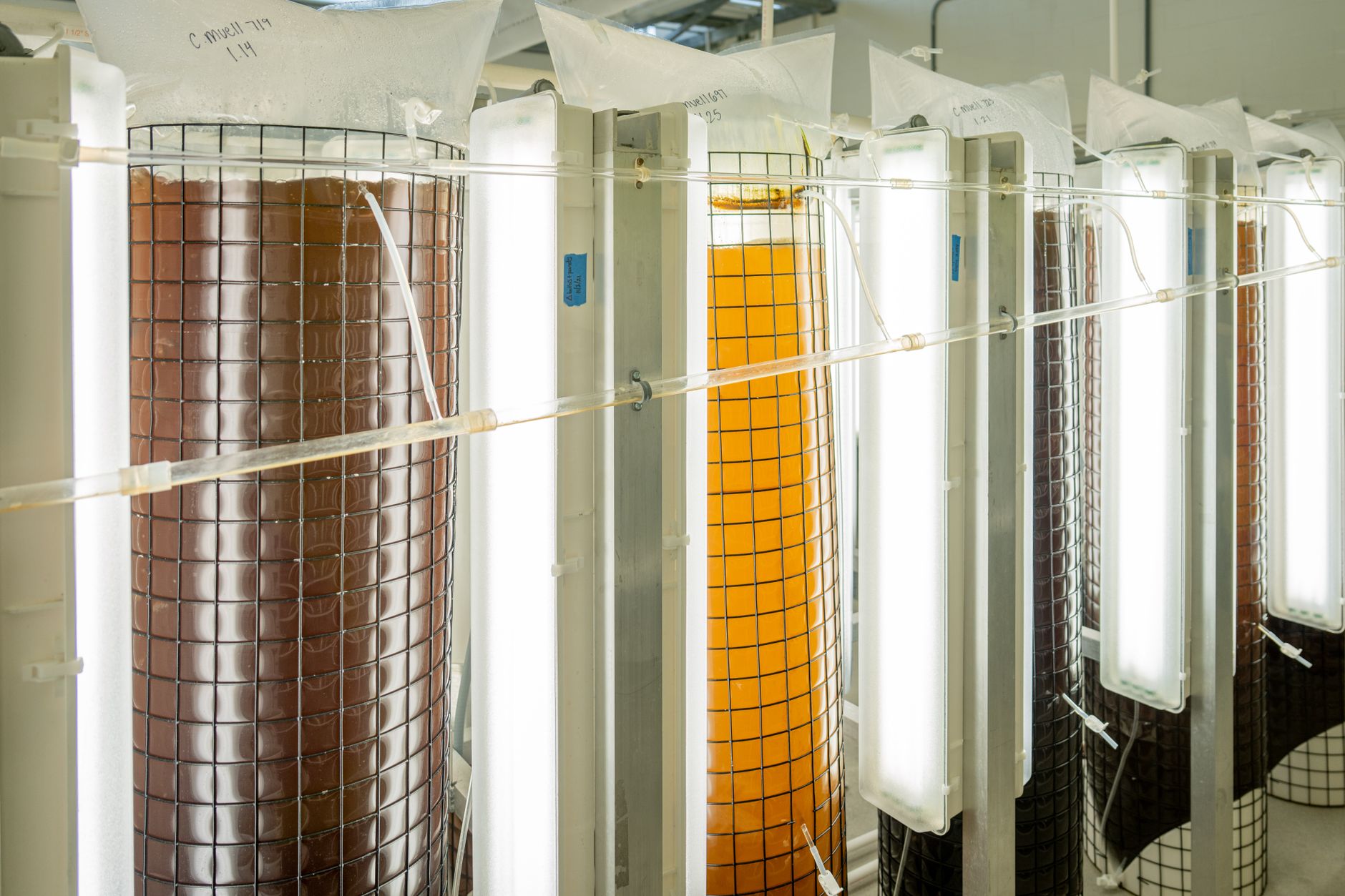
MK-7 comes from bacterial fermentation. Long-chain menaquinones form when bacteria ferment foods — cheese, quark and sauerkraut contain MK-7 through MK-9, and natto, the Japanese food fermented from soybeans with Bacillus subtilis, contains them in exceptionally high concentration. That same strain appears in the EU authorisation: with Decision 2009/345/EC the Commission approved vitamin K2 (2-methyl-3-all-trans-polyprenyl-1,4-naphthoquinone) from Bacillus subtilis natto as a novel food ingredient — an oil suspension containing mainly MK-7 and a smaller amount of MK-6. Today MK-7 is also produced synthetically, in the same all-trans configuration.
MK-4, by contrast, comes from animal foods — butter, egg yolk, liver, poultry — where it is formed, as in human tissue, by conversion of other K forms. As an ingredient it is chemically synthesised.

For vegan buyers that is a concrete point: MK-7 obtained by fermentation is of plant origin, MK-4 from foods is not. In combination products the vitamin D3 comes on top, sourced from lanolin or from lichen — one product that is vegan throughout is Vitamin D3 20,000 IU + K2 (MK-7) vegan.

What may go into a supplement in the EU at all
Which vitamin compounds may be used in food supplements is set out in Annex II of Directive 2002/46/EC, as amended by Regulation (EC) No 1170/2009. Under vitamin K there are exactly two entries: phylloquinone (phytomenadione) and menaquinone. The latter carries a footnote, and that footnote is the decisive sentence: what is meant is menaquinone occurring mainly as menaquinone-7 and, to a lesser extent, as menaquinone-6.
MK-4 is not named there. A supplement declaring MK-4 as its vitamin K source therefore sits outside that list — which is why in the vitamin K2 category, here as in every German range, you find MK-7, and MK-4 mainly in imported offers. For the European market, in other words, the choice between the two forms has already been made before the reader stands in front of the shelf.
What the label should say
Because MK-7 is a given, scrutiny shifts to two other details. The first is the isomerism: only the all-trans form is biologically active, and good declarations say so. The ingredients list of our Vitamin D3 5,000 IU + K2 (MK-7) therefore reads vitamin K2 MK7 99.7+% all-trans and not merely vitamin K2. Which other statements on a tub actually tell you something is collected in Buying vitamin D3 + K2: label, price, supply.

The second is the amount. The nutrient reference value for vitamin K is 75 µg (Regulation (EU) No 1169/2011, Annex XIII); the EFSA gives an adequate intake of 70 µg per day for adults in its 2017 reference values, the German Nutrition Society (DGE) 60 to 80 µg depending on age and sex. What is notable is how the EFSA derives that figure: it sets it expressly for phylloquinone only, because the data on occurrence, intake, function and body pool of the menaquinones are insufficient. So there is no reference value of its own for MK-7 or MK-4.
| K2 amount per tablet | Share of the nutrient reference value (75 µg) |
|---|---|
| 25 µg | 33 % |
| 100 µg | 133 % |
| 200 µg | 267 % |
How these amounts relate to the vitamin D strength in the same tablet is a separate question — in short, the two numbers are not coupled. A tablet with 5,000 IU of D3 does not need more K2 than one with 4,000 IU.
Why the form matters with anticoagulants
There is one situation in which the longer residence time of MK-7 is not a side issue. Anyone taking coumarin-type anticoagulants — phenprocoumon, warfarin, acenocoumarol — should use vitamin K-containing supplements only after consulting their doctor; the German Federal Institute for Risk Assessment (BfR) recommends a corresponding warning on the pack. The newer anticoagulants, which do not act via vitamin K, are not affected.
The forms are not equally potent here. The BfR cites two studies in which subjects were stabilised at an INR of 2.0 and then given rising amounts over seven weeks: with vitamin K1 the threshold for a statistically detectable drop in INR was 150 µg per day, with vitamin K2 it was 45 µg — so K2 counteracts the therapy roughly 3.5 times as strongly. Applying an uncertainty factor of around 2, the BfR proposes maximum amounts of 80 µg K1 and 25 µg K2 per daily portion; a proposal, not law in force. The authors of the 2007 MK-7 study likewise noted that supplements delivering 50 µg MK-7 per day and more can influence the therapy to a clinically relevant degree. For comparison: from ordinary food, participants in the EPIC-Heidelberg study took in a median of 93.6 µg K1 and 34.7 µg K2 per day. Where the upper limits lie overall is set out in Vitamin K2 overdose: what you should know.
What may be printed on the tub
Authorised health claims are listed in Regulation (EU) No 432/2012. For vitamin K there are two, and only in this wording:
- Vitamin K contributes to the maintenance of normal bones.
- Vitamin K contributes to normal blood clotting.
Both speak of vitamin K, not of a form and not of a chain length. A supplement may carry them if it contains at least 15 % of the nutrient reference value per daily portion — for vitamin K, 11.25 µg.
Food supplements are not a substitute for a balanced and varied diet and a healthy lifestyle.
Common questions
Is MK-7 better than MK-4?
At supplement amounts MK-7 is the form that measurably reaches the blood — MK-4 was undetectable in the comparison study even at 420 µg. A blanket better does not follow from that, because MK-4 at medicinal doses is a different question. For a purchase in the European trade it is rarely relevant anyway: the source authorised here is menaquinone in the form of MK-7.
What does all-trans on the label mean?
Menaquinone-7 can exist in different isomeric forms; the active one is all-trans, and the cis fractions contribute nothing. A statement such as 99.7+% all-trans is therefore real information about quality — and it is why all-trans already appears in the EU authorisation of the substance itself.
Does MK-7 appear on every pack that contains K2?
Not necessarily. The plain designation menaquinone or vitamin K is permitted too — that is what the 2009 authorisation provides for. Anyone who wants to know the exact form should look at the ingredients list, not the nutrition table.
Do I have to take MK-7 in the evening because it stays so long?
With a half-life of around 68 hours the timing barely matters — serum levels stay stable over days. The meal is more important: vitamin K is fat-soluble. The practical side of that is covered in Taking vitamin D3 K2 5000 IU correctly.
Sources: Directive 2002/46/EC, Annex II as amended by Regulation (EC) No 1170/2009; Commission Decision 2009/345/EC on the placing on the market of vitamin K2 (menaquinone) from Bacillus subtilis natto; Regulation (EU) No 432/2012; Regulation (EU) No 1169/2011, Annex XIII; EFSA, Dietary Reference Values for vitamin K (2017); BfR, proposed maximum levels for the addition of vitamin K to foods including food supplements (2021); DGE reference values for vitamin K; Schurgers LJ et al., Vitamin K-containing dietary supplements: comparison of synthetic vitamin K1 and natto-derived menaquinone-7, Blood 109(8), 2007 (PubMed 17158229); Schurgers LJ, Vermeer C, Differential lipoprotein transport pathways of K-vitamins in healthy subjects, Biochimica et Biophysica Acta 1570(1), 2002 (PubMed 11960685); Sato T, Schurgers LJ, Uenishi K, Comparison of menaquinone-4 and menaquinone-7 bioavailability in healthy women, Nutrition Journal 11:93, 2012 (PubMed 23140417).