5-HTP dosage: how much is actually in there?
Futures Nutrition Editorial Team · 11 August 2026

The number printed largest on a 5-HTP pack is almost never the number people are looking for. "500 mg Griffonia extract" says nothing about how much 5-HTP is in it — that only follows from the standardisation. The one comparable figure sits on the back, in the nutrition table, and it reads mg 5-HTP per daily dose. Two products with an identical extract amount can differ there by a factor of three.
The second place buyers miscalculate: the much-quoted 30 percent limit in EU law is not a maximum amount in milligrams. It limits how concentrated the extract may be — not how much of it may go into a tablet. Keep the two apart and you can compare labels in thirty seconds.
The four numbers on the pack
| Statement | What it describes | Useful for comparison? |
|---|---|---|
| "Griffonia extract 500 mg" | amount of the raw material | no — without a percentage it cannot be converted |
| "16:1" (drug-extract ratio) | how much seed went into one unit of extract | no — a manufacturing figure, not a content |
| "standardised to 12.5 % 5-HTP" | content in the extract | only together with the extract amount |
| "5-HTP 12.5 mg per daily dose" | amount in the finished product | yes — this is the number |
The arithmetic behind it is a multiplication: extract amount × percentage = mg 5-HTP. If the percentage is missing, the daily amount cannot be determined from the front of the pack at all.
The arithmetic, with examples

Four products that all promise something different on the front — and what actually ends up in the daily dose:
| Declared extract | Standardisation | 5-HTP per daily dose |
|---|---|---|
| 100 mg | 12.5 % | 12.5 mg |
| 250 mg | 10 % | 25 mg |
| 400 mg | 12.5 % | 50 mg |
| 500 mg | 20 % | 100 mg |
Read the other way round — how much extract is needed to deliver a given amount of 5-HTP:
| Target: mg 5-HTP | at 10 % | at 12.5 % | at 20 % | at 30 % |
|---|---|---|---|---|
| 25 mg | 250 mg | 200 mg | 125 mg | 83 mg |
| 50 mg | 500 mg | 400 mg | 250 mg | 167 mg |
| 100 mg | 1000 mg | 800 mg | 500 mg | 333 mg |
That makes clear why concentration is so attractive to manufacturers: at 10 percent, 100 mg of 5-HTP no longer fits into an ordinary tablet; at 30 percent it does. This is the economic pressure behind the legal question in the next section.
What the 30 percent limit limits — and what it does not
In the European Commission's Novel Food Catalogue, Griffonia seeds and seed extracts with a content of up to 30 percent 5-HTP count as not novel and may be used in food supplements. Isolated 5-HTP, by contrast — chemically synthesised as well as an extract above 30 percent — is a novel food and cannot be placed on the market without its own authorisation. The German consumer advice centres (Verbraucherzentrale) put the same fact more bluntly: such extracts are banned in the EU.
Three practical conclusions:
- A percentage above 30 % is not a mark of quality. Where "95 % 5-HTP" or "98 % 5-HTP" appears on a tub, that is not a quality feature but a sign of a product that could not legally be sold here in that form. In the EU rapid alert system RASFF there were four alerts on 5-HTP extracts from Griffonia seeds in the first five months of 2024 alone.
- A high milligram figure, on the other hand, is unremarkable in itself. 100 mg of 5-HTP can be made from 500 mg of a 20 percent extract, and there is legally nothing wrong with that. There is no EU-wide harmonised maximum amount for 5-HTP in food supplements.
- A safety assessment is missing. The African black bean appears in the EFSA Compendium of botanicals — the list of plants that contain naturally occurring substances of possible concern. A detailed risk assessment of 5-HTP from Griffonia seeds is not yet available. That is precisely why comparing with amounts used in studies is so delicate.
What the literature reports
Anyone searching for "5-HTP dosage" quickly runs into three-digit numbers. They come from clinical research and from jurisdictions outside the EU. Two examples, so the order of magnitude is clear:
- The investigations EFSA assessed for the proposed satiety claim worked with 750 to 900 mg of 5-HTP per day (EFSA Journal 2011;9(6):2198). The result: a cause-and-effect relationship between the intake of 5-HTP and sustained satiety with reduced energy intake was not established. The applications concerning mood and attention were likewise rejected (EFSA Journal 2009;7(10):1273). For 5-HTP, no health claim is therefore authorised in the EU.
- The Canadian natural health products directorate lists 5-HTP in a product monograph (as of 28 August 2024) with daily amounts of 100 to 900 mg, graded by the purpose applied for, with a maximum of 300 mg per single dose and exclusively for adults aged 18 and over. The purposes those amounts are tied to there mostly no longer fall under food law in Germany.
Those figures are therefore no yardstick for a food supplement. What can be carried over from the same monograph are the practical notes: start with a low amount and increase it over about two weeks to limit gastrointestinal complaints, and take it with a meal. Both fit the observation that these complaints are related to the concentration in the blood — see How long does it take for 5-HTP to work?.
What our product declares

Our 5-HTP + Vitamin B6 sits at the lower end of the scale and declares both numbers openly:
| Per tablet (recommended daily dose) | Amount | % NRV* |
|---|---|---|
| Dry extract from Griffonia seeds 16:1, standardised to 12.5 % 5-HTP | around 100 mg by calculation | — |
| of which 5-HTP | 12.5 mg | no reference value set |
| Vitamin B6 | 1.6 mg | 114 % |
* Nutrient reference values in accordance with Regulation (EU) No 1169/2011, Annex XIII.
The recommended intake is: one tablet per day after a meal. For vitamin B6 there are — unlike for 5-HTP — authorised claims, and in their official wording they read: Vitamin B6 contributes to normal functioning of the nervous system, Vitamin B6 contributes to normal psychological function and Vitamin B6 contributes to the reduction of tiredness and fatigue (Regulation (EU) No 432/2012). Food supplements are not a substitute for a balanced and varied diet and a healthy lifestyle. The other variants stand side by side in the 5-HTP category.
Why the amount cannot simply be scaled up
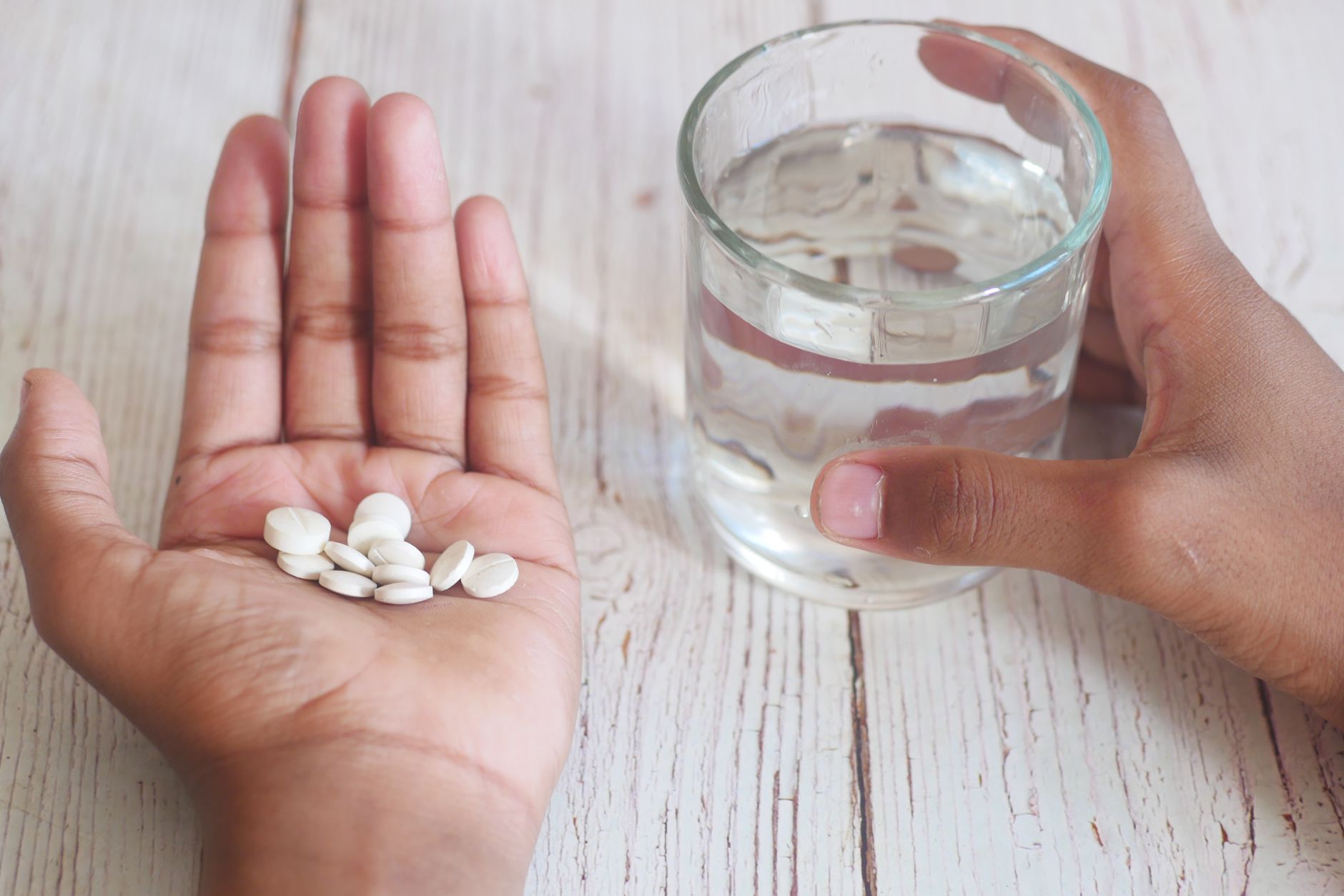
The obvious idea — four tablets instead of one, then it is 50 mg instead of 12.5 mg — has an arithmetical catch that has nothing to do with 5-HTP: the vitamin B6 is multiplied along with it. In 2023 EFSA set the tolerable upper intake level for vitamin B6 at 12 mg per day for adults, substantially lowering the earlier value (EFSA Journal 2023;21(5):8006).
| Tablets per day | 5-HTP | Vitamin B6 | Distance to the upper level |
|---|---|---|---|
| 1 (recommended intake) | 12.5 mg | 1.6 mg | 10.4 mg |
| 4 | 50 mg | 6.4 mg | 5.6 mg |
| 7 | 87.5 mg | 11.2 mg | 0.8 mg |
At seven tablets the upper level for vitamin B6 would be practically exhausted — and that before the amount of 5-HTP came anywhere near what the international literature reports. Further B6-containing products, a B complex or a multivitamin for instance, would come on top. The recommended intake of one tablet a day is therefore not to be exceeded; anyone looking for a higher amount of 5-HTP needs a differently composed product, not a multiple of this one.
Which other products count towards it is decided by the individual substance and not by the vitamin family: EFSA's 12 mg apply to vitamin B6 alone. A separately taken vitamin B12 contains no B6 and does not change the distance in the table above; a B complex or a multivitamin almost always contains some and shortens it. Doing the sums therefore means: look for the "vitamin B6" line in the nutrition table on every label and add up only those milligram figures.
Independently of that: 5-HTP acts on the same metabolic pathway as some medicines. Interactions are to be expected with antidepressants and other serotonergic agents; that combination does not belong in everyday use without medical advice. The product is not intended for pregnant or breastfeeding women, children or adolescents. Reported undesirable effects include nausea, vomiting, diarrhoea, headache, insomnia and a racing heart.
Frequently asked questions
How do I convert from extract to 5-HTP? Extract amount times standardisation: 400 mg of extract at 12.5 % gives 50 mg of 5-HTP. If the percentage is missing, the conversion is impossible — and then the statement "x mg Griffonia extract" is worthless for a comparison. The drug-extract ratio (16:1, say) does not help here; it describes the amount of raw material used.
Is a product with 100 mg of 5-HTP permitted? The milligram figure is not what matters. What is decisive is where the 5-HTP comes from: from a seed extract with a content of at most 30 percent, or from isolated 5-HTP. Only the extract up to 30 percent counts as not novel. An EU-wide maximum per daily dose does not exist.
Why do studies say 900 mg and my pack says 12.5 mg? Because the two are different things. The three-digit amounts come from clinical research with medical questions; a food supplement does not answer such questions, and the claims investigated there were expressly assessed by EFSA as not substantiated.
Should the amount be increased gradually? The Canadian product monograph recommends exactly that — start low and increase over two weeks — in order to limit gastrointestinal complaints. With a product that has a fixed daily dose of one tablet, however, there is no room for that; what counts is the recommended intake on the pack.
Sources: European Commission Novel Food Catalogue · EFSA, Scientific Opinion on the substantiation of health claims related to 5-hydroxytryptophan (5-HTP) and increase in satiety …, EFSA Journal 2011;9(6):2198 · EFSA, Scientific Opinion … enhancement of mood (ID 1575) and attention (ID 1828), EFSA Journal 2009;7(10):1273 · EFSA, Tolerable upper intake level for vitamin B6, EFSA Journal 2023;21(5):8006 · EFSA Compendium of botanicals · Health Canada / NNHPD, Monograph "5-HTP", as of 28 August 2024 · Turner, Loftis, Blackwell, Pharmacology & Therapeutics 2006;109(3):325 (PubMed 16023217) · Regulation (EU) No 432/2012 · Regulation (EU) No 1169/2011, Annex XIII · Verbraucherzentrale, "5-Hydroxytryptophan (5-HTP) from the African black bean", as of 07 June 2024.