Eyes and screen work: what the evidence shows
Futures Nutrition Editorial Team · 13 August 2026

13 August 2026
The short answer: the complaints are real — dry, burning, tired eyes, blurred vision in the late afternoon, headaches. What is documented, though, is something other than what the advertising suggests. It is not the screen as such that causes them, but hours of concentrated close work; for retinal damage from the blue light of displays the German Federal Office for Radiation Protection (Bundesamt für Strahlenschutz) found no indications in its investigations; and for no nutrient and no plant is there an authorised claim in the EU about tired eyes at a screen. Two applications to that effect were assessed and rejected. What actually helps is set out in occupational health and safety law and at the eye doctor, not on the shelf.
That is an uncomfortable piece of information for an industry that sells “eye complexes for heavy screen users”. It is, however, the only one that can be backed with sources — and anyone who knows it does not spend money on the wrong thing.
What actually happens in the eye during screen work
In the optometric literature the complaints are grouped under “digital eye strain” or “Computer Vision Syndrome”. The term describes a group of symptoms, not a diagnosis with a clear finding. Three mechanisms are well studied:
Sustained near focus. Looking at a monitor 50 to 70 cm away, the eye holds accommodation and convergence at one value for hours. That is not the load the system is built for — it is designed for switching between near and far.
Incomplete blinking. This is where it gets interesting, because the widespread explanation did not hold up. For a long time it was said that people blink less at a screen. In 2014 Chu, Rosenfield and Portello (Optometry and Vision Science 91(3):297–302, 25 subjects) were the first to compare against a clean control condition: the same reading task, once on a monitor and once on paper, same distance, same font size, same contrast. Blink rate did not differ (14.9 versus 13.6 per minute). What clearly did differ was the proportion of incomplete blinks: 7.02 per cent at the screen versus 4.33 per cent on paper. The authors conclude that earlier findings were down to the cognitive demand rather than to the medium.
That changes the practical conclusion. An incomplete blink does not spread the tear film all the way to the lower lid margin — the eyes dry out in the lower area even though it feels as if you are blinking often enough.
Uncorrected refractive error. Anyone who leaves a mild long-sightedness or an early presbyopia uncorrected compensates for it with extra work by the eye muscles. Over ten minutes of newspaper reading that goes unnoticed; over eight hours of spreadsheets it does not.
| Complaint | Likely cause | What is documented against it |
|---|---|---|
| Dryness, burning, foreign-body sensation | incomplete blinking, dry room air | deliberate complete blinking, air humidity, lubricating drops |
| Blurred vision towards evening | sustained accommodation | looking into the distance, breaks, correct visual aid |
| Headache, burning eyes with glare | reflections, poor lighting | workstation design (see below) |
| Double images, effort focusing | uncorrected refractive error, heterophoria | eye examination, screen glasses |
No line in this table contains a nutrient. That is not an oversight.
What the EU decided about “tired eyes at the screen”
This exact claim has already been applied for once — for anthocyanins from bilberry and blackcurrant. In the EU register of nutrition and health claims the wording applied for is given in the original, together with the reason for rejection:
| Substance | Claim applied for (original wording) | Reason for rejection | EFSA opinion | Entry |
|---|---|---|---|---|
| Anthocyanins from bilberry and blackcurrant | “are good for the eyes (improve adaptation to the dark and relieve eye tiredness caused by computer terminal work)” | food not sufficiently characterised for a scientific assessment | 2011;9(6):2244 | 2796 |
| Dry cassis extract from Ribes nigrum, standardised to 7 % anthocyanosides | “Can help to reduce eyestrain. Can help to improve night vision.” | the claimed effect was not substantiated for this food | 2011;9(6):2204 | 2750 |
| Zeaxanthin from marigold, paprika or wolfberry extract | “natural filter of high-energy, harmful blue light … helps protect the eye against visible light damage” | the claimed effect was not substantiated for this food | 2010;8(10):1724 | 2169 |
The two grounds for rejection need to be distinguished. In entry 2796 the object of assessment was not defined clearly enough — an extract can differ greatly depending on origin and process, and without a fixed description nothing can be evaluated. In 2750 and 2169 it was the evidence itself: it did not support the claimed effect.
On the subject of the eye only one sentence structure is authorised, and it is about something else. Under the health relationship “maintenance of normal vision”, Regulation (EU) No 432/2012 lists four entries — vitamin A, riboflavin, zinc and DHA. Their exact wording appears further down in this article. None of these four sentences says anything about fatigue, about screens or about the state of the eyes after a long working day. “Maintenance of a normal function” is not the same as “less tired eyes at 5 p.m.”
Blue-light filters: what the evidence supports
The blue-light filter is the best-selling promise around screen work — as a spectacle lens, as a display film, as night mode and indirectly as a carotenoid capsule said to act “like internal sunglasses”. That formulation, incidentally, appears verbatim in the register, under the same rejected zeaxanthin claim: “Zeaxanthin acts like internal sunglasses.”
Two questions need to be kept apart cleanly here.
Does the blue light from screens damage the retina? The German Federal Office for Radiation Protection describes the so-called blue-light hazard as “the risk of photochemical damage to the retina or the retinal pigment epithelium (RPE) from high-energy light” and states with regard to displays that “investigations with various displays produced no indications of this”. For the photobiological safety of lamps, standard EN 62471 applies, with four risk groups; screens are not the use case the warning is meant for.
Do blue-light filtering lenses help against the complaints? There is a Cochrane review from 2023 on this (Singh et al., Cochrane Database of Systematic Reviews 2023, Art. No. CD013244.pub2). It evaluates 17 randomised controlled trials with between 5 and 156 participants and observation periods from under one day to five weeks. The results:
- Eye strain: possibly no difference compared with lenses without a filter (low certainty of evidence).
- Visual acuity: probably little to no effect (moderate certainty; mean difference 0.00 logMAR, 156 participants).
- Sleep quality: contradictory findings — three of six studies found an improvement, three did not.
- Retinal health, contrast sensitivity, colour discrimination, glare sensitivity: no data from randomised trials, neither for nor against.
The authors conclude that blue-light filtering lenses may not attenuate symptoms of eye strain with computer use over short observation periods. How that is read matters: “no proven benefit” is something other than “proven lack of benefit”. The studies were small, short and methodologically open to criticism — 65 per cent had a high risk of detection bias.
The sleep question does have a real core, incidentally, one that has nothing to do with the eye as an organ of sight: blue light suppresses the release of melatonin, as the same office explicitly notes in its lighting recommendations — desirable during the day, mostly not in the evening. That is a question of timing and light quantity, not of eye health; anyone who wants to follow it up will find it in Melatonin: when to take it in the evening.
The 20-20-20 rule — and what of it is documented
Every 20 minutes, look for 20 seconds at something 20 feet (6 m) away: the rule is quoted everywhere, including by eye doctors. Peer-reviewed evidence for it is thin, however, and the study that tested it directly came out negative.
In 2023 Johnson and Rosenfield (Optometry and Vision Science 100(1):52–56) had 30 young subjects work through a cognitively demanding 40-minute reading task on a tablet four times — with 20-second breaks every 5, every 10, every 20 or every 40 minutes, the last therefore without a break. Result: symptoms increased significantly in all four runs (p < 0.001), but the breaks made no difference — neither for symptoms (p = 0.70) nor for reading speed (p = 0.93) or accuracy (p = 0.55). The authors' conclusion: the data do not support 20-second breaks as a therapeutic measure.
A single study with 30 participants does not conclusively refute a recommendation. It does shift the expectation, though: 20 seconds is probably too short to achieve anything. European employment law is aiming at something else anyway. Article 7 of Directive 90/270/EEC on work with display screen equipment, transposed into the national law of every Member State, provides:
“The employer must plan the worker's activities in such a way that daily work on a display screen is periodically interrupted by breaks or changes of activity reducing the workload at the display screen.”
What is meant, then, is a change of activity, not a glance out of the window.
What the employer owes
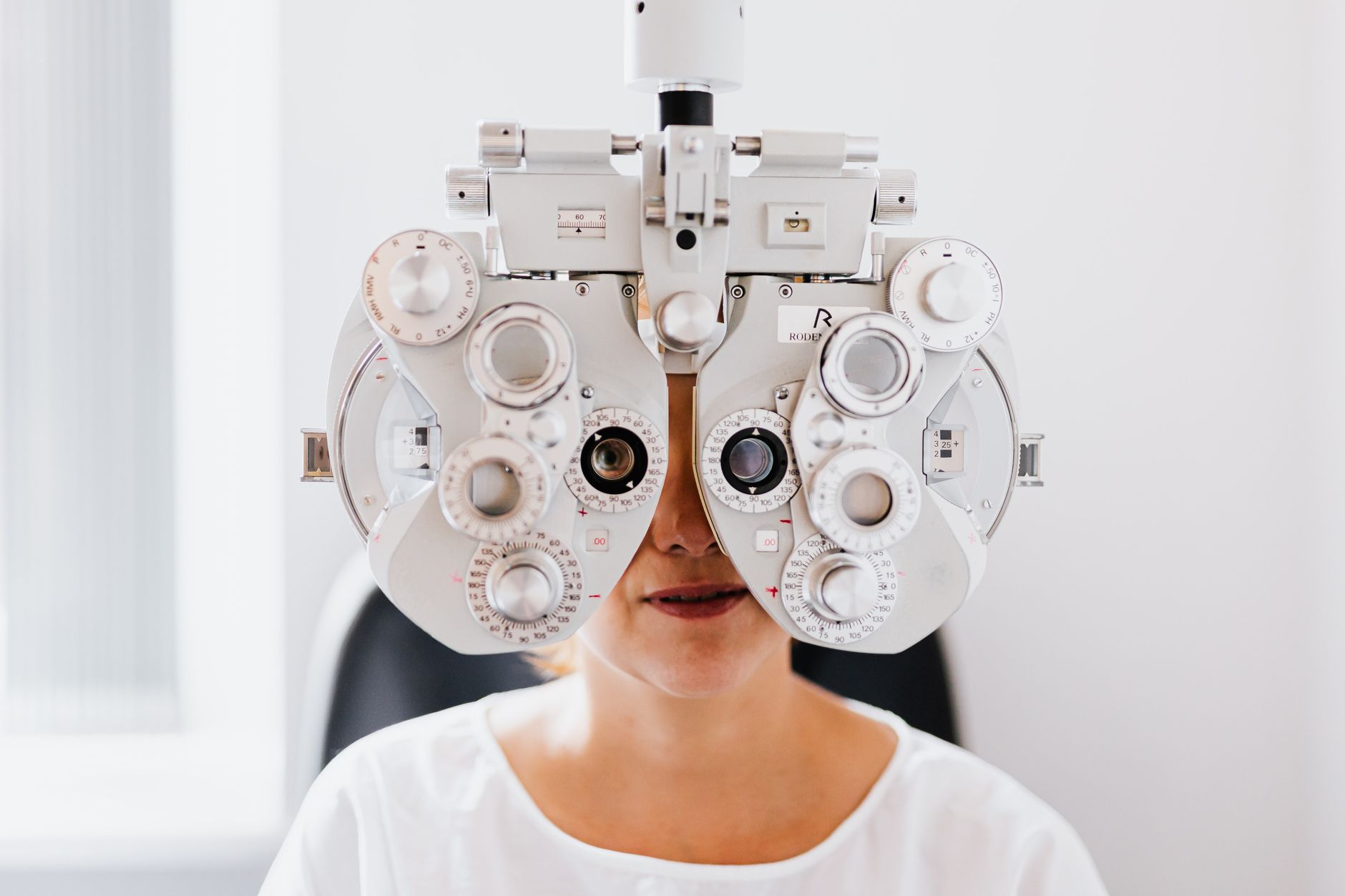
This is the part fewest people know about — and it is more concrete than any capsule. Article 9 of the same directive provides:
“Workers shall be entitled to an appropriate eye and eyesight test carried out by a person with the necessary capabilities: before commencing display screen work, at regular intervals thereafter, and if they experience visual difficulties which may be due to display screen work. […] If the results of the test […] show that it is necessary and if normal corrective appliances cannot be used, workers must be provided with special corrective appliances appropriate for the work concerned.”
Paragraph 4 of the same article adds that measures taken under it “may in no circumstances involve workers in additional financial cost”. Anyone complaining of eye problems at work therefore has an entitlement that costs nothing — and one that clarifies the most common actual cause, namely an uncorrected or wrongly corrected refractive error.
On top of that comes the design of the workstation itself. The annex to the directive requires, among other things, that the screen be “free of reflective glare and reflections liable to cause discomfort to the user”, that the image be stable and free of flicker, and that brightness and the contrast between characters and background be easily adjustable. A monitor placed facing a window causes more eye complaints than any nutrient gap.
What nutrients can do at this point — and what they cannot
That leaves the question of what an eye supplement is then good for. The honest answer: for the general supply of the nutrients that carry an authorised vision claim — not for the screen day. In their official wording the claims read:
- “Vitamin A contributes to the maintenance of normal vision.”
- “Riboflavin contributes to the maintenance of normal vision.”
- “Zinc contributes to the maintenance of normal vision.”
- “DHA contributes to the maintenance of normal vision.”
To these comes a claim often implied in eye supplements but not related to the eye: “Vitamin E contributes to the protection of cells from oxidative stress.” It applies to cells in general.
Anyone wanting to cover these nutrients will find them combined in our range: the supplement Vitamin A + E + lutein supplies 400 µg of vitamin A (50 % NRV), 20 mg of vitamin E (167 % NRV) and 10 mg of lutein from Tagetes erecta extract per tablet.

For the lutein in it, what is said above about the register applies: it is declared as an ingredient with a quantity, but there is no effect claim for it.
Zinc can be supplemented on its own; Zinc + vitamin B3 contains 25 mg of zinc per tablet (250 % NRV) and thus lies well above the 1.5 mg from which the zinc claim may be used at all.

For vitamin A the reference value also has to be taken into account, because retinol and beta-carotene cannot be converted one to one. Further combinations are collected in the category Eyes, zinc-only products under Zinc.
Food supplements are not a substitute for a balanced and varied diet and a healthy lifestyle.
Frequently asked questions
Does screen work damage the eyes permanently? For the mechanism most often named in this context — photochemical damage to the retina from blue light — the German Federal Office for Radiation Protection found no indications in investigations of various displays. The complaints at issue occur during and after work and then subside. That does not mean they should be taken lightly: persistent or one-sided visual disturbances belong in an eye examination, because something other than the monitor may be behind them.
Does lutein help against tired eyes at the screen? There is no authorised claim to that effect, and the applications closest in substance were rejected — for anthocyanins from bilberry with explicit reference to “eye tiredness caused by computer terminal work” (entry 2796), for zeaxanthin with reference to blue-light filtering (entry 2169). A rejection is not a verdict on whether a substance does anything; it means that the evidence submitted did not support the effect claimed. Nothing may be advertised with it.
Is a pair of blue-light filtering glasses worth it? According to the 2023 Cochrane review, a benefit for eye strain is not proven, and for visual acuity there is probably no effect. Anyone who already owns a pair and feels better with them need not put them away — the review found only isolated, minor adverse effects. As a purchase against tired eyes, though, the evidence is weak, and the same money put into properly fitted screen glasses has the better justification.
What does help with dry eyes at the monitor, then? Mostly the points that concern the tear film: deliberate, complete blinking (the proportion of incomplete blinks was the only measurable difference from paper in the 2014 study), a monitor below eye level so that the lid covers more of the ocular surface, sufficient air humidity, and no direct draught from air conditioning or ventilation. Lubricating eye drops are medical devices or medicinal products and therefore a question for the pharmacy or the eye doctor, not for the food supplement shelf.