Lutein in foods: what one portion delivers
Futures Nutrition Editorial Team · 13 August 2026
13 August 2026
The short answer: a side portion of cooked leaf spinach delivers around 22 milligrams of lutein and zeaxanthin, more than twice what a typical capsule holds. Kale comes to about 10 milligrams per portion, a hard-boiled egg to barely 0.2 milligrams, a side salad of iceberg lettuce to 0.17 milligrams. The distance between the front-runners and the rest is therefore not a matter of percentages but of a hundredfold — and it is decided by the single question of whether dark green leafy vegetables are on the plate or not. For comparison: in Germany an average of 1.91 milligrams of lutein per day has been measured.
The usual tables online give values per 100 grams. That is right for comparing two vegetables and fairly useless for the question "what am I eating tonight": nobody eats 100 grams of raw kale, whereas 100 grams of cooked spinach goes down easily. Which is why the portion table comes first here.
What a realistic portion delivers
The contents come from the FoodData Central nutrient database of the US Department of Agriculture (USDA, SR Legacy), which lists lutein and zeaxanthin as one combined value — the usual analytical methods do not routinely separate the two substances. The portion sizes are rounded everyday amounts, not official specifications; anyone who portions differently converts accordingly.
| Portion | Amount | Lutein + zeaxanthin |
|---|---|---|
| Leaf spinach, frozen, cooked | 200 g | 31.4 mg |
| Leaf spinach, fresh, cooked | 200 g | 22.6 mg |
| Swiss chard, cooked | 150 g | 16.5 mg |
| Kale, cooked | 200 g | 10.0 mg |
| Baby spinach as a salad, raw | 40 g | 4.9 mg |
| Peas, cooked | 150 g | 3.9 mg |
| Radicchio in a mixed salad | 30 g | 2.6 mg |
| Broccoli, cooked | 200 g | 2.2 mg |
| Romaine lettuce | 60 g | 1.4 mg |
| Rocket | 30 g | 1.1 mg |
| Sweetcorn, canned, drained | 150 g | 1.0 mg |
| Pistachios | 30 g | 0.87 mg |
| Parsley, freshly chopped | 10 g | 0.56 mg |
| Paprika powder | 1 tsp (2.3 g) | 0.44 mg |
| Egg (size M), hard-boiled | 53 g contents | 0.19 mg |
| Iceberg lettuce | 60 g | 0.17 mg |
Two rows deserve a second look. The last one shows that "salad" as a category says nothing about the content: iceberg lettuce sits at 277 µg per 100 grams, romaine at 2,310 µg — a factor of 8 between two leaves lying side by side in the supermarket. And the row with the egg explains why it turns up in every article on the subject anyway: what counts there is not the amount but the packaging — more on that below.
Why figures per 100 grams mislead
Raw kale contains 6,260 µg per 100 grams, cooked kale only 4,980 µg. Anyone reading that as a loss has misread it. Cooking changes the reference weight: part of the water and the soluble components moves into the cooking water or evaporates, while leafy vegetables take up water as they cook. 100 grams of cooked vegetables are therefore never the same starting material as 100 grams of raw.
With spinach it becomes even clearer. Raw 12,200 µg, cooked 11,300 µg, frozen and cooked 15,700 µg per 100 grams — the frozen spinach sits at the very top although it has the longest processing behind it. The reason is mundane: it is chopped and densely packed, so a spoonful of it simply holds more leaf mass than a loosely heaped spoonful of freshly steamed leaves. Effects like this say something about packing density, not about the stability of the substance.
Boiling, steaming, freezing
How stable lutein really is can only be measured once the shift in weight has been calculated out. That is exactly what an Italian research group did: it boiled and steamed four leafy vegetables — spinach among them — and related the values to dry matter and to the actual solid losses. The result: in boiling water, lutein and β-carotene remained unchanged; with steaming, the lutein content fell by an average of 20 per cent and the β-carotene content by 15 per cent (Foods 2021;10(5):960, PMID 33924885). That of all things the gentler method came off worse is counterintuitive, but the figures are unambiguous — presumably because steaming involves more oxygen and more time.
What does break lutein down is heat over long periods. In the industrial production of pumpkin purée, the xanthophylls — that is, lutein and violaxanthin — were among the most sensitive components, while more than 75 per cent of the provitamin A carotenes survived (Food Chem 2011;128(1):195–202, PMID 25214348). For the domestic kitchen that means: ten minutes in boiling water are uncritical, hours of reducing are not.
What remains in practice: cook briefly, do not fear the cooking water as a source of loss, and take frozen produce without a guilty conscience. Anyone choosing between steaming and boiling loses nothing worth mentioning either way — the decision may be made on taste.
Without fat, much of it stays on the plate
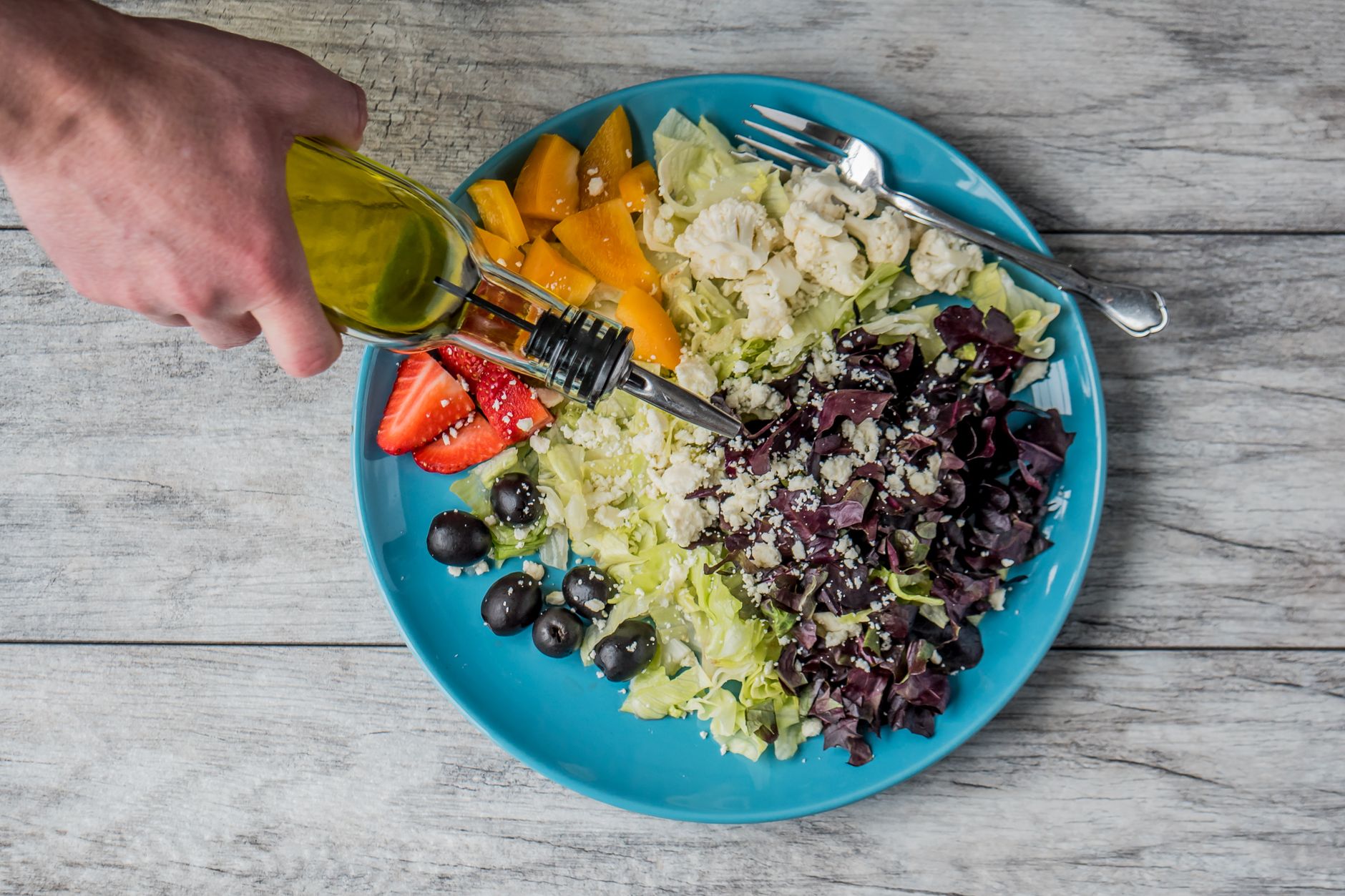
The bigger lever lies not in the pot but next to it. Lutein and zeaxanthin are fat-soluble; they are absorbed via fat digestion. How much that counts is shown by a study with eleven people who ate a salad once with and once without 150 grams of avocado. Measured by the area under the concentration curve in the triglyceride-rich lipoprotein fraction, lutein absorption with avocado was 5.1 times as high, and for β-carotene as much as 15.3 times. Whether the fat came as fruit or as avocado oil, and whether it was 12 or 24 grams, made no difference (J Nutr 2005;135(3):431–436, PMID 15735074). A tablespoon of oil over the salad is thus the single most effective measure in this whole article. The same principle governs preparations, where the meal decides rather than the clock — the figures on that are in Taking lutein: fat matters, the time of day barely.
The second factor is the matrix the substance sits in. With spinach this was tested directly: whole leaves, chopped spinach and enzymatically liquefied spinach were compared over three weeks. For β-carotene, the chopping made a great deal of difference — relative bioavailability rose from 5.1 to 9.5 per cent compared with a preparation. For lutein, by contrast, practically nothing changed; it lay between 45 and 55 per cent for all preparations (J Nutr 1999;129(2):349–355, PMID 10024612). Lutein from leafy vegetables therefore arrives at around half in any case, however finely you chop.
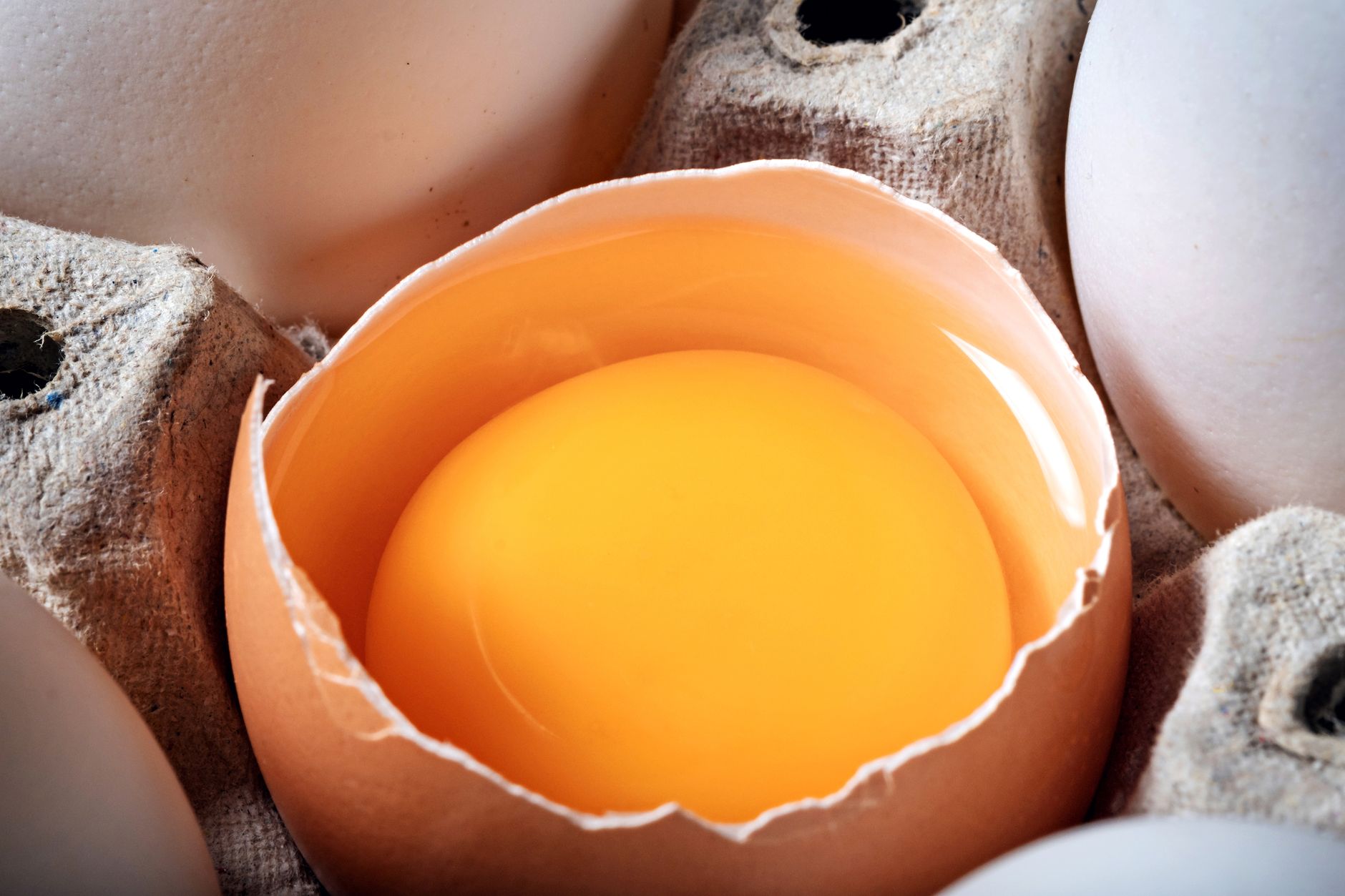
And with that, back to the egg. Its numerical value is meagre, but in the yolk the xanthophylls are already dissolved in fat rather than bound to cell walls and protein complexes — in what an Irish intervention study calls a highly bioavailable matrix. In that investigation, serum values rose significantly over eight weeks with both enriched and ordinary eggs; a measurable effect on macular pigment or on visual performance, on the other hand, did not appear in that time (Br J Nutr 2017;117(1):108–123, PMID 28122649). The one simply does not follow from the other.
What actually adds up in Germany
For the German National Nutrition Survey, a carotenoid database had to be built specially, because the German nutrient tables contained nothing on the subject beyond β-carotene. The analysis produced a mean intake of 1.91 mg of lutein per day, alongside 5.33 mg of total carotenoids. Green salads and vegetables were the most important lutein suppliers; zeaxanthin came above all from maize (Z Ernährungswiss 1998;37(4):319–327, PMID 9894680).
These 1.91 mg are the reference point that is missing from advertising statements. A single plate of spinach lifts the daily figure to ten times that; a week without dark green leafy vegetables pushes it down to a fraction. The day-to-day variation is greater with this substance than with almost any vitamin — which also explains why a single blood measurement says little.
There is no official reference value: Annex XIII of Regulation (EU) No 1169/2011 sets reference intakes only for vitamins and minerals, and lutein is neither. So there is no percentage figure on the pack and no recommendation you could fall short of. The German Nutrition Society (DGE) recommends in general at least five portions of fruit and vegetables per day — anyone who regularly makes one of them green and dark is automatically well above average on lutein.
Anyone reaching for a preparation instead should know the order of magnitude: our Vitamin A + E + lutein contains 10 mg of lutein per tablet, about five times the average daily intake from the diet — and roughly as much as half a portion of spinach. The approved statement on this pack does not hang on the lutein but on the vitamin A it contains: Vitamin A contributes to the maintenance of normal vision. Which nutrients may carry that sentence at all is set out in Eye nutrients: which claims are approved.

Food supplements are not a substitute for a balanced and varied diet and a healthy lifestyle.
Frequently asked questions
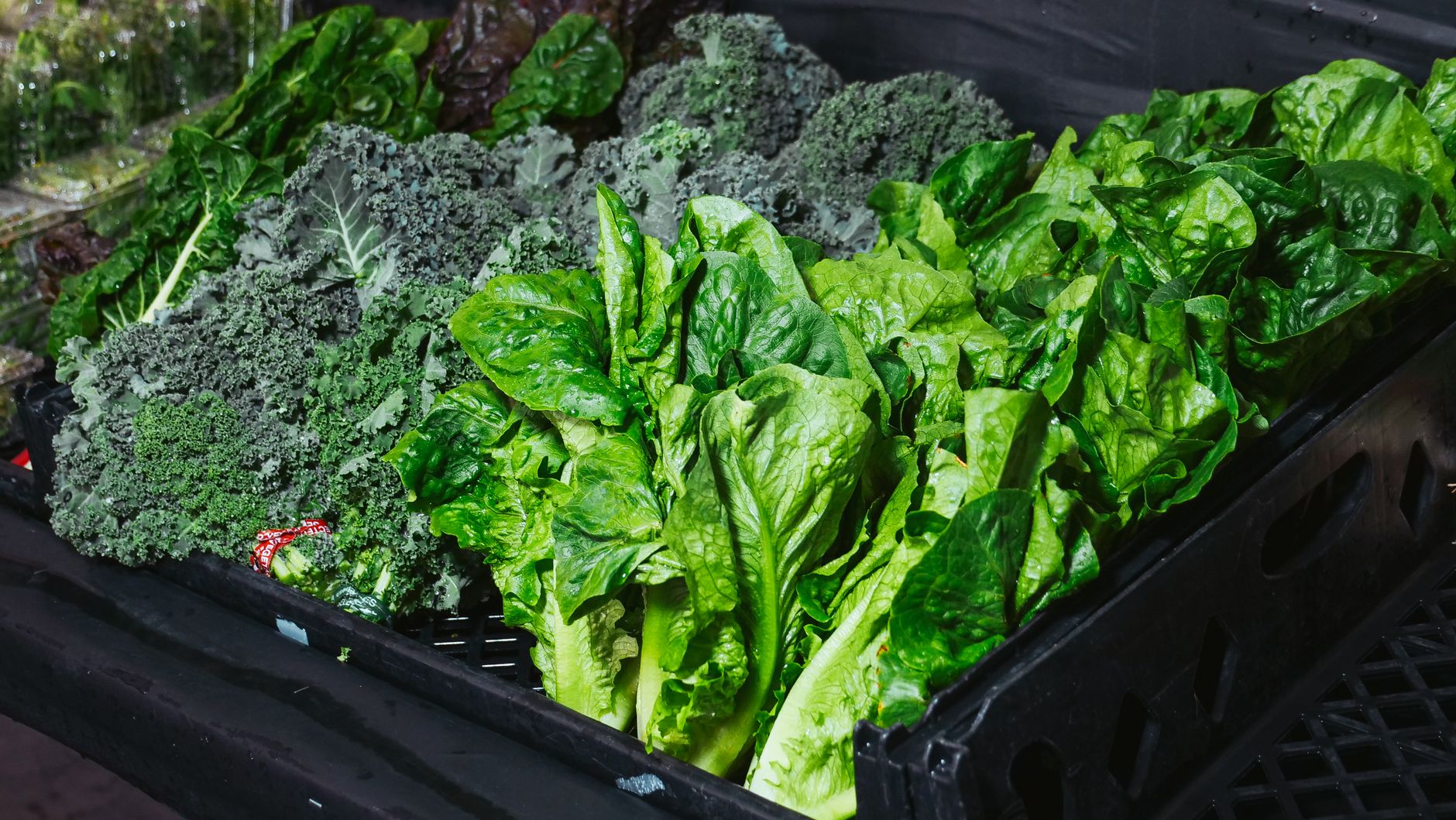
Do I have to eat spinach, or will salad do? It depends on the variety, not on the category. Between iceberg lettuce (277 µg per 100 g) and romaine (2,310 µg) lies a factor of 8, between iceberg and raw spinach (12,200 µg) a factor of 44. A salad of dark leaves — romaine, rocket, radicchio, baby spinach — brings many times more into the bowl than a pale head lettuce, at the same volume and the same price.
Does frozen produce lose lutein? Not to any relevant extent, according to the available analyses. Frozen leaf spinach was even above the fresh in the USDA data — which, however, is mainly down to the denser packing and not to lutein being created by freezing. What is critical for this substance is long heat processes, not cold.
How much fat does it take? In the avocado study, 12 and 24 grams of fat made no difference — the smaller amount was already enough. A tablespoon of oil in the dressing or a knob of butter on steamed spinach is in that order of magnitude. Anyone eating leafy vegetables consistently fat-free, by contrast, gives away a considerable part.
Can I take in too much lutein from food? EFSA has not derived a tolerable upper intake level (UL) for lutein. The only quantitative reference point is the ADI for the food colour from Tagetes erecta of 1 mg per kilogram of body weight per day, that is 70 mg at 70 kg (EFSA Journal 2010;8(7):1678). Even a large plate of frozen spinach stays below that at a good 30 mg. Anyone additionally taking a combination preparation adds up the daily total; what else the range holds on the subject is shown by the category Eyes.