Silymarin: what is in milk thistle extract
Futures Nutrition Editorial Team · 14 August 2026
Silymarin is not a single substance but the collective name for a group of related molecules from the milk thistle fruit — six main representatives, listed by name in the pharmacopoeia. That is exactly where the practical difficulty on the shelf comes from: two packs can contain the same raw material and still carry different numbers. Anyone who wants to compare needs three figures — how much extract, which drug-extract ratio, how much silymarin — and needs to know which method produced the third one. This article explains all three.
Silymarin is a mixture, not a molecule
The flavonolignans make up 1.3 to 3 % of the dried milk thistle fruit (assessment report of the European Medicines Agency, EMA/HMPC/294188/2013). They form in the plant when the flavonoid taxifolin joins a building block of wood substance — hence the name from “flavone” and “lignan”. Because several linkage points and mirror-image forms are possible, the result is not a uniform substance but a mixture.
How that mixture may be composed is laid down in the European Pharmacopoeia monograph for the refined and standardised dry extract (Ph. Eur. 01/2019:2071). The proportions refer not to the extract but to the silymarin within it:
| Constituent | Share of silymarin | Note |
|---|---|---|
| Silibinin A + silibinin B | 40–65 % | the largest fraction by quantity |
| Silicristin + silidianin | 20–45 % | barely detectable in blood |
| Isosilibinin A + isosilibinin B | 10–20 % | positional isomers of silibinin |
All six share the same molecular formula (C₂₅H₂₂O₁₀) and the same molar mass (482.4). They differ only in how the two building blocks are connected. For analysis this is a complication: substances with the same mass cannot be separated by mass, only by how they behave in chromatography.
That an extract falls within these ranges is not a given. Which isomer ratio comes out depends on the solvent and the process — the pharmacopoeia permits ethyl acetate, acetone, ethanol and methanol, each neat or with water.
From 2 % in the fruit to more than 50 % in the extract
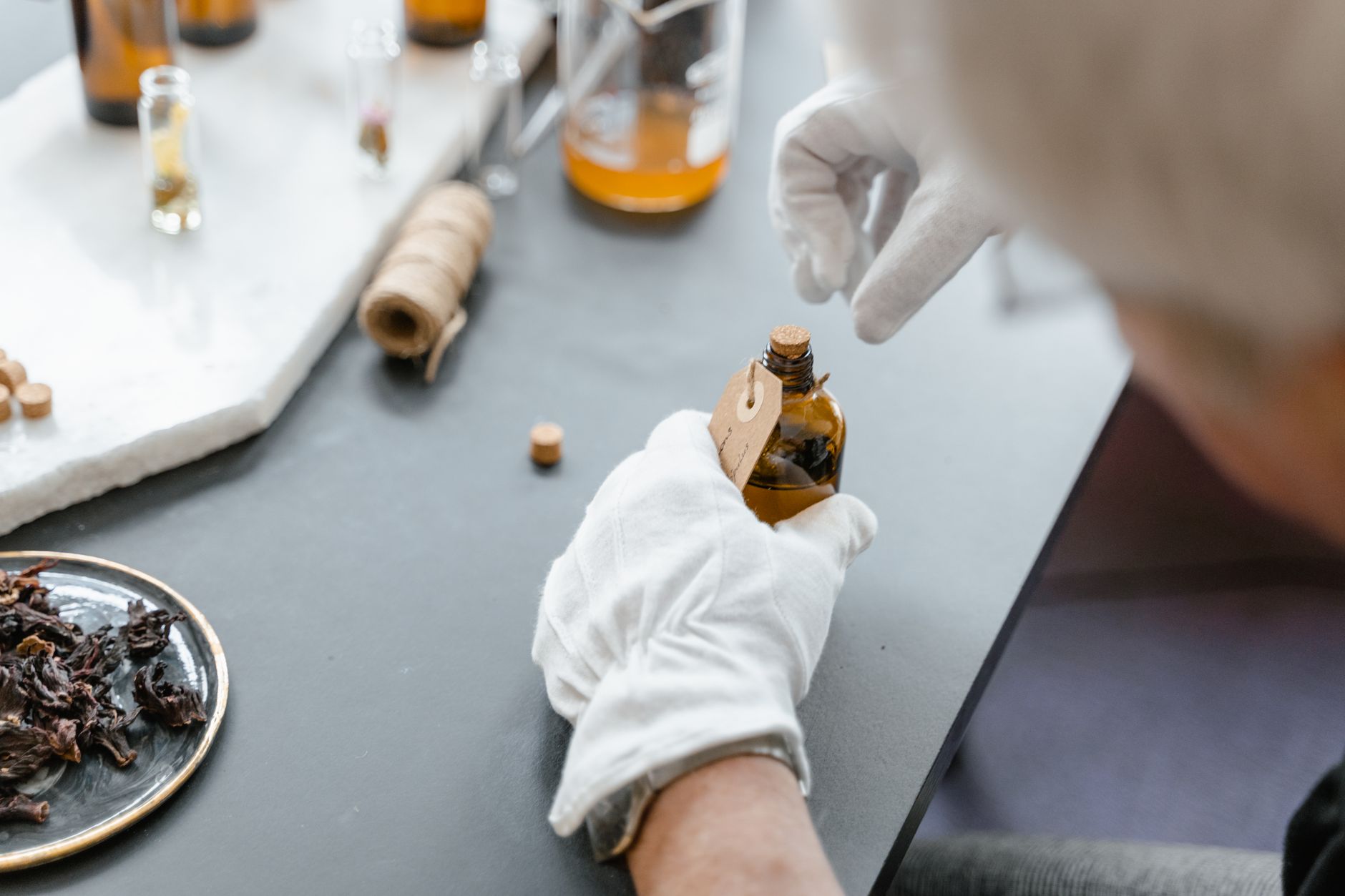
A product with 100 mg of silymarin per tablet cannot be built from ground fruit. At a 2 % content it would take 5 grams of powder — more than fits into a tablet. That is why extraction is used: the solvent dissolves the flavonolignans out and leaves oil, protein and starch behind.
How strongly the material was concentrated is described by the drug-extract ratio (DER). It states how much starting material goes into one unit of extract. The EU monograph of the EMA Committee on Herbal Medicinal Products (HMPC) of 5 June 2018 (EMA/HMPC/294187/2013) lists these preparations for milk thistle fruit:
| Preparation | Drug-extract ratio | Solvent |
|---|---|---|
| Dry extract | 20–70:1 | acetone |
| Dry extract | 30–40:1 | ethanol 96 % |
| Dry extract | 20–35:1 | ethyl acetate |
| Dry extract | 26–45:1 | ethyl acetate |
| Dry extract | 36–44:1 | ethyl acetate |
| Dry extract | 20–34:1 | methanol 90 % |
| Soft extract | 10–17:1 | ethanol 60 % |
A rough plausibility calculation follows from the DER. If 20 kg of fruit containing 1.5 to 3 % silymarin become 1 kg of extract, the content of that extract works out at 30 to 60 % at most. That is precisely the range the pharmacopoeia sets for the standardised extract: 30 to 65 % silymarin, with the actual content required to lie between 90 and 110 % of the declared value.
At higher ratios the calculation no longer holds — at 70:1 well over 100 % would be arithmetically possible, which shows that what limits the result there is not arithmetic but yield. A high DER therefore does not automatically mean a high silymarin content; to begin with, it only means that a lot of raw material was used.
The three numbers on the pack
With that, what is printed on a tin can be read. An example from our own range: the milk thistle seed extract 20:1 is declared with 80 % silymarin, which gives 100 mg of silymarin per tablet, plus 100 mg of inulin from chicory root. Calculated backwards: 100 mg of silymarin at an 80 % content requires 125 mg of extract, and 125 mg of extract at 20:1 comes from 2.5 g of fruit.

The most common mistake when comparing is to take the first number for the third. “500 mg milk thistle extract” says nothing about the silymarin content — that can be an extract with 30 % (150 mg silymarin) or one with 80 % (400 mg). Conversely, a small amount of extract is no disadvantage if the content is high. Only the silymarin figure is comparable.
A look at authorised medicines shows the range in practice. The EMA assessment report lists the composition of the products marketable in the EU:
| Country | Extract per unit | corresponds to silymarin |
|---|---|---|
| Croatia | 150 mg (DER 26–45:1) | 100 mg |
| Germany | 82–111 mg (DER 35–40:1) | 60 mg (HPLC) |
| Belgium | 173.0–186.7 mg (DER 36–44:1) | 140 mg or 108.2 mg |
The last line is not a typo. It leads to the actual stumbling block.
Two measuring methods, two numbers for the same extract
For the same Belgian extract, two silymarin values appear in the documents: 140 mg by the DNPH method (a photometric procedure) and 108.2 mg by HPLC. The same capsule, the same contents, two numbers — the difference lies solely in the method.
Photometry measures via a colour reaction and in doing so also captures related compounds that are not flavonolignans. High-performance liquid chromatography (HPLC) first separates the constituents and counts only the six defined substances. It therefore yields the lower, more specific value.
| Extract | photometric | by HPLC | Difference |
|---|---|---|---|
| DER 35–40:1, acetone | 70 mg | 60 mg | around 17 % |
| Acetone 95 % | 140 mg | 108.2 mg | around 29 % |
This is why a pack stating “140 mg silymarin” does not necessarily contain more than one stating “108 mg”. If the method is not given — and with food supplements it almost never is — two numbers of different origin are not directly comparable. It also explains why declared contents above the pharmacopoeia range of 30 to 65 % occur: a photometrically determined value lies roughly a fifth to a third above the one determined by HPLC. For food supplements the pharmacopoeia monograph is not binding anyway.
Why “calculated as silibinin” is added
Because silymarin is a mixture, the analysis needs a reference substance. Both pharmacopoeia monographs name silibinin for this: the fruit must contain at least 1.5 % silymarin, calculated as silibinin (Ph. Eur. 01/2014:1860), and the same reference applies to the extract. The addition is therefore not a marketing phrase but the statement of which standard was measured against.
What the body takes up from it
Silymarin is practically insoluble in water, and that shapes its behaviour in the body. The EMA assessment report summarises the data as follows: silibinin is only partly absorbed from the gastrointestinal tract (23–47 %), depending among other things on accompanying substances in the extract. Peak blood levels are reached after about two hours, around three quarters of which are present in bound form; the half-life is approximately six hours. 20 to 40 % of the dose is excreted via the bile, only about 5 % via the urine.
Two details from this are of interest when choosing a product. First: silicristin and silidianin were very low to undetectable in blood and bile — the fraction that makes up 20 to 45 % of the extract barely shows up in the body. Second: in an investigation in nine people, a silibinin–phosphatidylcholine complex reached a relative availability in the bile of 420 % compared with ordinary silymarin (Schandalik et al., 1992). Such complexes are the reason why some products work with considerably smaller milligram figures — here too, the bare number does not carry the comparison on its own.
How timing and meals affect absorption belongs to the subject of taking it, not to extract quality; which part of the plant is actually processed, and why the label says “seeds” instead of “fruit”, is covered in Milk thistle: plant, origin and use.
What a food supplement may say about it
For milk thistle and silymarin there is no health claim authorised under the Health Claims Regulation (EC) No 1924/2006; the applications concerning plant substances have been on hold for years. A food supplement therefore describes what it contains — extract, ratio, silymarin content — and says nothing about what it is supposed to do. Food supplements are not a substitute for a balanced and varied diet and a healthy lifestyle.
In practice this means: with these products the declaration is the only solid distinguishing feature. Anyone who reads the three numbers knows more about a pack than any presentation reveals. Which products from the range belong here is shown in the liver category.
Two notes from the EU monograph belong here regardless of content: hypersensitivity to Asteraceae is a contraindication, and for pregnancy, breastfeeding and for those under 18 there is insufficient data. Silibinin inhibits the enzymes CYP3A4, CYP2C9 and UGT1A1 in the laboratory; the clinical significance of these interactions is, according to the EMA, not well defined.
Frequently asked questions
Is an 80:1 extract better than a 20:1 extract? Not necessarily, and the two numbers are frequently confused. The drug-extract ratio says how much raw material was used; the silymarin content in per cent says what ended up in the extract. “20:1 with 80 % silymarin” is a content statement, not a ratio of 80:1. In the end, only the milligrams of silymarin per daily portion are comparable.
Why do two packs with the same extract state different amounts? Because two methods are permitted. Photometry captures more than HPLC does; in the EMA assessment report 140 mg photometric corresponds to 108.2 mg by HPLC — around 29 % difference for identical contents.
Does milk thistle tea contain silymarin as well? In the fruit yes, in the infusion only to a small extent: silymarin is insoluble in water, and hot water barely dissolves it out. The EU monograph lists tea preparations from 3 to 5 g of fruit per 100 ml as a preparation of its own — in a different order of magnitude from a dry extract, not a replacement for one.
How do I recognise a usable declaration? By all three figures being there: amount of extract, drug-extract ratio and silymarin content in milligrams per daily portion. If the third is missing, the product cannot be compared with any other.
Sources: European Medicines Agency, assessment report on Silybum marianum (L.) Gaertn., fructus, EMA/HMPC/294188/2013 (5 June 2018) — with details on Ph. Eur. 01/2014:1860 and Ph. Eur. 01/2019:2071, on the composition of authorised products in the EU and on pharmacokinetics (Saller et al., 2001; Schandalik et al., 1992) · EU monograph EMA/HMPC/294187/2013 (5 June 2018) · Regulation (EC) No 1924/2006.