Taking vitamin B12: timing, stomach acid, metformin
Futures Nutrition Editorial Team · 12 August 2026

12 August 2026
The short answer: with vitamin B12 the time of day does not decide anything, the portioning does. Whether the tablet is swallowed at seven in the morning or at nine in the evening is the most frequently asked and the least important question. What matters is how many portions a daily amount is split into — and whether there is an absorption route open at all.
That sounds unspectacular, but it has practical consequences. Anyone who gets B12 from food takes more out of two small portions than out of one large one. Anyone taking a high-dose tablet can forget about clocks and meals. And anyone taking metformin or an acid blocker gains precisely nothing from a time gap — unlike with other nutrients.
Why the time of day hardly matters
Vitamin B12 is water-soluble. It needs no dietary fat as a vehicle, as vitamin D or K2 do, and there is no established daily rhythm the intake would have to follow. Neither the German Nutrition Society (DGE) nor the European Food Safety Authority (EFSA) names a time of day for B12 — both name daily amounts. The DGE estimated value for adults is 4.0 µg per day.
The common justification that B12 belongs in the morning because it "wakes you up" is not an authorised claim, and it is not otherwise well supported. Anyone who remembers it better in the evening takes it in the evening. The best moment is the one you can keep up for a year — with a vitamin whose effect hangs on stores built over months, regularity is the only variable that measurably changes anything.
Portioning beats the clock
The reason lies in the absorption route. Active transport via intrinsic factor is saturated after roughly 1.5 to 2 µg per meal; only after several hours is it available again. Anything above that merely seeps passively through the intestinal wall, and it does so on the order of one percent of the amount. This is set out in detail in Vitamin B12 absorption.
Three workable approaches follow from this. They do not differ in the time of day, but in the route they use:
| Approach | What does the work | What it suits |
|---|---|---|
| 2–3 small portions across the day (2–5 µg each) | mostly the active route | diets with fortified foods, low-dose products |
| once daily 25–50 µg | active route plus a growing passive share | everyday compromise without reminder pressure |
| once daily 250–1,000 µg | almost exclusively the passive route | impaired absorption, purely plant-based diet, documented gap |
The German consumer advice centre (Verbraucherzentrale) describes exactly this choice: either several low doses a day or one higher amount once a day, which is then "not absorbed by the body actively in its entirety" but partly via passive diffusion.
With or without a meal?
Here the answer depends on where the B12 comes from.
From food it is bound to protein, and stomach acid has to release that bond first. For meat, fish, egg and cheese the rule is therefore: the meal is the absorption route, not an obstacle to it.
From a tablet it is already present in crystalline, free form. That first step drops out, and with it the question of stomach acid. For a high-dose product it makes practically no difference whether it is taken fasting or with breakfast — there is no rule here that deserves the name. Anyone with a sensitive stomach takes it with food; anyone who would otherwise forget puts it next to the coffee cup.
A brake of the kind described for iron with coffee and black tea does not exist for B12. And lozenges have no proven advantage over swallowed tablets: a systematic review found no meaningful differences in blood values between oral, sublingual and intramuscular administration.
Vitamin C, iron, calcium: what does B12 need a gap from?

The most persistent gap rule concerns vitamin C. It goes back to a 1974 paper by Herbert and Jacob, according to which ascorbic acid destroyed the B12 in a meal. Two independent laboratories repeated the experiments in 1976 with the same meals and standardised methods — and found no harmful effect of the added ascorbic acid; the B12 contents originally measured had been several times too low. That cobalamins can be chemically altered in aqueous solution by high amounts of vitamin C is undisputed. That a glass of orange juice reduces absorption from a tablet has not been shown in any human study.
With iron, zinc and calcium there is known competition for shared transport routes — which is why gaps are a topic there. For B12 that does not apply: it uses a receptor of its own that no other mineral occupies.
With calcium it is even the other way round, at least in one special case. The receptor at the end of the small intestine works in a calcium-dependent way — and that is exactly where metformin intervenes. In a study of people with type 2 diabetes, oral calcium raised the B12 transport values that metformin had pushed down (Bauman et al., Diabetes Care 2000). A pilot study using ¹³C-labelled cyanocobalamin in seven healthy adults reached the same picture in 2024: bioavailability fell under metformin from 42.6 to 30.8 % and rose to 46.4 % when calcium was given at the same time. Seven participants are few, and the authors explicitly call this an approach that still has to be tested in actual metformin users. Products combining calcium and vitamin D3 exist independently of this for other reasons — no treatment recommendation follows from the above, and decisions about medicines belong to a medical practice, not to a shelf.
Metformin and acid blockers: a gap does not help
This is the point where habits from iron and zinc advice lead astray. Leaving two hours between metformin and B12 does nothing wrong — it simply achieves nothing. Metformin and the tablet do not meet in the stomach; the point of attack is the receptor in the ileum. A time gap does not move the collision, which takes place at a different station anyway.
What does help is the amount: the passive route bypasses the receptor entirely and works even when the active route is blocked. The British medicines regulator MHRA classified lowered B12 levels as a common side effect of metformin in 2022 and recommends monitoring in patients at risk — whether and when measurements are taken belongs in medical hands.
For acid blockers the same logic applies with the sign reversed: they lower stomach acid, and stomach acid is only needed to release B12 from dietary protein. The crystalline B12 in a tablet is unaffected. A gap to the tablet changes nothing; the form of the B12 is the answer, not the schedule.
Daily, or is less often enough?
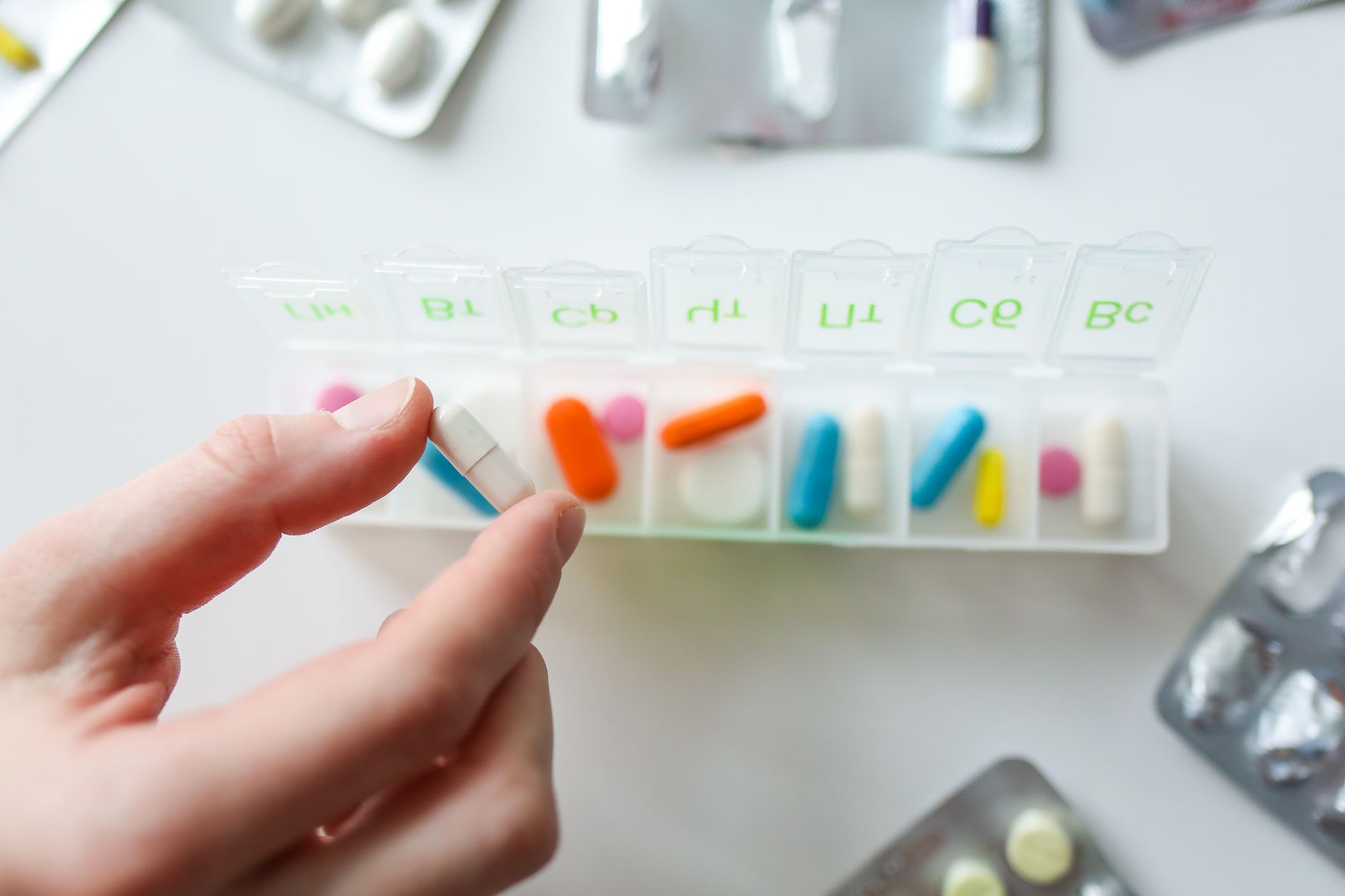
The body stores 2 to 5 mg of B12, mostly in the liver — a forgotten tablet does not show up against that. Even so, the data speak for a daily rhythm, simply because the studies on which high oral doses rest dosed daily.
- A dose-finding study in 120 older people with mild deficiency tested 2.5, 100, 250, 500 and 1,000 µg of cyanocobalamin daily over 16 weeks. For 80 to 90 % of the maximum achievable reduction in methylmalonic acid, 647 to 1,032 µg per day were needed by calculation (Eussen et al., Archives of Internal Medicine 2005).
- In pronounced deficiency, an older study showed that 2 mg orally per day was not inferior to a series of injections (Kuzminski et al., Blood 1998).
For weekly intervals, by contrast, there is barely any robust comparative data. In practice that means: take it daily, and do not replace a forgotten tablet with a double amount the next day — the active route gains nothing from it, and the passive one is counting in percentages anyway.

Our tablet sits at the upper end of that scale with 1,000 µg of methylcobalamin and is intended for one intake per day: Vitamin B12 1000 µg, 180 tablets. All strengths and forms are listed in the vitamin B12 category.
The other direction belongs in the picture too: the German Federal Institute for Risk Assessment (BfR) proposes adding "no more than 25 micrograms (μg) of vitamin B12 per daily dose" to food supplements, pointing to indications from more recent epidemiological studies that long-term intake of high amounts could be associated with undesirable effects. That is a proposal, not a legal limit — there is no statutory maximum for B12 in Germany, and many products on the market lie well above it. Anyone dosing high over the long term should know this and know the reason for it.
How long does it take before anything changes?
Longer than most people expect. The dose-finding study measured over 16 weeks, and even there methylmalonic acid was the sluggish part. The transport marker holo-transcobalamin responds noticeably faster; serum B12 says the least while intake is ongoing.
The reverse holds for stopping: because the liver holds a year's supply, nothing disappears after a few missed weeks. Anyone taking B12 because their diet contains no animal foods on a lasting basis, however, takes it on a lasting basis — the DGE considers a supplement "necessary" for this group.
Among the claims authorised for vitamin B12 are these: Vitamin B12 contributes to normal energy-yielding metabolism. Vitamin B12 contributes to normal functioning of the nervous system. Vitamin B12 contributes to normal red blood cell formation. Vitamin B12 contributes to the reduction of tiredness and fatigue. (Regulation (EU) No 432/2012). Food supplements are not a substitute for a balanced and varied diet and a healthy lifestyle.
Frequently asked questions
Should I take B12 on an empty stomach? With a high-dose tablet it makes no difference, because the passive route needs neither stomach acid nor intrinsic factor. With low-dose products and fortified foods, the meal is helpful rather than a hindrance. There is no fasting rule for B12.
May I take B12 together with vitamin C or orange juice? Yes. The idea that vitamin C destroys B12 comes from a 1974 paper that two independent laboratories were unable to confirm in 1976. Impaired absorption in humans has not been demonstrated.
I take metformin — should I leave two hours in between? The gap changes nothing, because metformin does not disturb the tablet in the stomach but absorption at the receptor in the ileum. The amount matters more and, according to the MHRA, so does regular monitoring in patients at risk. That decision is made by the treating practice.
Can I take one high dose per week instead of daily? The studies on which high oral doses rest dosed daily; for weekly intervals there is barely any comparable data. Since the body stores 2 to 5 mg, a forgotten day is uncritical — but as a planned schedule, daily intake is the better documented option.