Vitamin K2 in food: natto, cheese and the rest
Futures Nutrition Editorial Team · 11 August 2026
The short version: vitamin K2 is made by bacteria, which is why it sits where something has been fermented — first and foremost in Japanese natto, at around 1,100 µg per 100 g. After that comes a wide gap: the best cheese reaches 80 µg per 100 g, meat and eggs land in the single digits to the low double digits, and green vegetables supply practically no K2 at all but vitamin K1 instead. In Central Europe the K2 share of the diet therefore comes almost entirely from dairy and meat — measured in Germany, that amounts to about 35 µg per day.
This article lays out the numbers behind those statements: measured values rather than rounded lists, and broken down by K2 form. That is the point where the usual overviews go quiet — the K2 in cheese is a different molecule from the K2 in a capsule.
Why K2 sits in completely different foods than K1
Vitamin K is a collective name for two groups of substances. Phylloquinone (K1) is made by plants for their photosynthesis and accordingly sits in leaf green. Menaquinones (K2) are made by bacteria; they sit where bacteria have been at work or where an animal has stored them. Menaquinones are numbered by the length of their side chain, from MK-4 to roughly MK-13 — what exactly that number means is set out in Vitamin K2 forms: MK-4, MK-7 and the production route.
MK-4 plays a special role: it arises not only microbially but also in animal metabolism. Poultry feed contains menadione, which is converted to MK-4 in certain tissues — EFSA names precisely that as the reason why chicken meat contains comparatively large amounts of MK-4 (EFSA Journal 2017;15(5):4780).
EFSA summarises the orders of magnitude in its derivation of the reference values as follows: liver 0.3 to 369 µg MK-4 per 100 g, meat and meat products 0.1 to 42 µg, poultry 5.8 to 60 µg, cheese and dairy 0.1 to 94 µg (MK-4 to MK-10, above all MK-9), egg and egg yolk 10 to 30 µg MK-4, natto around 850 to 1,000 µg MK-7. For comparison, the K1 side of the same source: dark green leafy vegetables about 60 to 365 µg per 100 g, brassicas 80 to 585 µg, seed oils and spreadable fats 25 to 60 µg.
Natto: the outlier
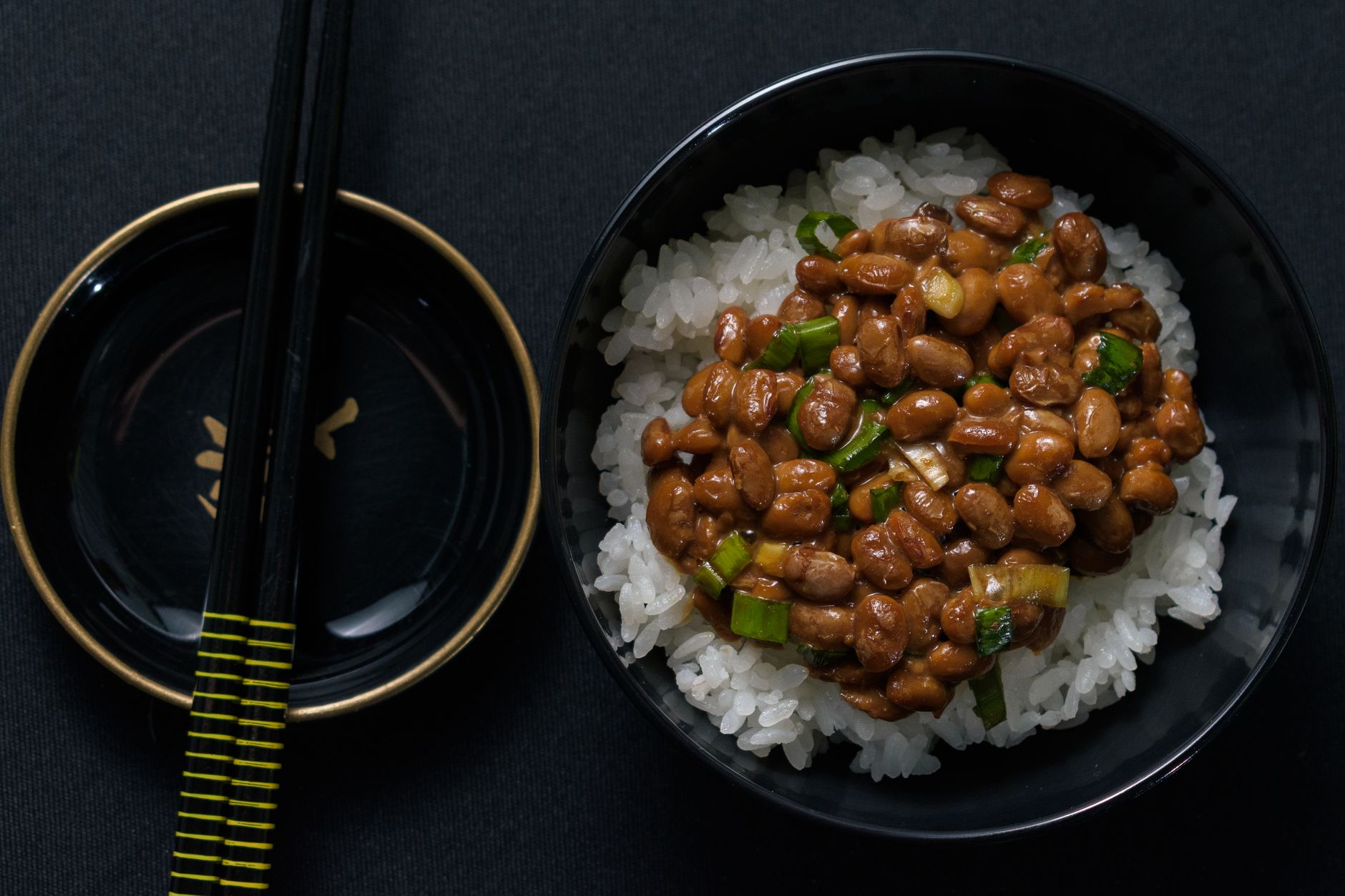
Natto is soybeans fermented with Bacillus subtilis. This bacterium produces MK-7 in quantities no other food reaches. In the measurement series by Vermeer and colleagues (Nutrients 2018;10(4):446), natto contained 9,965 ng/g MK-7 — converted, 996 µg per 100 g — with a total K2 content of 1,098 µg per 100 g. A standard portion of 40 g therefore puts around 439 µg K2 on the plate, predominantly as MK-7.
For most people in Europe this still matters little in practice. Natto has a pungent smell, pulls threads and is not part of the everyday range in Germany. Anyone wanting to try it will find it frozen in Asian grocery shops — and anyone who dislikes it is not missing an alternative in the same league: there is simply no second food of this magnitude.
Cheese: the actual K2 source in Central Europe
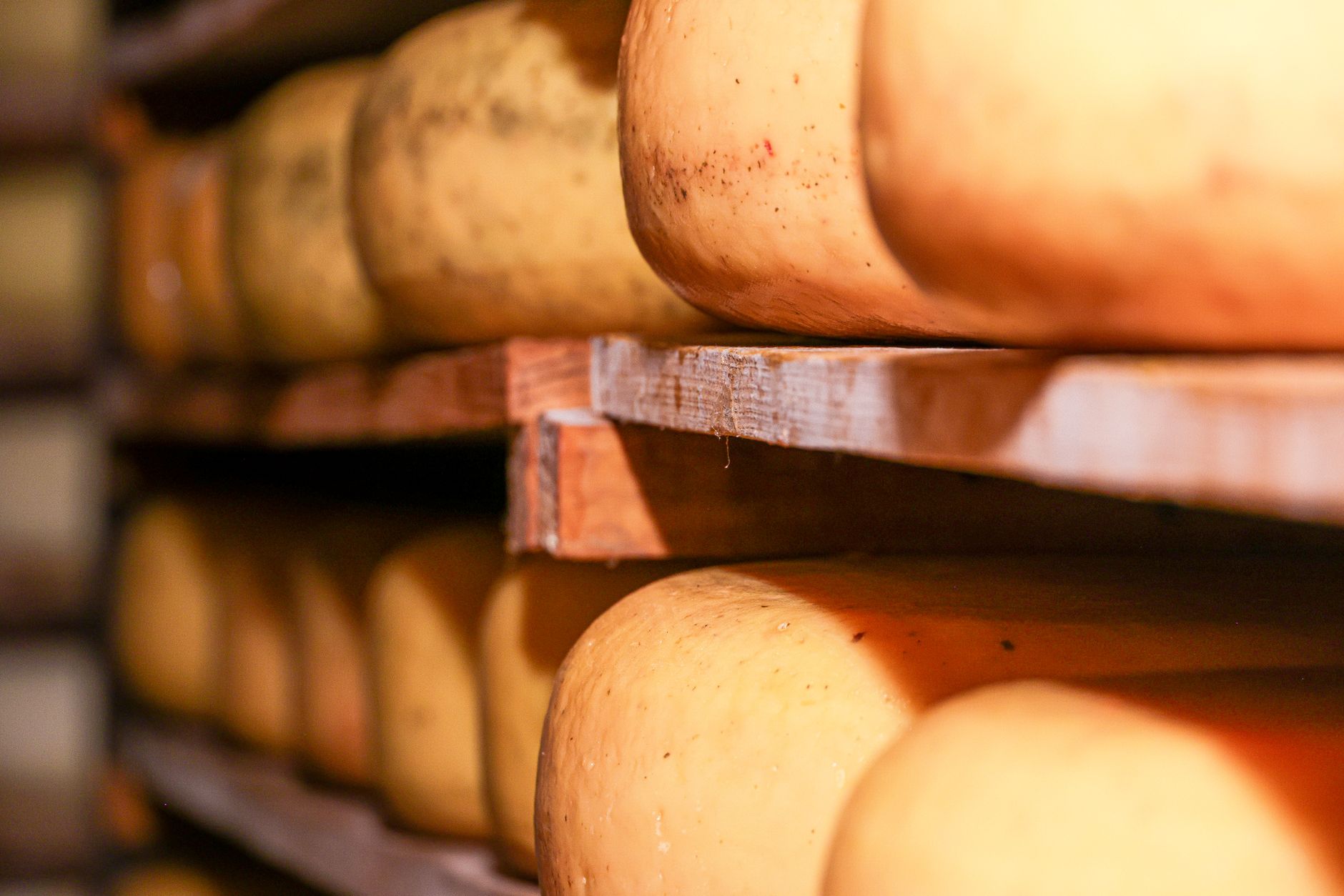
In cheese, different bacteria are at work than in natto, and they supply different forms: lactic acid bacteria mainly produce MK-8, propionibacteria MK-9. The K2 in cheese therefore consists predominantly of MK-9 and MK-4, while MK-7 occurs only in traces. The following values come from the same measurement series (Vermeer et al., Nutrients 2018), given in ng/g in the original and converted here to µg per 100 g.
| Cheese | Total vitamin K2 | of which MK-9 | of which MK-4 | of which MK-7 |
|---|---|---|---|---|
| Munster | 80.1 µg | 19.4 µg | 10.2 µg | 8.4 µg |
| Gouda 50 % fat, 26 weeks | 72.9 µg | 40.3 µg | 20.8 µg | 1.6 µg |
| Camembert | 68.1 µg | 39.5 µg | 8.0 µg | 3.2 µg |
| Gouda 50 % fat, 13 weeks | 65.6 µg | 39.6 µg | 14.8 µg | 1.6 µg |
| Edam 40 % fat | 64.7 µg | 45.9 µg | 11.3 µg | 0 µg |
| Gamalost (Norwegian) | 54.2 µg | 44.0 µg | 1.0 µg | 1.0 µg |
| Stilton | 49.4 µg | 29.8 µg | 10.0 µg | 1.4 µg |
| Maasdam | 49.0 µg | 26.6 µg | 11.5 µg | 1.5 µg |
| Emmental | 43.3 µg | 0 µg | 9.0 µg | 0 µg |
| Roquefort | 38.1 µg | 17.6 µg | 13.1 µg | 1.2 µg |
| Raclette | 32.3 µg | 20.9 µg | 4.8 µg | 1.1 µg |
| Cheddar | 23.5 µg | 12.5 µg | 5.1 µg | 1.9 µg |
| Gorgonzola | 15.3 µg | 0.3 µg | 11.1 µg | 3.1 µg |
| Quark, low fat | 14.0 µg | 9.7 µg | 1.6 µg | 0.5 µg |
| Brie | 12.5 µg | 0 µg | 12.5 µg | 0 µg |
| Feta | 11.7 µg | 7.7 µg | 0.1 µg | 1.2 µg |
| Gruyère | 6.5 µg | 0 µg | 5.2 µg | 0 µg |
| Mozzarella | 6.2 µg | 0.8 µg | 5.3 µg | 0 µg |
| Parmesan (Grana Padano) | 0.3 µg | 0 µg | 0 µg | 0.1 µg |
Three things stand out in this table.
The range is enormous. Between Munster and Parmesan lies a factor of 250 — both cheese, both matured. So it is not "cheese" that supplies K2 but a particular culture. Emmental is a special case: its K2 consists almost entirely of MK-10 (32.2 µg per 100 g), which no other variety in the series contained in that quantity.
Ripening and fat content shift the number. For the same Gouda, the content rose from 47.3 µg after four weeks to 65.6 µg after 13 and 72.9 µg after 26 weeks. And among three Dutch semi-hard cheeses of the same type, all measured after 13 weeks, the values fell with the fat content: 65.6 µg at 50 % fat, 47.4 µg at 30 % and 27.0 µg at 20 %. Vitamin K is fat-soluble; where fat is removed, it goes along.
MK-7 is almost absent from cheese. Precisely the form sold in supplements sits below 2 µg per 100 g in most varieties. Anyone who wants to "take in MK-7" through food cannot get around natto. That says nothing about the total amount of vitamin K2 — they are simply two different questions that often get stirred into one.
Meat, offal, eggs and fish
Here MK-4 dominates, and the amounts are markedly smaller than in cheese. These values, too, come from the measurement series by Vermeer et al. (2018), converted to µg per 100 g.
| Food | Total vitamin K2 | Main form |
|---|---|---|
| Eel | 63.1 µg | MK-4 |
| Beef liver | 11.2 µg | MK-7, MK-8, MK-10 |
| Chicken meat | 10.1 µg | MK-4 |
| Minced meat | 7.6 µg | MK-4 |
| Plaice | 5.3 µg | MK-8 |
| Beef | 1.9 µg | MK-4 |
| Pork liver | 1.8 µg | MK-6 |
| Pork | 1.4 µg | MK-4 |
| Venison (saddle) | 0.9 µg | MK-4 |
| Salmon | 0.6 µg | MK-4 |
| Herring | 0.1 µg | MK-4 |
Eel is the second outlier on the list, and that has to do with the fish's high fat content. For the remaining fish the contribution is negligible: a 150 g portion of salmon supplies less than one microgram of K2. Eggs are not included in this series; EFSA gives 10 to 30 µg MK-4 per 100 g for egg and egg yolk, which puts the yolk of a medium egg at roughly 3 to 5 µg.
Not every fermentation supplies K2
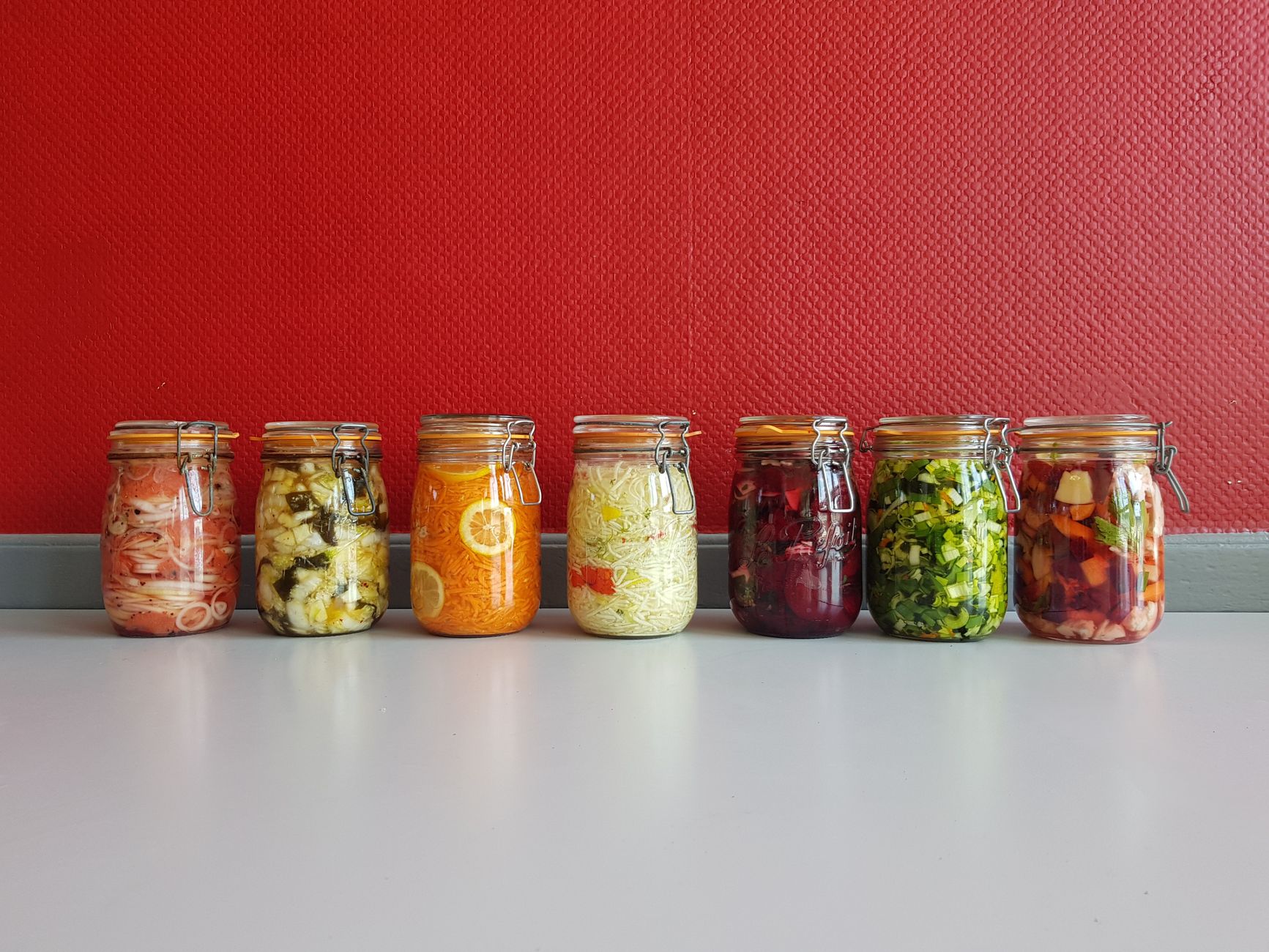
"Fermented" is no guarantee of vitamin K2 — what matters is which bacterium did the fermenting. Sauerkraut came in at 5.5 µg K2 per 100 g in the measurement series, but at 22.4 µg K1 per 100 g: the white cabbage brings its phylloquinone along, and lactic acid fermentation adds only a little K2. The same applies to kimchi, kombucha or sourdough bread: the cultures involved are not the K2 producers from the natto process.
The idea that one's own gut could cover the requirement does not carry far either. Gut bacteria do form menaquinones, but they do so predominantly in the large intestine, where fat absorption has long since finished. EFSA points expressly to the fact that bacterial synthesis in the gut is not sufficient to maintain serum concentrations.
What adds up over an ordinary day
The individual values are one thing, everyday eating another. A sample calculation with realistic portions, using the values above:
| Portion | Vitamin K2 |
|---|---|
| 30 g Gouda (matured 13 weeks), two slices | 19.7 µg |
| 150 g chicken breast | 15.2 µg |
| 150 g sauerkraut | 8.3 µg |
| Yolk of one egg | approx. 4 µg |
| Total | around 47 µg |
| plus 40 g natto | + 439 µg |
Without natto, then, a decidedly cheese-heavy day lands at just under 50 µg K2 — and that is already above what is actually measured in Germany. In the EPIC-Heidelberg study with 25,540 participants, median K2 intake was 34.7 µg per day and K1 intake 93.6 µg. One pack of natto, by contrast, exceeds both several times over.
For vitamin K overall, supply in Germany is unremarkable: from the available consumption data, the BfR sees no indication of insufficient intake. There is no separate reference value for K2 at all — the figures published by nutrition societies apply to vitamin K as a whole.
Food and supplement are not the same question
If you convert a commercially available supplement into food, the answer depends on the question asked. The calculation uses the values above: natto 1,098 µg total K2 and 996 µg MK-7 per 100 g, Gouda (13 weeks) 65.6 µg total K2 and 1.6 µg MK-7 per 100 g.
| Question | Answer |
|---|---|
| How much food for 100 µg total vitamin K2? | 9 g natto or around 150 g Gouda |
| How much food for 200 µg total vitamin K2? | 18 g natto or around 305 g Gouda |
| How much food for 100 µg MK-7? | 10 g natto — or, on paper, over 6 kg of Gouda |
| How much food for 200 µg MK-7? | 20 g natto — or, on paper, over 12 kg of Gouda |
The two lower rows are the reason supplements work with MK-7 from natto fermentation and not with cheese extract. They are at the same time an argument against the widespread equation "200 µg on the tin = a multiple of the diet": in terms of total K2 that holds roughly true, in terms of MK-7 not at all, because the diet in this part of the world contains almost no MK-7.
Both of these amounts appear in our own range, mostly combined with vitamin D3: 200 µg MK-7 per tablet in the Vitamin D3 4,000 IU + K2 200 µg MK-7, 100 µg MK-7 per capsule in the liposomal vitamin D3 5,000 IU + K2. According to the table, then, the capsule corresponds to just under ten grams of natto and the tablet to a good 18 grams — amounts that in cheese terms come to 150 and 305 grams respectively. How much of that arrives per day on paper depends on the intake rhythm, though: depot products taken only every ten or twenty days deliver considerably less on average than a 200 µg product taken daily.
Pure K2 supplements are in the vitamin K2 category, the combinations in vitamin D3 + K2. Why the two vitamins are so often offered together is put in context by Vitamin K2 and calcium.

What may be said about vitamin K
Two claims are authorised in the EU (Regulation (EU) No 432/2012); they apply to the nutrient vitamin K, regardless of whether it comes from cheese, from natto or from a capsule:
- Vitamin K contributes to the maintenance of normal bones.
- Vitamin K contributes to normal blood clotting.
Food supplements are not a substitute for a balanced and varied diet and a healthy lifestyle.
Anyone taking coumarin-type anticoagulants should have vitamin-K-containing food supplements cleared with a doctor first — the BfR recommends this explicitly. With food, what counts is less the amount than the consistency: a diet that does not change abruptly makes it easier to settle the dose. Why this combination is about vitamin K as a whole and not about one particular form is explained in Vitamin K1 vs K2: difference in origin and uptake.
Common questions
Which food has the most vitamin K2? Natto, by a clear margin: around 1,100 µg per 100 g, of which about 1,000 µg is MK-7. Second place goes to matured cheeses at 40 to 80 µg per 100 g, and after that it quickly turns single-digit. There is no alternative in natto's league.
Can I cover my K2 needs through cheese? The question cannot be answered cleanly, because no separate requirement has been set for vitamin K2 — the reference values apply to vitamin K as a whole. What can be said: two slices of Gouda supply around 20 µg K2 and thus more than half of the median daily K2 intake measured in Germany.
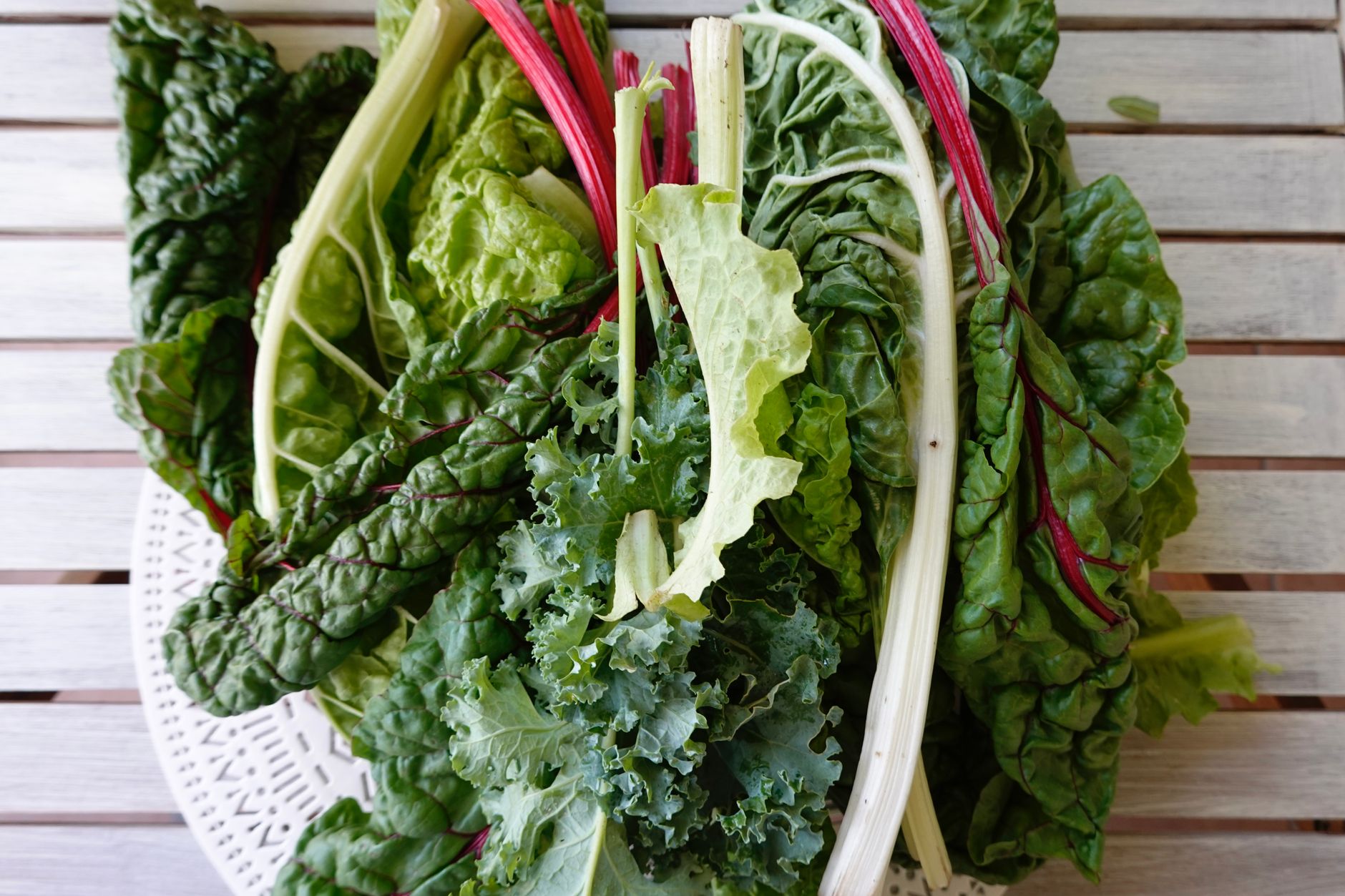
Do green vegetables contain vitamin K2? No, practically none. Kale, spinach and broccoli supply K1 — and a great deal of it, 60 to 585 µg per 100 g according to EFSA data. So anyone concerned about their vitamin K supply overall is well served by green vegetables; anyone specifically looking for menaquinones will not find them there.
Is vitamin K2 from food better usable than from a capsule? That cannot be said in those terms. Uptake depends on the form and on the food matrix: MK-7, with its long side chain, remains measurable in the blood considerably longer after uptake than K1 from vegetables. EFSA, however, expressly considers the data on uptake and fate of the menaquinones too thin to derive separate reference values from — firm statements about the superiority of one source or the other cannot be drawn from it.