Ashwagandha: how long to take it, and when to pause
Futures Nutrition Editorial Team · 11 August 2026
11 August 2026
The short answer: there is no officially fixed intake duration for ashwagandha — and the rule circulating online, "eight weeks on, two weeks off", comes from no assessment at all, but from how long studies happened to run. Anyone reading it takes it for a requirement. It is a rule of thumb someone derived from study protocols in which participants were simply observed for as long as the trial design called for.
That does not answer the question, but at least it frames it correctly: not "how long am I allowed to?", but "what is actually known about longer intake?" — and the answer to that is short. This is precisely what Germany's Federal Institute for Risk Assessment (BfR) writes in its statement 039/2024: the data are not sufficient for a reliable assessment, "among other reasons because the possible consequences of long-term intake have so far been investigated only inadequately".
Where the week counts come from

The numbers that circulate in forums and blogs as a course-of-treatment scheme can be traced back to their source: they are the duration of clinical studies. In the review by Cheah and colleagues (PLOS ONE, 2021), which summarises five randomised trials with 400 participants in total, the investigations ran for between six and twelve weeks; the amounts used ranged from 120 to 600 mg of extract per day.
Six to twelve weeks is therefore the period over which anything was observed under controlled conditions at all. As this gets passed along, it first becomes "a course lasts eight weeks" and then "after eight weeks a break has to follow". Neither appears in any study. A study ends because the protocol ends — not because a limit would be reached on that day.
| What is often claimed | What actually lies behind it |
|---|---|
| "A course lasts 8 weeks" | Usual duration of clinical studies (6–12 weeks) |
| "After the course, 2–4 weeks off" | No source; carried over from course-based thinking in other fields |
| "Longer than 3 months is harmless" | For longer periods, hardly any data exist (BfR) |
| "The body gets used to it, hence the break" | Not demonstrated for ashwagandha |
The BfR names the same problem from the other side: in the studies on possible positive effects, "the preparations used, the dosages, the dosage forms, but also the groups of people examined and the duration of intake" all differed. If even the duration varies from study to study, no common recommendation can be calculated out of that pile. That two preparations with the same milligram figure need not contain the same thing anyway is the second open construction site.
What authorities say about duration — and what they don't
For a traditional herbal medicinal product, the duration of use is stated in the package leaflet, often with the addition that medical advice should be sought after two or four weeks. That figure comes from the monograph of the responsible committee at the European Medicines Agency (EMA).
For ashwagandha this monograph does not exist. The Committee on Herbal Medicinal Products (HMPC) worked on the topic and on 9 July 2013 published, instead of a monograph, a public statement (EMA/HMPC/681519/2012): a monograph on Withania somnifera (L.) Dunal, radix could not be drawn up because sufficient evidence could not be found. That is why no official duration of use exists for ashwagandha — not because unlimited intake would be fine, but because the basis from which such a figure would be derived is missing.
The BfR is equally clear in the same direction. A "guidance value for a health-wise safe intake could not so far be derived on the basis of the available data" — so there is not even a daily amount against which a duration could be measured. On top of that, the available human studies involved "no systematic recording of possible adverse effects". What was examined was mainly the possible benefit; what happens with longer intake was not the research question.
National rules, too, address the amount rather than the time: Poland limits food supplements to a maximum of 3 g of root powder and a maximum of 10 mg of withanolides per daily portion, and Denmark has banned ashwagandha in food supplements since April 2023. A provision naming a maximum intake duration exists in none of these countries — nor in Germany, where the manufacturer is liable for safety under Article 14 of Regulation (EC) No 178/2002.
The course-with-a-break is an idea from tradition
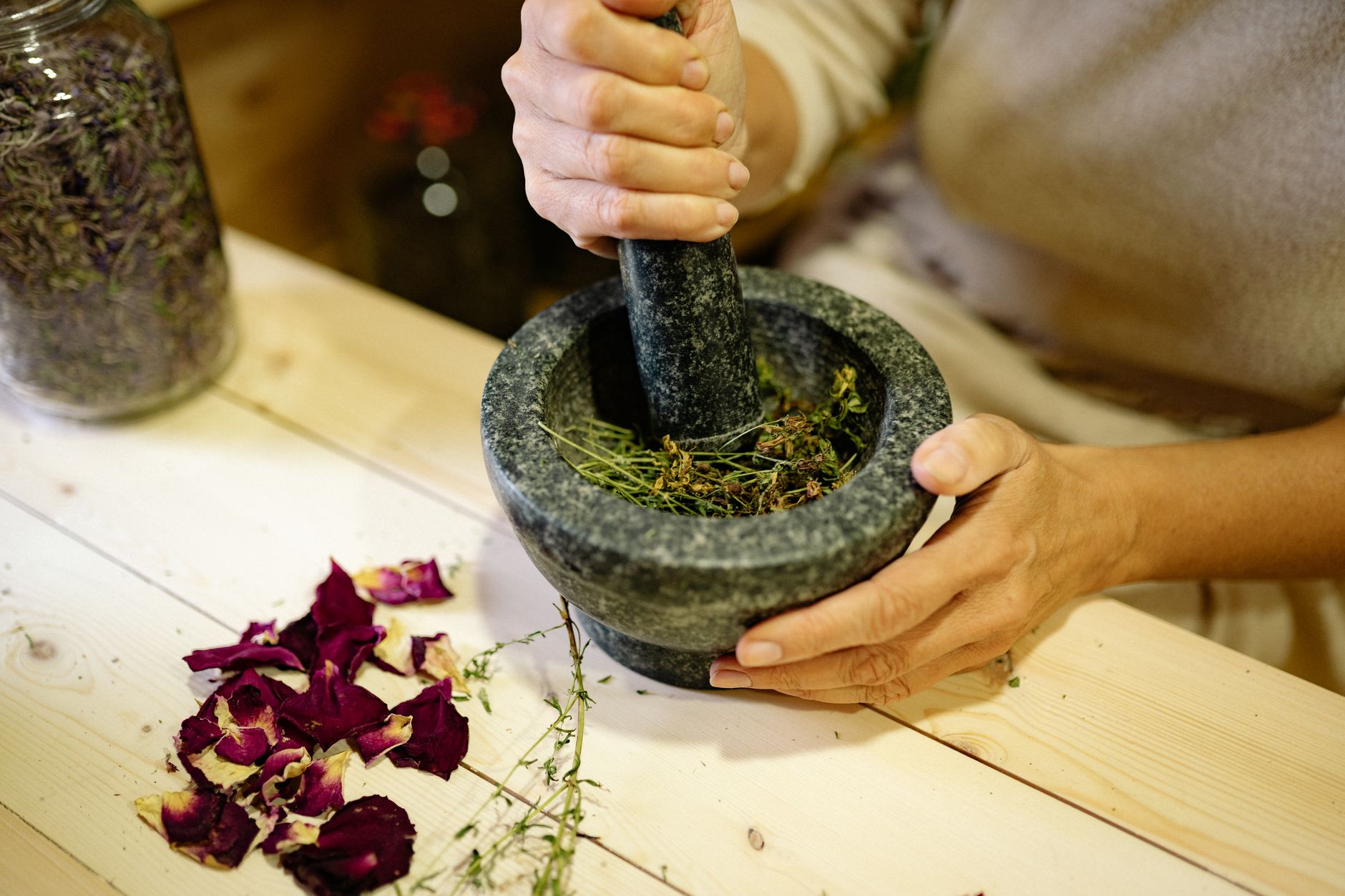
The notion of taking a plant preparation in cycles is older than the studies. Ashwagandha is, as the BfR writes, "traditionally used in Ayurvedic medicine", and there the time-limited application followed by a break is a common pattern — the root is taken in preparations with milk, ghee or honey over a delimited period, often at the turn of the seasons.
That is an understandable practice with a long history. It is simply not a safety assessment, and it says nothing about how a modern extract standardised to withanolides behaves over months. The traditional preparation is a root decoction or powder, today's product a concentrate with an extract ratio of roughly 8:1 to 12:1. How the Ayurvedic root differs from the root of the Chinese tradition is set out in Ashwagandha and ginseng compared.
What is on the pack is the binding statement
As long as there is no official requirement, the manufacturer's recommended intake applies — it is part of the labelling and thus the only binding statement in play. Our ashwagandha extract provides for one tablet daily with a meal; the tablet delivers root extract with 10 % withanolides.

There is a further misunderstanding here, one about pack size: 365 tablets are a supply size, not a recommendation to take them for 365 days in a row. Annual supplies exist because they cost less per tablet and because nobody wants to reorder every four weeks — not because the tin makes a statement about duration. Anyone who empties it in two or three stretches is using it just as intended as someone taking one a day.
A special role falls to the combination with melatonin: there melatonin is the component for which an authorised claim exists — "Melatonin contributes to the reduction of time taken to fall asleep." The beneficial effect is obtained with the consumption of 1 mg of melatonin close to bedtime. That claim is tied to the timing, not to a course length. Both preparations sit side by side in the ashwagandha category.
When the question of duration becomes a different question
For certain groups the question does not arise in the first place. The BfR advises children, pregnant and breastfeeding women and people with an existing or previous liver disease in particular not to take ashwagandha preparations, and also urges restraint on other parts of the general population. There are indications of interactions with medicines that regulate blood sugar (antidiabetics), blood pressure (antihypertensives) and the immune system (immunosuppressants) — with long-term medication of that kind, intake belongs in a conversation with a doctor, regardless of how long it is planned for.
And independently of any scheme: anyone who notices complaints stops taking it and does not wait for the end of a self-imposed course. What has been reported in terms of adverse effects is collected in Ashwagandha side effects.
Frequently asked questions
Do I have to take a break after eight weeks?
No provision requires it, and no investigation shows that a break after exactly eight weeks achieves anything. Anyone taking it in stretches is doing so by their own decision — which, given the thin data on long-term intake, is a defensible decision. It is simply not a rule set from outside.
How long does it take before something shows?
That cannot be answered seriously. No health claim is authorised for ashwagandha in the EU; the applications submitted have been "on hold" at EFSA for years. Studies that examined effects ran for six to twelve weeks — what follows from that is an observation period, not a promised effect after X days.
Can I take ashwagandha permanently?
Reliable data on permanent intake are lacking; that is exactly the point at which the BfR calls the data situation inadequate. Anyone wishing to take it permanently should know that they are then moving outside what has been investigated — and should discuss it with a doctor in the case of long-term medication or existing illnesses.
Does it matter whether I take it in the morning or in the evening?
Not for the question of duration. The timing follows the product's recommended intake; for our extract it is tied to a meal, because taking it with food is the more tolerable option for most people. With melatonin combinations, by contrast, the timing is part of the authorised claim — there what matters is "close to bedtime".
Food supplements are not a substitute for a balanced and varied diet and a healthy lifestyle.