Biotin in foods: table and everyday examples
Futures Nutrition Editorial Team · 12 August 2026
The short answer: the top of the table is offal, soybeans and egg yolk — beef liver sits at around 100 µg per 100 g, soybeans at about 60 µg, egg yolk at about 50 µg. The amount that actually supplies the German population, however, comes from none of these foods but from milk, dairy products and fortified multifruit juices: not because they contain much biotin, but because a lot of them is eaten and drunk. An ordinary mixed-diet day therefore adds up to roughly 40 to 50 µg — exactly the range the reference values provide for.
That makes biotin a special case among the B vitamins. With folate or B12, the food table shows where a gap opens up. With biotin it mainly shows that there hardly is one: the German national nutrition survey (Nationale Verzehrsstudie II) found a mean intake of 40 µg per day in women and 46 µg in men — against an estimated value of 40 µg for adults.
Content per 100 g: the ranking
The values below are rounded figures from the German nutrient tables (Souci/Fachmann/Kraut, Bundeslebensmittelschlüssel). They refer to 100 g of the edible portion.
| Food | Biotin per 100 g |
|---|---|
| Beef liver | 100 µg |
| Calf liver | 75 µg |
| Soybeans (dried) | 60 µg |
| Hen's egg, yolk only | 50 µg |
| Wheat bran | 44 µg |
| Hazelnuts | 39 µg |
| Peanuts | 34 µg |
| Hen's egg, whole | 25 µg |
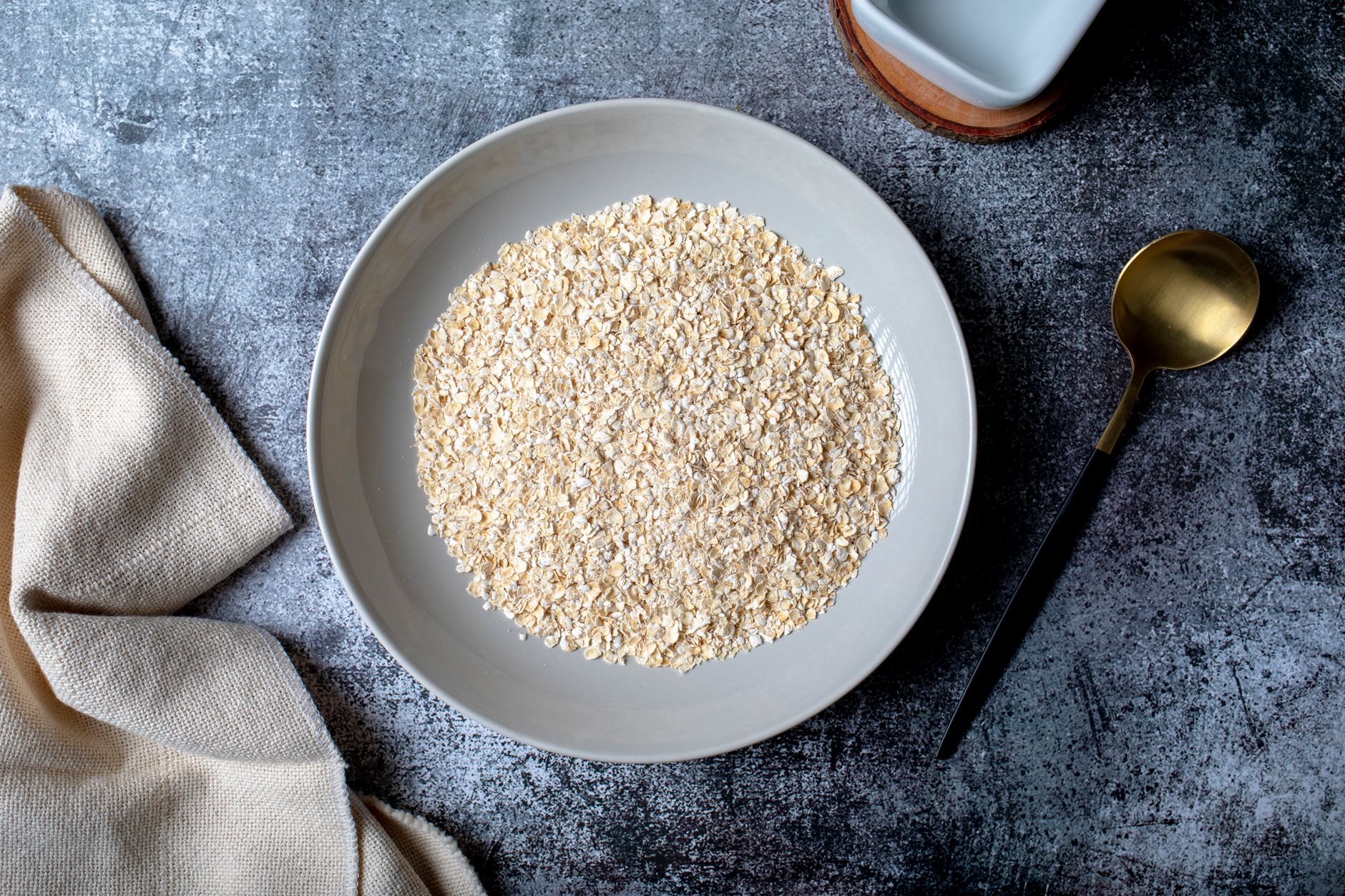
| Rolled oats | 20 µg |
| Peas (dried seeds) | 19 µg |
| Walnuts | 19 µg |
| Button mushrooms (fresh) | 16 µg |
| Green beans (fresh) | 7.0 µg |
| Banana | 5.5 µg |
| Carrots | 5.0 µg |
| Emmental (45 % fat in dry matter) | 3.0 µg |
| Wheat flour type 405 | 1.5 µg |
Two rows of this table say more than all the rest: wheat bran delivers 44 µg, white wheat flour 1.5 µg. Biotin sits in the outer layers of the grain, and the extraction rate decides how much of it ends up in the flour. Eating wholemeal instead of white flour shifts a factor of 30 here — in a food that is on the table every day.
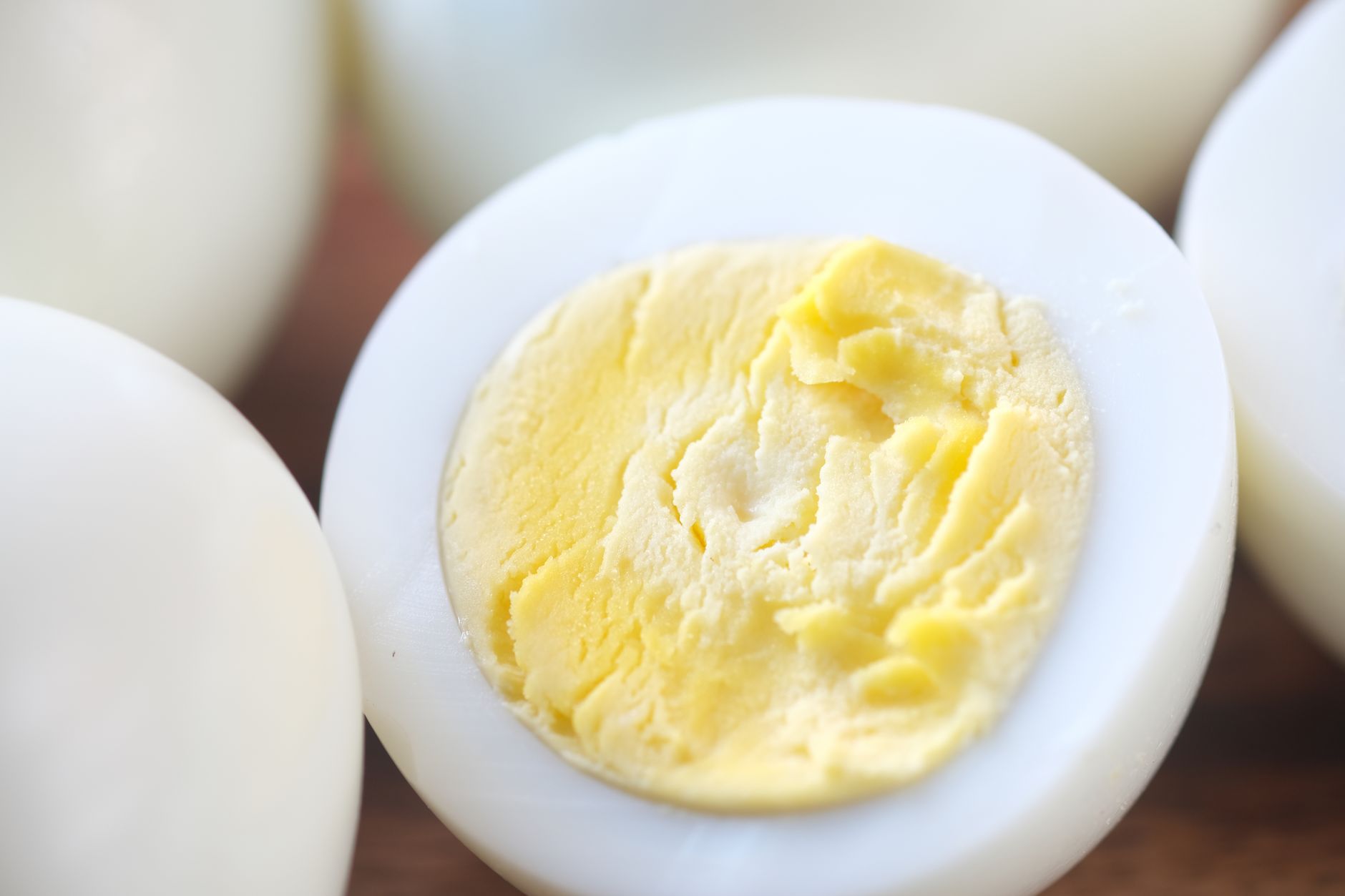
With eggs the difference is not in the processing but in the part: the yolk contains about twice the average value for the whole egg, the white virtually nothing. Anyone eating a breakfast egg is essentially eating the yolk.
What an ordinary day adds up to
Single values per 100 g do not answer the real question, because nobody thinks in units of 100 g of liver. The German Nutrition Society (DGE) therefore works through three example days in its questions and answers on biotin — with portions as they actually reach the plate. The values come from the DGExpert nutrient database; these are not complete daily meal plans but the biotin-relevant items.
| Diet | Portion | Biotin |
|---|---|---|
| Mixed diet | 150 ml cow's milk (3.5 %) | 6 µg |
| 150 g green peas (cooked) | 7 µg | |
| 200 g button mushrooms (cooked) | 29 µg | |
| 125 g escalope (pork, cooked) | 7 µg | |
| Total | 49 µg | |
| Ovo-lacto-vegetarian | 100 g wholemeal bread with sunflower seeds | 9 µg |
| 30 g Emmental (45 % fat i.d.m.) | 1 µg | |
| 60 g hen's egg (cooked) | 12 µg | |
| 200 g green beans (cooked) | 13 µg | |
| 100 g quark (20 % fat i.d.m.) | 6 µg | |
| Total | 41 µg | |
| Vegan | 20 g flaxseed (raw) | 4 µg |
| 50 g wholegrain rolled oats | 10 µg | |
| 150 ml soy drink | 3 µg | |
| 25 g walnuts | 9 µg | |
| 200 g spinach (frozen, cooked) | 15 µg | |
| 150 g rice (brown, cooked) | 5 µg | |
| Total | 46 µg |
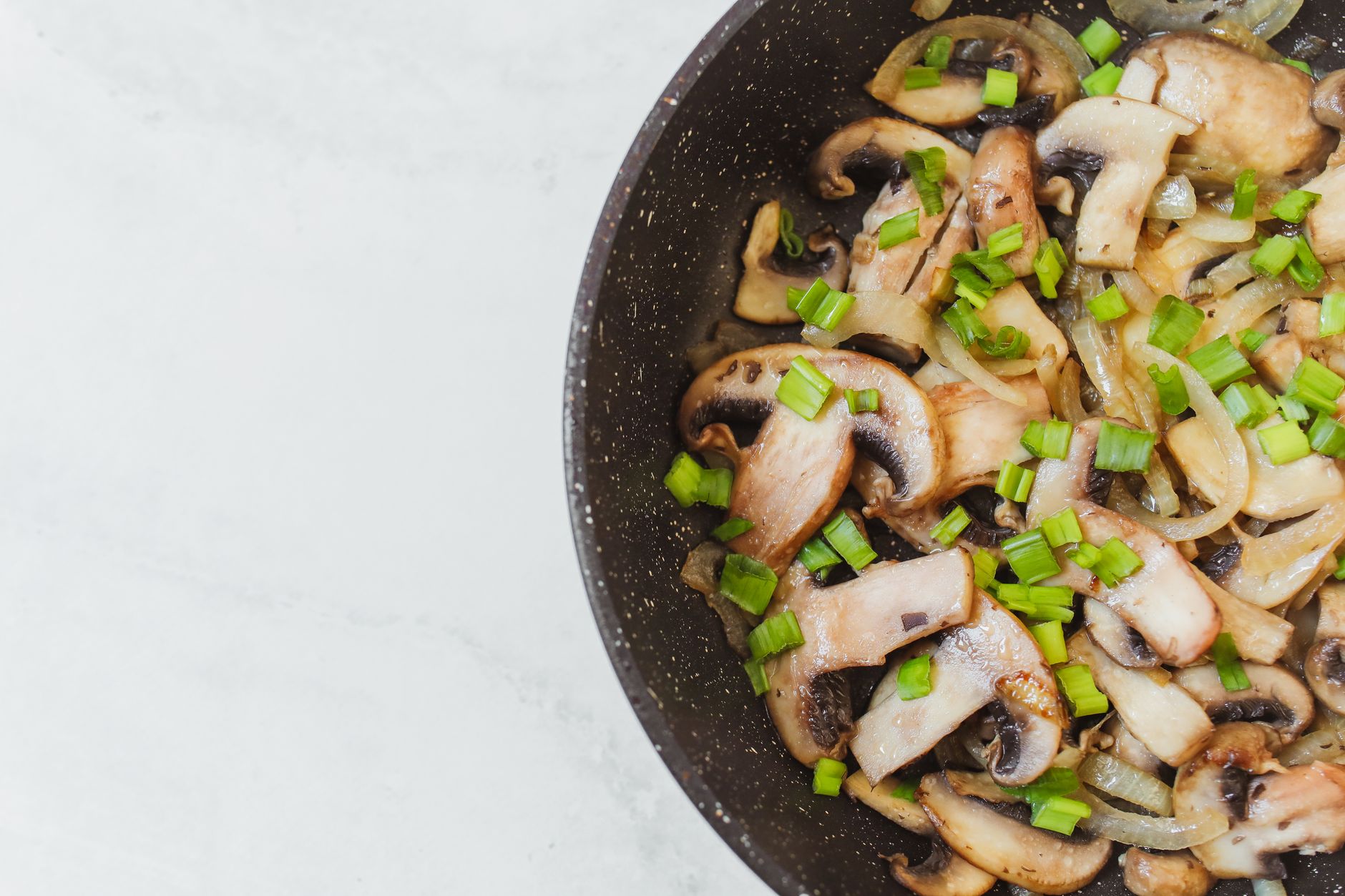
What is striking is what these three days lack: no liver, no soybeans, no plain egg yolk. The leaders of the ranking are not needed to meet requirements. The largest single item is a pan of mushrooms — 200 g cooked provide 29 µg and thus, on their own, roughly three quarters of the estimated value. The vegan version too clears 40 µg without any tricks.
Also worth noting: the numbers in the two tables only roughly agree. 25 g of walnuts at 9 µg would correspond to 36 µg per 100 g, while the nutrient table states 19 µg. Such deviations are normal with biotin — the analysis is laborious, contents vary with variety, soil and processing, and the databases are of different ages. In practice that means: orders of magnitude hold, decimal places do not.
Why the µg on the plate count differently from those in the tablet
This is where most comparisons go wrong. In foods, biotin is predominantly bound to protein, especially in animal products as biocytin. Before the body can take it up, it has to be released in the digestive tract. The German Federal Institute for Risk Assessment (BfR) therefore puts the absorption rate from foods at about 50 %. From food supplements and medicines, in which biotin is present in free form, it is absorbed at close to 100 %.
A day with 45 µg from food and a tablet with 45 µg are therefore not the same thing — on paper the tablet delivers roughly twice as much usable biotin. That also explains why the reference values still fit: they are derived from observed intake from foods, so the 50 % is already priced in.
Raw egg white — the one case where food gets in the way
There is exactly one dietary brake that matters in practice: raw egg white contains the glycoprotein avidin, which binds biotin in the gut and prevents its absorption. Eating very large amounts of raw egg white over a long period can cause a deficiency — the classic "egg white injury".
Under normal eating habits this is not an issue, because heating inactivates avidin. Boiled, fried or baked eggs are therefore a good source of biotin; raw eggs in a shake are not. For anyone who wants to separate the two cleanly: the yolk on its own is unproblematic even raw, the avidin sits in the white.
Alongside this the DGE names three factors that act independently of the menu: high alcohol consumption, smoking and the use of certain anticonvulsants impair the absorption of biotin or speed up its breakdown.
What that means for supplementation
The conclusion drawn by BfR and DGE is clear at this point: requirements can be met with a varied diet, there is no widespread deficiency in Germany, and accordingly there is no general recommendation for preparations either. A diet-related biotin deficiency practically does not occur in healthy people eating a mixed diet.
Anyone who still opts for a preparation is therefore not doing so to close a gap in the menu — any of the three example calculations above will show that. For the authorised claim, 7.5 µg per daily dose is already enough, that is 15 % of the nutrient reference value:
Biotin contributes to normal energy-yielding metabolism.

Preparations such as our Biotin 10,000 µg are many times above anything a plate can deliver; where milligram amounts like these come from is explained in High-dose biotin, and other strengths are in the biotin category. One point matters here in practice that has nothing to do with food: from 150 µg per daily dose biotin can distort certain laboratory tests — what that means for a blood-sampling appointment is set out in Biotin and blood tests. Food supplements are not a substitute for a balanced and varied diet and a healthy lifestyle.
Frequently asked questions
Do I have to eat liver to get enough biotin? No. Liver leads the table with around 100 µg per 100 g, but it appears in none of the three DGE example calculations — and all of them reach the reference value. Mushrooms, oats, nuts, eggs, pulses and dairy products carry the day just as well.
Is biotin lost during cooking? Biotin is water-soluble and more heat-stable than folate, for instance; losses in ordinary cooking are moderate. In the DGE examples the values are given for cooked portions — 200 g of cooked mushrooms at 29 µg remain the largest single item. With eggs, heating even increases the available amount, because the avidin in the white is destroyed.
Does a vegan diet cover biotin requirements? According to the DGE calculation, yes: flaxseed, oats, soy drink, walnuts, spinach and brown rice add up to 46 µg. Soybeans and sunflower seeds are further generous plant sources. Unlike with vitamin B12, going without animal foods does not create a systematic gap for biotin.
Why are dairy products the most important source according to the BfR, when milk contains little biotin? Because the amount consumed counts, not the content. 100 ml of milk provides around 4 µg — little compared with egg yolk, but milk, yoghurt, quark and cheese add up for many people daily and in large quantities. According to the national nutrition survey (NVS II), dairy products together with fortified multifruit juices account for the largest share of biotin intake in Germany.
Sources: BfR, FAQ "Biotin: Supplemente können Laboruntersuchungen verfälschen", 21 May 2026 (absorption rate from foods approx. 50 % versus close to 100 % from preparations, good biotin sources, NVS II intake data, avidin, 150 µg threshold) · DGE, "Ausgewählte Fragen und Antworten zu Biotin", as of 10 September 2025 (estimated values, Table 1 with the three example calculations based on DGExpert, mean intake according to NVS II, avidin, alcohol/smoking/anticonvulsants) · BfR, "Höchstmengenvorschläge für Biotin in Lebensmitteln inklusive Nahrungsergänzungsmitteln", 2021 · Souci/Fachmann/Kraut, Die Zusammensetzung der Lebensmittel — Nährwerttabellen, and Bundeslebensmittelschlüssel (contents per 100 g) · Regulation (EU) No 1169/2011, Annex XIII (nutrient reference value for biotin: 50 µg) · Regulation (EC) No 1924/2006, Annex (the 15 % condition) · Regulation (EU) No 432/2012, Annex (wording of the authorised claim).