Hawthorn extract: what 20:1 actually means
Futures Nutrition Editorial Team · 14 August 2026
"Hawthorn extract 20:1" means: 20 kilograms of dried plant material have become 1 kilogram of extract. The number says no more than that — and above all it does not say that a 20:1 extract is four times as strong as a 5:1 extract. Whether an extract contains much or little of the characteristic constituents is decided by the solvent, by the plant part and by the starting form of the herbal drug. The ratio on its own only describes how much material was evaporated off.
So the real question in front of the shelf is not "how high is the ratio", but: 20 kilograms of what — and against what was the finished extract measured?
What a drug-extract ratio tells you
The drug-extract ratio (DER) relates the amount of plant material used to the amount of extract obtained. "Drug" here does not mean a narcotic but the dried plant part — a pharmaceutical term that has made it all the way onto labels.
You can do the arithmetic in both directions. Our own tin gives the figure in the long form: a hawthorn berry extract at a ratio of 20:1, corresponding to 600 mg of hawthorn berry powder per tablet. 600 divided by 20 gives 30 mg of extract. Both numbers describe the same ingredient; one states the amount in the batch, the other the amount of plant material it took.
This is precisely where most misunderstandings arise when comparing prices: "600 mg of hawthorn" and "30 mg of extract" can be the same product. If a pack states only a figure in milligrams without saying whether it refers to the extract or to the plant equivalent, comparing it with another pack is worthless.
20:1 and 1:20 are not the same thing
For dry extracts the larger number comes first: 4–7:1 means that 4 to 7 parts of herbal drug give one part of extract. For liquid extracts the notation is reversed, because the solvent stays in the product — there, 1:20 means that one part of herbal drug is contained in twenty parts of extract. The number before the colon is always the herbal drug.
How wide the range is for one and the same plant is shown by the EU monograph of the Committee on Herbal Medicinal Products (HMPC) of the European Medicines Agency on Crataegus spp., folium cum flore (EMA/HMPC/159075/2014). It lists eleven preparations from hawthorn leaf with flower:
| Preparation | Ratio | Extraction solvent |
|---|---|---|
| Dry extract | 4–7:1 | methanol 70 % (V/V) |
| Dry extract | 4–7.1:1 | ethanol 45–70 % (V/V) |
| Dry extract | 4–5:1 | water |
| Liquid extract | 1:0.9–1.1 | ethanol 45 % (V/V) |
| Liquid extract | 1:2 | ethanol 45 % (V/V) |
| Liquid extract | 1:19.2–20 | sweet wine |
| Tincture | 1:3.5–4.5 | ethanol 35 % (V/V) |
| Expressed juice from fresh drug | 1:0.63–0.9 or 1:0.9–1.1 | — |
The sweet-wine extract at the bottom end and the dry extract at the top are both authorised preparations of the same herbal drug. Anyone comparing them by the ratio figure is comparing degree of evaporation, not content.
Why a high number does not mean "stronger"
Three factors stand between the ratio figure and what ends up in the tablet.
The starting form. Fresh plant material consists mostly of water. If it is counted as the starting quantity, the ratio figure rises without a single additional molecule ending up in the extract. The EU monograph on artichoke leaf (EMA/HMPC/194014/2017) makes this visible for one and the same plant: a dry extract from dried leaves with water has a ratio of 2–7.5:1, from fresh leaves 15–35:1. The difference is essentially water removed.
The solvent. Flavonoids, procyanidins, triterpene acids and organic acids dissolve to differing degrees in water, ethanol and methanol. The European Pharmacopoeia therefore requires different minimum contents for hawthorn dry extract depending on the extraction solvent: at least 2.5 % total flavonoids (expressed as hyperoside) for aqueous extracts and at least 6 % for hydroalcoholic ones. For the quantified liquid extract, 0.8–3 % is specified. Same herbal drug, same pharmacopoeia, a factor of two to three from the solvent alone.
The plant part. Leaf with flower and fruit are two separate herbal drugs with two separate tests — and only a label that names the part processed lets you tell which set of figures applies to the product in your hand.
Standardised means: it was measured afterwards
A ratio describes a manufacturing step. A content describes the result. Only the content makes two products comparable, and there are two customary ways of stating it:
- Quantified — the extract is adjusted to a range, for example 0.8–3 % flavonoids.
- Standardised — the content is adjusted to a fixed value, if necessary by blending different batches.
In medicinal products this is the norm. The two best-studied hawthorn special extracts are WS 1442 (dry extract from leaf with flower, extraction solvent ethanol 45 %, ratio 4–6.6:1, adjusted to 18.75 % oligomeric procyanidins) and LI 132 (extraction solvent methanol 70 %, adjusted to 2.2 % flavonoids). Both are therefore well above the minimum contents of the pharmacopoeia — and their figures apply exclusively to themselves, not to "hawthorn extract" in general.
A review in the journal Pharmaceuticals (Woerdenbag et al. 2024; 17(11):1490, PubMed 39598401) considers exactly this point the core problem when comparing hawthorn products: the preparations examined were not adjusted to the same constituents and contents, and details of species, plant part, pharmacopoeial quality and manufacturing process were frequently missing — which makes a comparison between the products barely possible.
Berry or leaf with flower: two different measures
For the fruit, the measurement is not made on flavonoids but on procyanidins, expressed as cyanidin chloride. The European Pharmacopoeia requires at least 0.06 % of these for hawthorn berries (Woerdenbag et al. 2024). Setting that figure next to the 1.5 % flavonoids of the leaf-with-flower drug makes no sense: they are two different groups of substances with two different methods of measurement, in the way that a speed limit and a weight limit are both stated as numbers and still have nothing to do with each other.
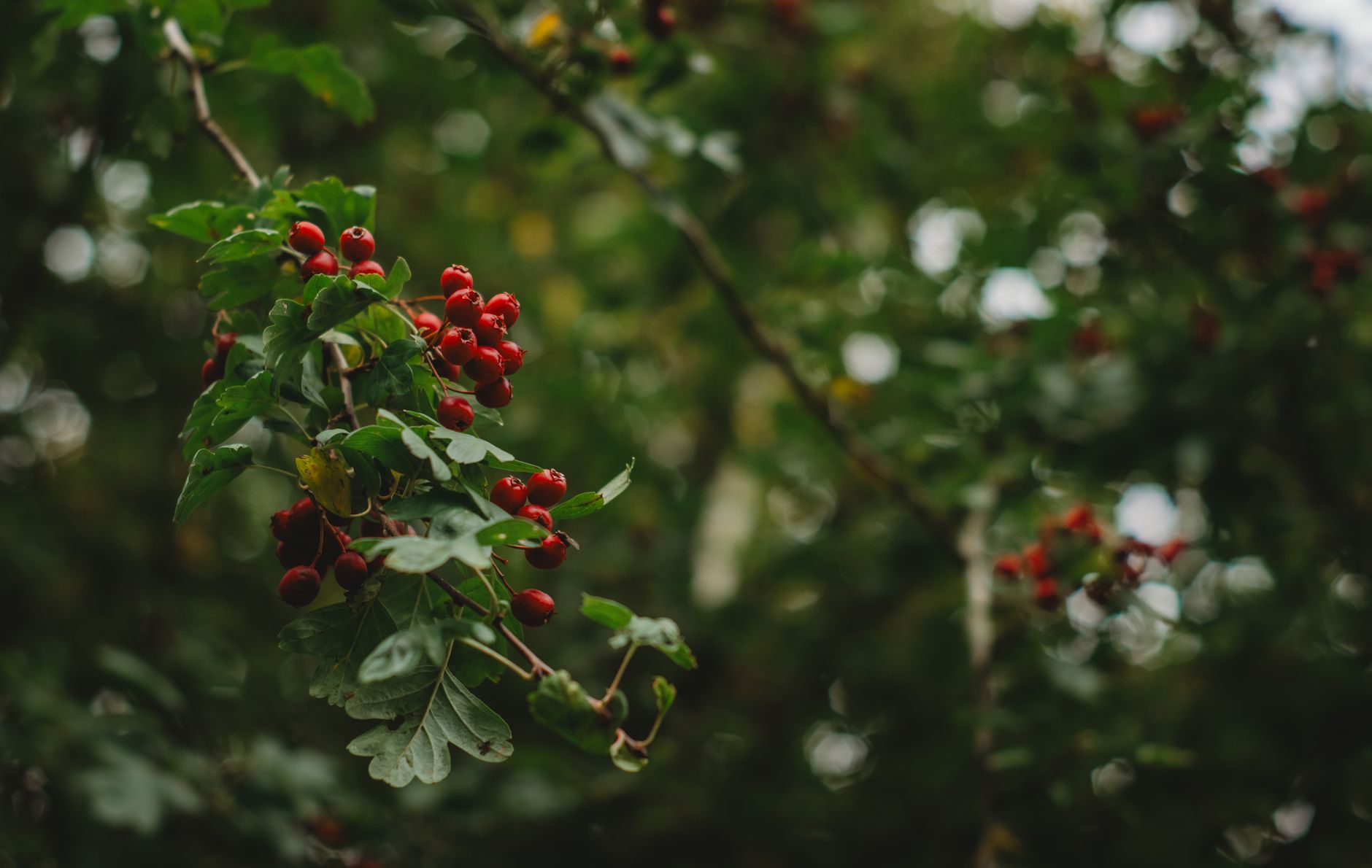
On top of that comes the species question. The hawthorn listed as a pharmacopoeial herbal drug in Europe is Crataegus monogyna or C. laevigata; many berry extracts, by contrast, come from Crataegus pinnatifida, Chinese hawthorn. Its fruits likewise contain flavonoids such as hyperoside and vitexin as well as procyanidins, plus plenty of organic acids (citric, malic, quinic acid) — the composition is related, but not identical (Molecules 2014;19(2):1685–1712, PubMed 24487567).
What our tin states — and what it does not
Hawthorn + magnesium contains, per tablet, a hawthorn berry extract from Crataegus pinnatifida at a ratio of 20:1, corresponding to 600 mg of berry powder, plus 56.25 mg of magnesium from magnesium oxide.

What is not stated there is a standardised procyanidin or flavonoid content. With food supplements that is the rule and not an omission: standardisation to a marker substance belongs to medicines law, under which a manufacturer has to demonstrate a consistent composition. Food supplements fall under food law — they have to declare what is in them, but they do not have to guarantee an active-substance content. Food supplements are not a substitute for a balanced and varied diet and a healthy lifestyle.
For Crataegus there is moreover no health claim authorised under the health claims Regulation (EC) No 1924/2006. That is why such preparations often have a nutrient alongside that carries authorised claims of its own — how much magnesium ends up in a combination product like this, and what such a figure is worth, is broken down in Magnesium in combination supplements: how much?. Anyone looking only for a defined amount of magnesium will find it in the magnesium category; the hawthorn products are in the hawthorn category. How many tablets a day the tin is laid out for, and for how long, is set out in Taking hawthorn: timing, duration, course.
How to spot a label that says something
Five pieces of information make a plant extract describable. If one of them is missing, the product cannot be compared with another:
- Species — C. monogyna, C. laevigata or C. pinnatifida
- Plant part — leaf with flower or fruit
- Ratio — 20:1, 4–7:1, 1:20
- Extraction solvent — water, ethanol 45 %, methanol 70 %
- What the milligram figure refers to — extract or plant equivalent
Point 3 alone — the number printed largest in advertising — is the least informative of the five.
Frequently asked questions
Is a 20:1 extract twenty times as strong as the powder? No. It is evaporated twentyfold as far as mass is concerned. How much of the characteristic constituents came along depends on whether they dissolve in the solvent used at all. Water-soluble components are concentrated in an aqueous extract, fat-soluble ones are left behind — and vice versa.
Why do some packs say 1:20 instead of 20:1? Because they are liquid extracts, in which the extraction solvent stays in the product. The number before the colon always denotes the herbal drug used. A sweet-wine extract at 1:19.2–20 is, according to the EU monograph, a proper preparation — just a very dilute one.
Can I compare two hawthorn preparations by the milligram figure? Only if both state the same reference and the same plant part was processed. 500 mg of extract and 500 mg of plant equivalent can differ by a factor of 20. If a pack says "500 mg hawthorn" without a ratio, it is not even clear which of the two is meant.
Why don't food supplements standardise the way medicines do? Because they fall under a different legal framework. A medicine has to meet and demonstrate a defined content; a food supplement has to declare its ingredients correctly. Some manufacturers standardise voluntarily; then the marker substance and its percentage are on the pack, and that is exactly what is worth looking for.
Sources: European Medicines Agency, EU monograph on Crataegus spp., folium cum flore, EMA/HMPC/159075/2014 (5 April 2016) · Assessment report thereto, EMA/HMPC/159076/2014 (preparations a–k, Ph. Eur. contents for herbal drug, liquid and dry extract, WS 1442) · EU monograph on Cynara cardunculus L., folium, EMA/HMPC/194014/2017 · Woerdenbag HJ et al., Pharmaceuticals 2024;17(11):1490 (PubMed 39598401) · Wu J et al., Molecules 2014;19(2):1685–1712 (PubMed 24487567) · Regulation (EC) No 1924/2006 · Regulation (EU) No 1169/2011.