Taking biotin: timing, duration and effect
Futures Nutrition Editorial Team · 12 August 2026

The short answer: there is no documented rule for the timing. Biotin is water-soluble, is absorbed from preparations at close to 100 %, and needs neither a particular hour of the day nor a meal nor fat to do so — the only instruction on intake in the product information for the biotin medicine reads "with sufficient liquid". The more interesting question concerns duration, and it is not the tablet that answers it but biology: scalp hair grows about one centimetre a month, and a fingernail has grown out completely only after four to six months. Before that, nothing can show — and according to the German Federal Institute for Risk Assessment (BfR), where intake is already sufficient, no benefit is to be expected afterwards either.
That is the point at which most expectations tip over. "When is the best time to take it?" sounds like the decisive question, but it is the least important one in this article. What is decisive is the time scale — and one single appointment at which the timing really counts: the blood draw.
What the product information says about intake
For food supplements there is no official rule on intake. The closest thing to one is the product information for the pharmacy-only medicine Biotin 5 mg (March 2019 version) — the same molecule, only in a regulated setting. On this point its dosage section is remarkably brief: "It is taken with sufficient liquid." That is all it says. No time of day, no interval from meals, no fasting.
The reason lies in the pharmacokinetics. Free biotin is absorbed in the upper small intestine, the molecule passes through the intestinal wall unchanged, and uptake occurs mainly by diffusion; alongside this there is evidence of active transport via a carrier-biotin-sodium complex. A process that largely follows the concentration gradient can hardly be steered by the clock.
| Question | Answer | Basis |
|---|---|---|
| Morning or evening? | no requirement, no documented difference | product information Biotin 5 mg |
| With or without a meal? | either is possible | product information, section 5.2 |
| Is fat needed with it? | no, biotin is water-soluble | BfR |
| Coffee, tea, milk? | no documented interaction | — |
| Raw egg white | the only documented brake (avidin) | BfR, DGE, product information |
| Anticonvulsants | lower the biotin plasma level | product information, section 4.5 |
| Before a blood test | plan an interval, tell the practice | BfR, safety letter 2019 |
This sets biotin clearly apart from the fat-soluble vitamins, where the meal genuinely makes a difference — what that looks like is set out in Vitamin D3: drops or tablets. With biotin the only practical recommendation is the one you would give for any other water-soluble vitamin: at a time of day you will reliably keep to. Regularity beats optimisation.
The 50 % applies to food only
A misunderstanding that comes from food composition tables: in food, biotin is largely bound to protein and has to be released in the digestive tract first. The BfR therefore puts the absorption rate from food at around 50 %. From medicines and food supplements, in which biotin is present in free form, it is absorbed at close to 100 % instead. That figure holds regardless of whether a meal comes with it — another reason why taking biotin "with food" plays no part. How much the plate supplies anyway is a separate question: cooked eggs, liver, yeast, nuts and pulses are the richest sources.
Raw egg white — the only real brake
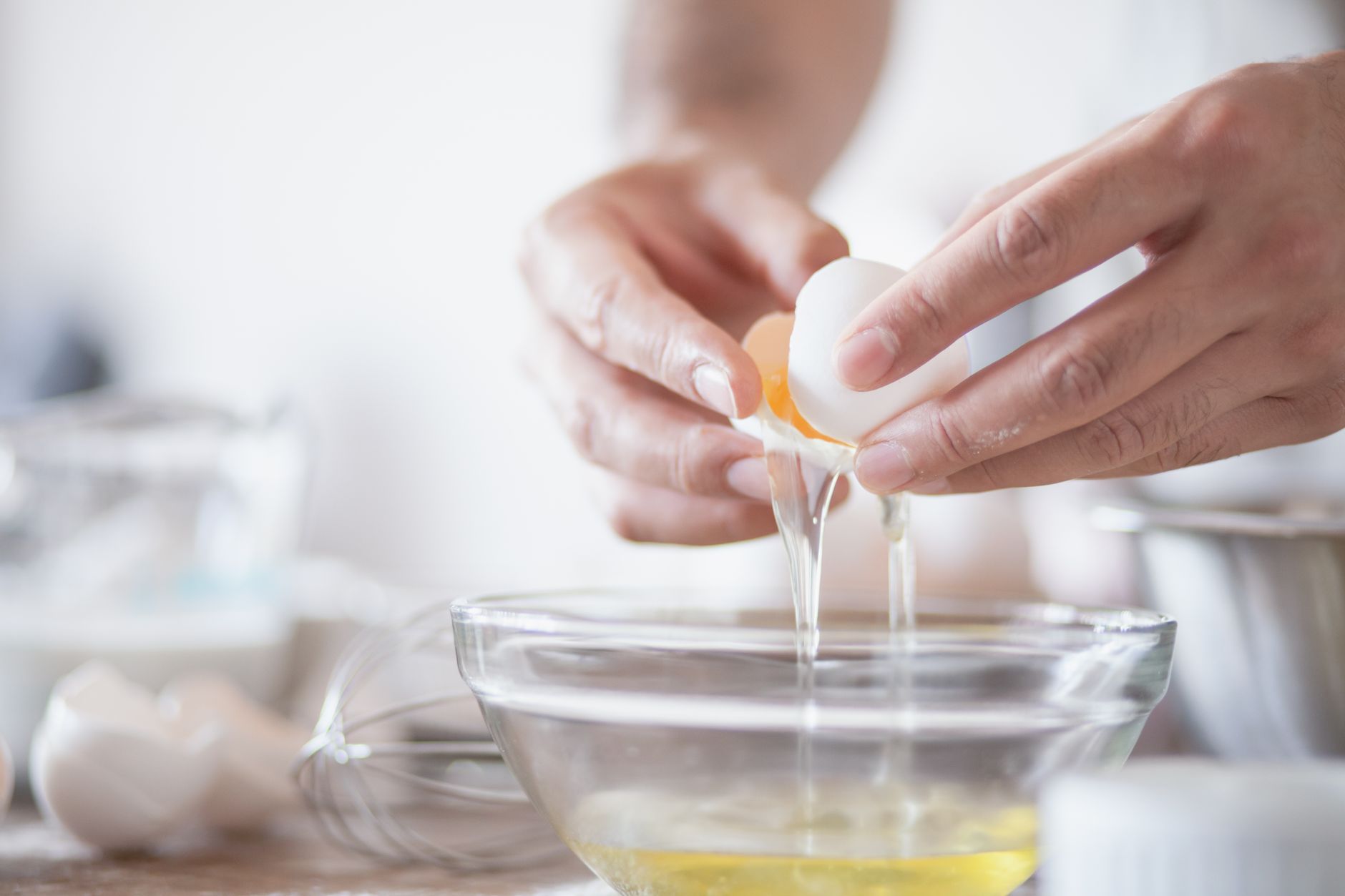
There is exactly one situation in which food genuinely interferes with absorption, and German even has a name for it: egg-white damage. Raw egg white contains the glycoprotein avidin, which forms a stable complex with biotin that can no longer be broken down in the gastrointestinal tract. The biotin is then unavailable to the body. This does, however, require very large amounts of raw egg white over a long period — heat destroys avidin, so boiled and fried eggs are a good source rather than a brake.
Alongside this, the German Nutrition Society (DGE) names three factors that act independently of the menu: high alcohol consumption, smoking and certain epilepsy medicines can impair absorption or accelerate breakdown. On the medicine side, the product information puts it this way: there is evidence that anticonvulsants lower the plasma level of biotin.
A missed tablet, a double dose
Anyone who forgets a dose can safely let it go. Biotin's elimination time is dose-dependent and, after oral intake of high doses (100 µg per kilogram of body weight), is about 26 hours; around 80 % of the biotin in blood is bound to plasma proteins. A high single amount therefore does not disappear within hours — a skipped day accordingly leaves no gap that would need making up.
Conversely, doubling up achieves nothing: excretion is via the urine, normally 6 to 50 µg in 24 hours, roughly half unchanged and half as biologically inactive breakdown products. Whatever exceeds requirements leaves the body again. For the record, the product information notes that biotin has a wide therapeutic range and that no signs of overdose are known; as a very rare adverse effect, allergic skin reactions (urticaria) are described, in fewer than 0.01 % of those treated.
How long does it take before anything shows?
This question has two parts, and they are rarely answered together.
The first part is the lower limit that biology sets. Hair and nails are dead material; only what is newly formed can change, and that grows out at a fixed speed. The values below are averaged orders of magnitude from hair and nail physiology and vary considerably between individuals — with age, season and body site.
| Tissue | Growth | Until everything visible is new |
|---|---|---|
| Scalp hair | around 1 cm a month (about 0.3 mm a day) | a hand's breadth of length takes about half a year |
| Fingernail | around 3 mm a month | 4 to 6 months |
| Toenail | around 1 mm a month | 12 to 18 months |
From this follows a sober calculation: someone starting in January will see a completely newly formed plate on the fingernail in early summer at the earliest, and with hair, any change concerns only the few centimetres near the scalp — the lengths you see in the mirror are one to three years old and will not change any more. Four weeks is simply not an observation period for hair and nails.
The second part is less comfortable: whether anything happens at all. EFSA has accepted the claims for biotin relating to the maintenance of normal hair and normal skin — but in its assessment it expressly pointed out that this acceptance does not mean that biotin intake in the population is insufficient for the maintenance of normal hair. The BfR draws the direct conclusion: because the population generally takes in sufficient amounts through food, no benefit for skin or hair is to be expected from additional intake via food supplements. "Maintenance" is precisely not "improvement" — and that distinction is exactly what carries, or fails to carry, a buyer's expectation.
The case is different only where there is an actual deficiency, which practically does not occur in healthy people on a mixed diet. The duration then depends, according to the product information, on the course of the underlying illness — that is a doctor's decision, not the pack size's.
Is there a course with a beginning and an end?
No, at any rate none that is laid down anywhere. For biotin, EFSA has derived no tolerable upper intake level (UL), because no adverse effects were observed even at intakes far above the reference value; the BfR therefore refrains from a maximum-amount recommendation for food supplements. The European Commission's former Scientific Committee on Food concluded, on the basis of the few observational data, that with a total intake of up to around 100 µg per day the risk of undesirable effects for the general population is low.
A fixed course length, of the kind discussed for some plant extracts, thus does not exist for biotin. The one practical reason to interrupt intake is not a health reason — it is a diagnostic one.
The appointment at which timing really counts
From 150 µg per daily serving, biotin can distort certain laboratory tests. Immunoassays use the binding between biotin and streptavidin; if there is a lot of free biotin in the blood, it competes with the test reagents, and depending on the test design the result comes out too high or too low. Thyroid values and the heart attack marker troponin are among those affected. The BfR therefore recommends a note on biotin-containing preparations advising people to inform their doctor or the laboratory staff about the intake before laboratory investigations.
In practice this means: plan the laboratory appointment like a fasting blood draw. As rules of thumb, the guidance document of the American clinical chemistry society names at least eight hours' interval after 5 to 10 mg of biotin, and up to 72 hours with sensitive test systems. With a preparation for skin and hair, a break of two or three days costs nothing — there is no effect that would be lost in that time.
What that means for choosing
Because the timing plays no part, the choice is decided only by what otherwise fits the day: one tablet a day, a strength you do not have to split, and a pack size that covers the period over which anything can be judged at all — months, then, not weeks.

Our Biotin 10,000 µg covers exactly such a period with 90 tablets; further strengths and combinations are in the Biotin category. For the authorised claim, 7.5 µg per daily serving is enough in any case, that is 15 % of the nutrient reference value:
Biotin contributes to normal energy-yielding metabolism.
Food supplements are not a substitute for a balanced and varied diet and a healthy lifestyle.
Frequently asked questions
Morning or evening — which is better? There are no robust data on this and no requirement. The product information for the biotin medicine names "with sufficient liquid" as its only instruction on intake. What makes sense is the time of day you can keep up for months, because that is the period over which anything can be judged at hair and nails.
Do I have to take biotin on an empty stomach? No. Biotin is water-soluble and is absorbed in the upper small intestine mainly by diffusion; from preparations the absorption rate is close to 100 % according to the BfR. An empty stomach is not needed for this, and neither is fat. The only documented exception concerns very large amounts of raw egg white over a long period.
How long does it take before anything shows on hair or nails? If anything shows, it shows in months, not weeks: scalp hair grows about one centimetre a month, a fingernail is completely renewed after four to six months, a toenail only after a year or more. Just as important for expectations is the assessment by EFSA and the BfR — where intake through the diet is sufficient, no benefit for skin or hair is to be expected from additional intake.
Can I take biotin permanently? There is no legal maximum amount, and EFSA has derived no upper limit for want of observed adverse effects. The point that becomes practical with long-term intake is laboratory diagnostics: from 150 µg per daily serving, the intake belongs in the conversation before every blood draw. Anyone who has thyroid values checked regularly simply plans the interval in.
Sources: Product information Biotin-ratiopharm 5 mg, March 2019 version (intake with sufficient liquid, duration depending on the course of the underlying illness, absorption in the upper small intestine by diffusion, plasma protein binding 80 %, excretion 6–50 µg/24 h, elimination time approx. 26 hours after 100 µg/kg body weight, anticonvulsants, avidin, urticaria, therapeutic range) · BfR, FAQ "Biotin: supplements can distort laboratory investigations", 21 May 2026 (absorption rate approx. 50 % from food versus close to 100 % from preparations, EFSA's classification regarding skin and hair, the 150 µg threshold, recommendation for a note on the pack, no UL, SCF value of about 100 µg per day) · BfArM, safety letter on biotin, May 2019 · DGE, "Selected questions and answers on biotin", version of 10 September 2025 (alcohol, smoking, anticonvulsants, avidin) · AACC/ADLM, guidance document on biotin interference in immunoassays (intervals of 8 to 72 hours) · Regulation (EU) No 432/2012, Annex (wording of the authorised claim) · Regulation (EC) No 1924/2006, Annex (the 15 % condition) · Regulation (EU) No 1169/2011, Annex XIII (nutrient reference value for biotin: 50 µg). The growth rates of hair and nails are averaged values from the physiology of the skin and its appendages and vary between individuals.