Vitamin D in food: table and portion sizes
Futures Nutrition Editorial Team · 11 August 2026
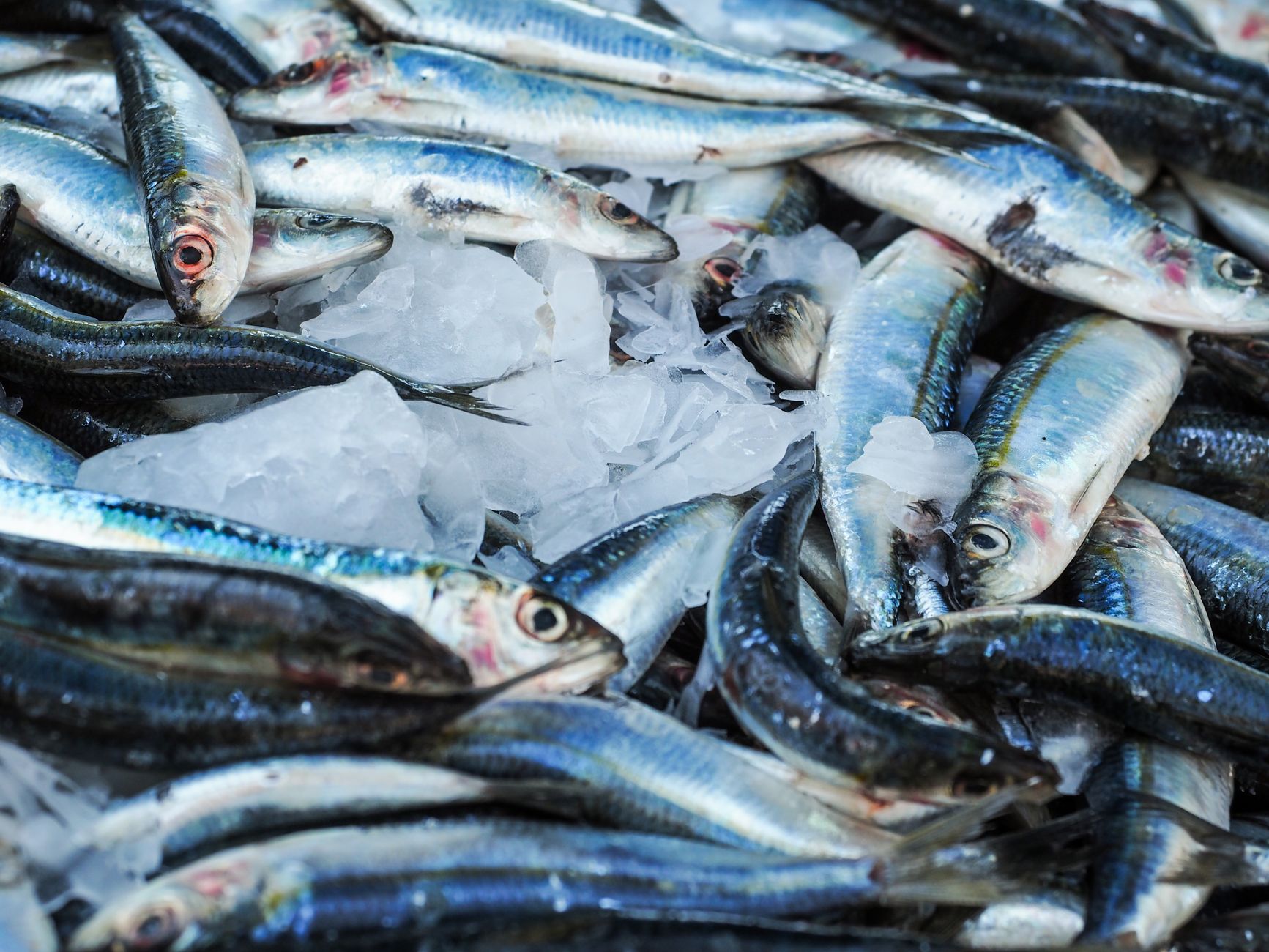
The short answer: food typically supplies adults in Germany with 2 to 4 µg of vitamin D per day — the estimated value of the German Nutrition Society (DGE) is 20 µg. That is not carelessness at the supermarket but a peculiarity of this vitamin: it occurs in appreciable amounts almost exclusively in oily sea fish, and hardly anyone eats that every day. Everything else — eggs, mushrooms, cheese, butter — contributes but does not cover the gap.
This article shows in two tables how much is really in there: once per 100 grams, the way it is listed everywhere, and once per portion, the way people actually eat. After that comes the question of why vitamin D of all things is so rare in food, and what that means in practice.
µg, IU and the reference value on the label
Three numbers come up around vitamin D, and they mean the same thing written in different ways:
- 1 µg (microgram) = 40 IU (International Units). So 20 µg is 800 IU.
- The nutrient reference value (NRV) on food labels is 5 µg (200 IU) and comes from Annex XIII of Regulation (EU) No 1169/2011. It is a labelling benchmark, not a recommendation.
- The DGE estimated value for an adequate intake in the absence of endogenous synthesis is 20 µg (800 IU) per day for children from one year, adolescents, adults and seniors.
The last point contains an important qualifier: "in the absence of endogenous synthesis". Normally 80 to 90 % of vitamin D comes from the body's own production in the skin; food was never intended to be the main source. At our latitudes that synthesis effectively stops for several months of the year.
Incidentally, the reference value also explains why so few foods are allowed to advertise vitamin D at all: under the health claims Regulation (EC) No 1924/2006, "source of vitamin D" may only appear where 100 grams supply at least 15 % of the NRV — that is 0.75 µg. Whole milk misses that mark by more than eightfold.
Table 1: vitamin D per 100 grams
The values come from the German nutrient database (Bundeslebensmittelschlüssel) and Souci/Fachmann/Kraut, the same sources the DGE uses in its overviews. Where a range is given, the range is real: in fish, the content varies with species, fishing ground, season and — in farmed fish — with the feed.
| Food | µg per 100 g | IU per 100 g |
|---|---|---|
| Herring (Atlantic) | 7.8–25 | 310–1,000 |
| Eel | 20 | 800 |
| Salmon | 16 | 640 |
| Sardines, in oil, drained | 11 | 440 |
| Tuna, canned | 4.5 | 180 |
| Mackerel | 4 | 160 |
| Porcini mushrooms | 3.1 | 124 |
| Hen's egg, whole | 2.9 | 116 |
| Button mushrooms | 1.9 | 76 |
| Beef liver | 1.7 | 68 |
| Margarine (with added vitamin D) | 2.5–7.5 | 100–300 |
| Gouda 45 % | 1.3 | 52 |
| Butter | 1.2 | 48 |
| Whole milk 3.5 % | 0.09 | 3.6 |
Between row one and row fourteen lies a factor of 200. There is no broad middle ground: either a food is oily sea fish, or it delivers decimal places.
Table 2: what a realistic portion contributes
100 grams is a unit of calculation, not a plate. What is more interesting is how much a usual portion contributes to the estimated value of 20 µg.
| Portion | Amount | µg | Share of 20 µg |
|---|---|---|---|
| Herring fillet | 100 g | ~25 | 125 % |
| Salmon fillet | 150 g | ~24 | 120 % |
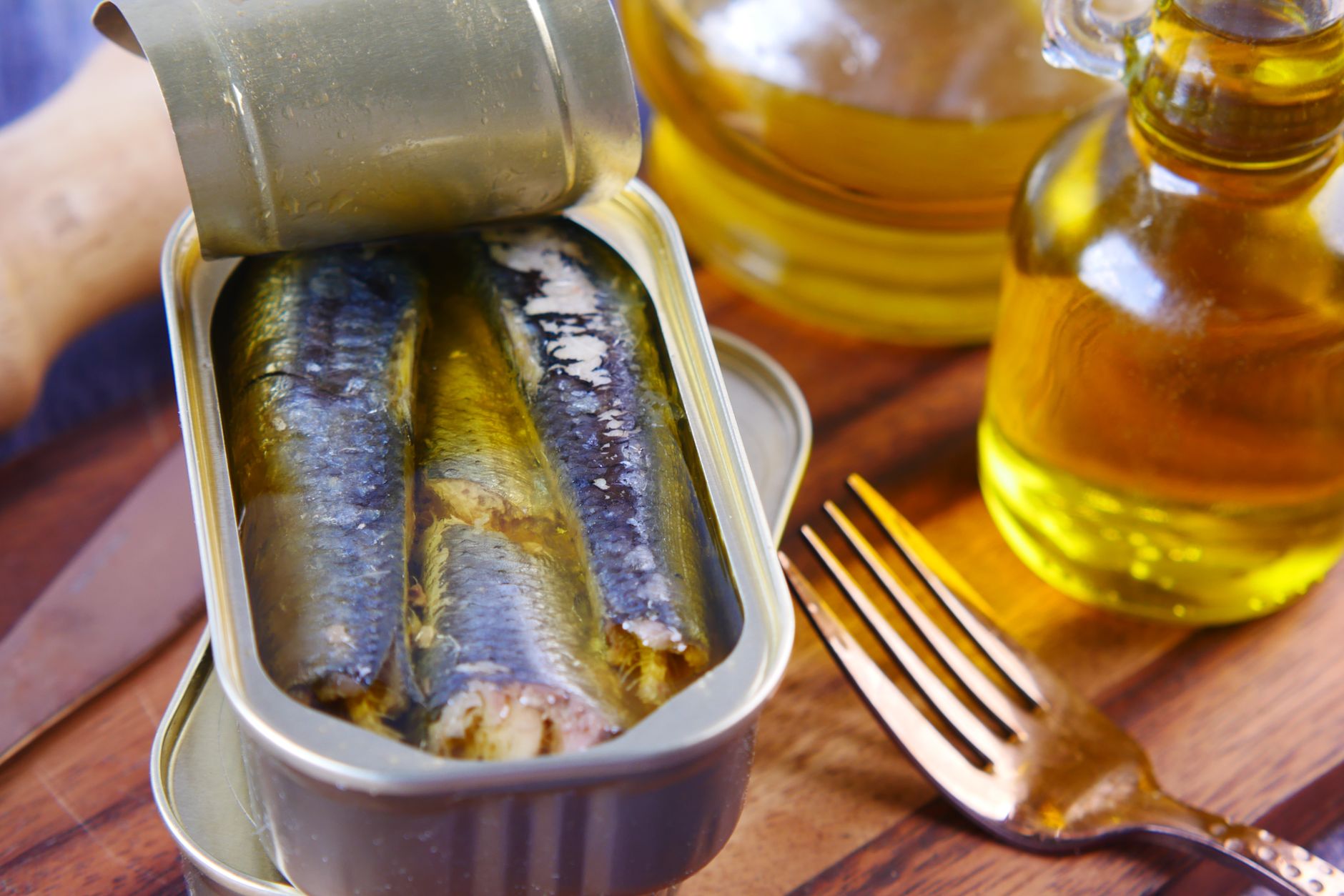
| Sardines, one tin drained | 90 g | ~10 | 50 % |
| Mackerel fillet, smoked | 80 g | ~3.2 | 16 % |
| Two eggs | 110 g | ~3.2 | 16 % |
| Button mushrooms, fried | 150 g | ~2.9 | 14 % |
| Canned tuna | 60 g | ~2.7 | 14 % |
| Bread with butter and Gouda | 10 g + 30 g | ~0.5 | 3 % |
| Glass of whole milk | 200 ml | ~0.18 | 1 % |
From this follows the actual message of this article: a day without oily sea fish ends up in the range of 2 to 4 µg almost regardless of what else is eaten. That is exactly what the German National Nutrition Survey II and the DGE evaluations measured. Two fish meals per week — the amount the DGE recommends anyway — noticeably lift the weekly average, but only to a third or half of the estimated value.
Why vitamin D of all things is missing from food
Strictly speaking, vitamin D is not a classic vitamin. By definition a vitamin is something the body cannot make itself — vitamin D it forms in the skin from 7-dehydrocholesterol under UV-B radiation. Evolution therefore had no reason to enrich it in plants or land animals.
Where it does occur in food, it follows that logic:
- Oily sea fish carries so much because vitamin D is fat-soluble and accumulates in fatty tissue along the food chain. That is why herring is far ahead of lean fish such as cod, which supplies practically nothing.
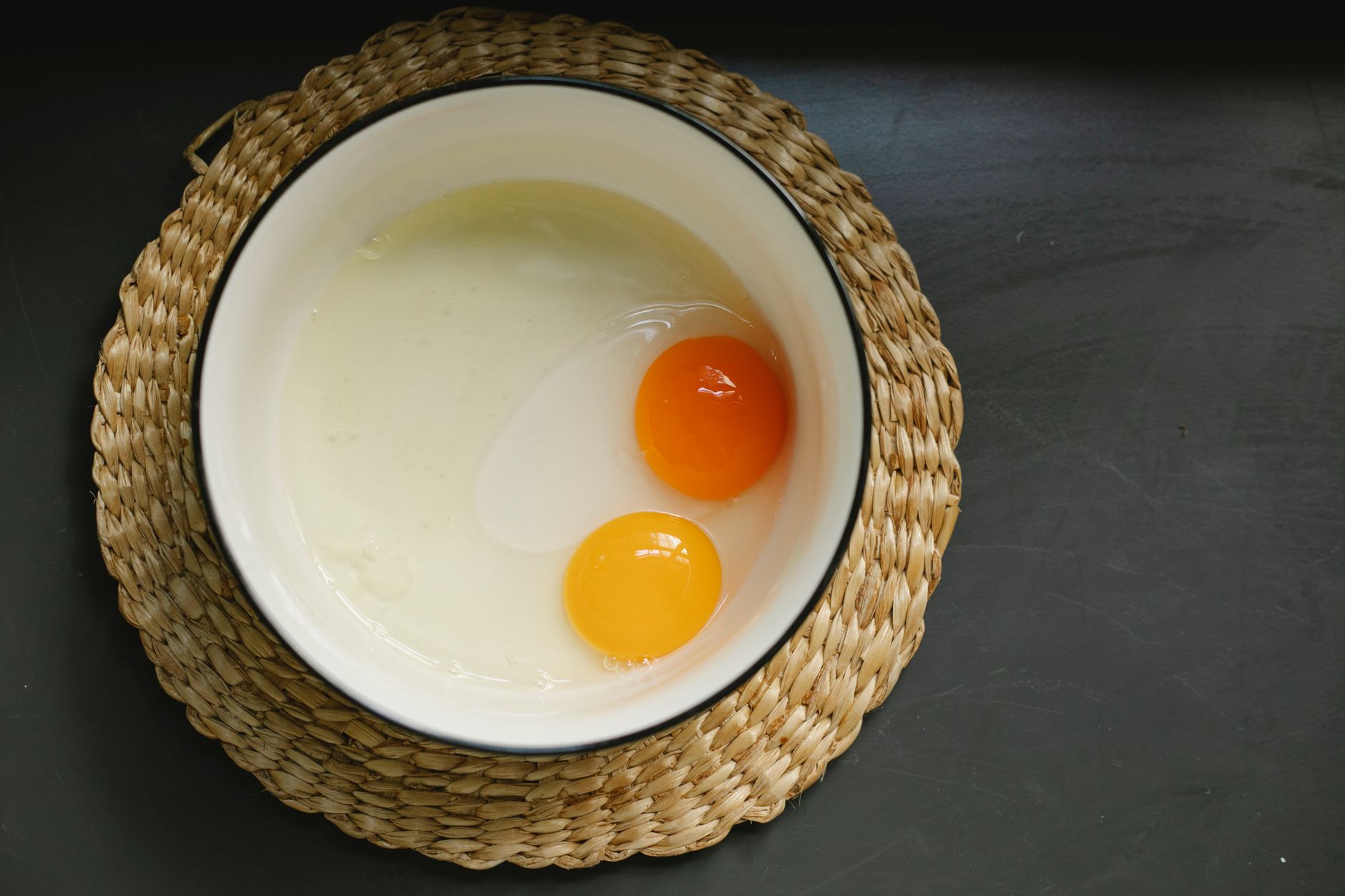
- Egg yolk contains what the hen took in through feed and outdoor access. The value varies accordingly; there is nothing in the white.
- Mushrooms form vitamin D2 from ergosterol under UV light — the same reaction as in our skin, just from a different starting molecule.
- Milk, cheese, butter contain traces from the milk fat. The fattier the product, the more — and still it stays at tenths of a microgram.
There is a detail about mushrooms that often gets lost: they supply vitamin D2 (ergocalciferol), not D3 (cholecalciferol). Both forms raise the blood level, but on current evidence D3 does so more reliably and for longer. What distinguishes the two forms and where vegan D3 comes from is explained in Vitamin D forms: D2 or D3, lanolin or lichen.
Button mushrooms treated with UV light are now widely available as well: after harvest they undergo a short irradiation and thereby reach a multiple of their natural content. In the EU they are authorised as a novel food and must be labelled as goods treated with UV light — if that is not on the pack, it is an ordinary mushroom with the 1.9 µg from the table.
Fortified foods: the exception in Germany
Anyone reading intake figures from abroad is often comparing apples with oranges. In Finland, drinking milk has been systematically fortified with vitamin D since the early 2000s; in the USA the same has applied to milk for decades. The Finnish average is therefore higher than the German one, without people eating any differently there.
In Germany the addition of vitamins to foods is governed by Regulation (EC) No 1925/2006 and is narrowly limited in practice. The classic exception is spreadable fats: margarine has always been allowed to have vitamin A and D added, because it was intended as a butter substitute — hence the comparatively high row in Table 1. Beyond that you find fortified breakfast cereals and individual plant drinks. German cow's milk from the chilled shelf is not fortified.
In practice that means: the statement on the pack decides, not the product category. A plant drink can contain 0.75 µg per 100 ml or nothing at all — both stand on the same shelf.
Preparation, fat and what actually arrives
Vitamin D is considered comparatively heat-stable; during cooking, less is lost to temperature than to fat. Grill fish and let the escaping fat drip away and part of the content goes with the fat — steaming or frying in a closed pan keeps more in the food.
Its fat solubility also means that a meal with some fat aids absorption. With oily fish that takes care of itself; with mushrooms in the pan or with a tablet it is the reason why intake with a meal is recommended.
Without fish the arithmetic gets tight: a vegetarian diet rarely exceeds 3 to 4 µg through eggs, mushrooms and spreadable fats, a vegan one without fortified products barely 1 to 2 µg.
When diet is not enough
For most people it is not enough — that is not a judgement but the consequence of Table 2. In the summer half of the year the skin compensates, in the winter half it does not. Whether your own level holds up is shown only by measuring 25-OH-D in the blood; how to read that result is explained in Vitamin D blood level: reading 25-OH-D correctly.
Anyone closing the gap with a supplement should know the orders of magnitude. The DGE estimated value of 20 µg corresponds to 800 IU per day. As an upper level for long-term intake from all sources, EFSA sets 100 µg (4,000 IU) per day for adults and adolescents from eleven years; the German Federal Institute for Risk Assessment proposes a maximum amount of 20 µg (800 IU) per daily portion for food supplements. What happens if that is permanently exceeded is covered in Can you take too much vitamin D?.
In practice that means: higher tablet strengths are designed for longer intervals between doses, not for every day. The Vitamin D3 4,000 IU year's supply is intended for every second day and thus works out at 2,000 IU per day.

Anyone who eats few dairy products often has the same question twice — about vitamin D and about calcium. For that case there are combinations such as Calcium + Vitamin D3 4,000 IU; the remaining strengths stand side by side in the Vitamin D3 category, and which one suits which daily routine is compared in Vitamin D3 dosage: 1000 IU to 10000 IU.

The following claims are authorised under Regulation (EU) No 432/2012: Vitamin D contributes to the normal function of the immune system. Vitamin D contributes to the maintenance of normal bones. Vitamin D contributes to the maintenance of normal muscle function. Vitamin D contributes to normal absorption and utilisation of calcium. Food supplements are not a substitute for a balanced and varied diet and a healthy lifestyle.
Frequently asked questions
Can I cover my requirement through food alone? Arithmetically yes, in practice hardly. On average you would have to eat around 100 grams of herring or 150 grams of salmon every day. Two fish meals a week — the usual recommendation — bring the weekly average to roughly a third to half of the estimated value.
Is wild salmon better than farmed salmon? On this question, yes. Wild salmon takes up vitamin D through the natural food chain and comes out considerably higher in analyses than farmed salmon, whose content depends on the feed. That is why reputable tables give ranges and not point values.
Do UV-treated mushrooms really help? They contain measurably more, and specifically vitamin D2. That raises the blood level, but on current evidence less reliably than D3. As a supplement to a plant-based diet they make sense; as the sole source in the winter half of the year they are hard to calculate with.
Does cooking destroy the vitamin D in fish? Not appreciably. Vitamin D is more heat-stable than vitamin C, for example. Relevant losses occur mainly where fat escapes and is poured away.
Why does my milk carton say nothing about vitamin D? Because German drinking milk is not fortified and the natural content of 0.09 µg per 100 g is too low to be advertised as a source at all. Fortified milk from Finland or the USA is a different product.